Gear Guides
Igloo BMX vs RTIC: Which Hard Cooler Should You Buy?
Both brands publish an ice-retention figure of roughly four to five days, so that is not the decision. The decision is how the box is made - and that one difference explains the weight, the price and how long it survives a truck bed.
Buy the Igloo BMX 52 QT for most hunters. It holds more, costs a lot less and weighs about half what the comparable RTIC does, and its published ice-retention figure is within a day of the RTIC's. Buy the RTIC 45 QT instead for the hunter whose cooler lives outdoors permanently — a truck bed, a boat, a camp that gets left standing — because rotomolded construction is the thing that survives a decade of that and blow-molded construction is not.
This comparison gets searched because the two coolers look like they are competing and the prices say they are not. On a shelf, a BMX and an RTIC read as the same product: thick walls, rubber T-latches, a drain plug, a lid you could stand on. Then one is roughly a third the price of the other and the obvious conclusion is that somebody is being overcharged.
Nobody is. They are made by two completely different processes, and once you know which is which, every other difference on this page stops being a mystery and starts being a consequence. That is the whole comparison, and it is worth four minutes before you spend either amount of money.
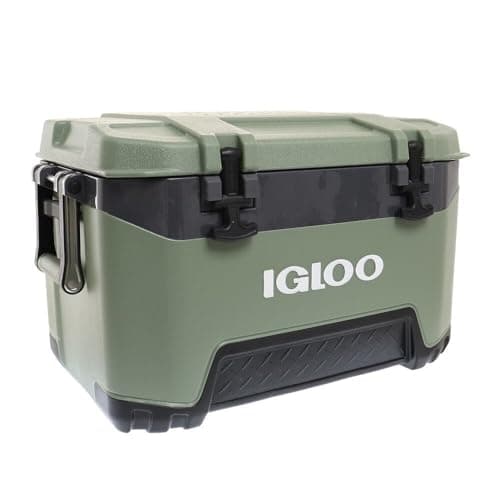
Igloo BMX 52 QT Hard Cooler
The pick. Igloo publishes four days of ice retention at 90F in controlled test conditions for the BMX line, which is within a day of what RTIC claims for a rotomolded box costing several times as much - and the BMX 52 holds 83 cans against the RTIC 45's 60. It is blow-molded rather than rotomolded, which is the reason for both the price and the weight: retailer listings put it around 16 pounds empty, roughly half the RTIC, and an empty cooler you can carry one-handed is an empty cooler that actually gets loaded into the truck. Igloo's own feature list covers the parts that break first on cheap coolers: rubberized lid T-latches, a stainless-steel-reinforced triple-point grab handle, a stainless kick plate, and skid pads on the corners. For a gift, this is the one to wrap - it looks like a serious cooler, it holds a weekend plus a quartered deer, and it leaves enough budget for something else. Honest cons: a blow-molded shell is a hollow plastic box with foam injected into the walls, so it will flex and eventually crack where a rotomolded box would not; the walls are thinner than the RTIC's published 2.9 inches of foam, so in genuine heat it loses the long tail of ice life; and it is not certified bear-resistant, which matters if they hunt where that is a rule rather than a worry.
#ad · Price as of October 20, 2026. We may earn a commission.
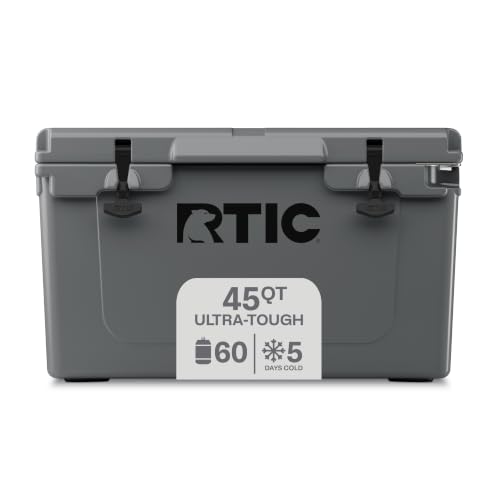
RTIC 45 QT Hard Cooler
The pick when the cooler is not going to live in a garage between trips. RTIC publishes up to 2.9 inches of closed-cell foam insulation, a freezer-style gasket and up to five days of cold when you follow their pre-chill routine, in a rotomolded body - which means the whole shell was formed as one thick-walled piece rather than assembled from a blow-molded skin. That is the difference that shows up in year eight, not week one: there is no seam to split, the lid compresses onto a real gasket instead of plastic, and the box shrugs off being dragged across a tailgate loaded. If you are buying for somebody who hunts out of a truck for a week at a time, drives meat home across two states in August, or runs a boat, this is the correct purchase and the BMX is a false economy. Honest cons: it is the single heaviest thing on this page - retailer listings run from roughly 27 to 30 pounds empty for the 45 QT, before ice - and that weight is real every time it moves; it holds 60 cans against the BMX 52's 83, so you are paying substantially more for less space; and the published ice-retention gap over the BMX is about one day, which is a thin return on the money unless durability is the thing you are actually buying.
#ad · Price as of October 20, 2026. We may earn a commission.
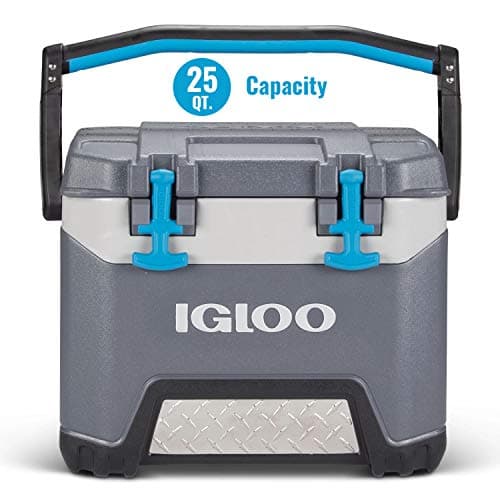
Igloo BMX 25 QT Hard Cooler
Included because the most common cooler mistake is buying one too big to bother with. A 52-quart box is a two-person job when it is loaded, which means on a day hunt it stays home and a grocery bag of ice goes instead. The BMX 25 is the same construction, the same rubberized T-latches and the same stainless-reinforced handle in a 37-can box one person can carry with a rifle in the other hand - the cooler that rides along on the ordinary hunts rather than the trips. It is also the lowest-risk gift of the three: nobody has too many small coolers, there is no size or fit to guess, and it does not commit the recipient to storing something the size of a chest freezer. Honest cons: 25 quarts is drinks, lunch and a couple of bags of ice, not game meat - it will not get a deer home; small coolers have proportionally more surface area per quart of contents, so real-world ice life is shorter than the line's published figure; and if they already own a day cooler this is the one pick here that could duplicate something in the garage.
#ad · Price as of October 20, 2026. We may earn a commission.
The three side by side
| Igloo BMX 52 QT | RTIC 45 QT | Igloo BMX 25 QT | |
|---|---|---|---|
| Construction | Blow-molded, foam-filled walls | Rotomolded, one-piece shell | Blow-molded, foam-filled walls |
| Published ice retention | 4 days at 90F (controlled test) | Up to 5 days (with pre-chill) | Igloo publishes the figure for the BMX line |
| Can capacity | 83 cans | 60 cans | 37 cans |
| Empty weight (retailer listings) | About 16 lb | About 27-30 lb | Lighter still |
| Carry | One person, loaded with effort | Two people once loaded | One person, easily |
| Best job | Weekend camp, a quartered deer | A cooler that lives outdoors for a decade | Day hunts and drinks |
Every figure in that table is the manufacturer's or a retailer's published number, cited at the bottom of this page. We have not put a thermometer in either cooler, and we are not going to pretend otherwise. Where retailer listings disagree — and on weight they disagree by several pounds — the table gives the range rather than picking the flattering end.
Blow-molded versus rotomolded, in one minute
This is the entire comparison, so it is worth getting right.
Blow-moldedis how the Igloo BMX is built, and how almost every cooler under a hundred dollars is built. Molten plastic is blown into a mold to make a hollow shell — think of a two-liter bottle, scaled up and squared off — and then insulating foam is injected into the cavity between the inner and outer walls. It is fast, it is cheap, and it produces a cooler that is remarkably light for its volume, because most of what you are carrying is foam and air rather than plastic. Igloo describes the BMX as heavy-duty blow-molded construction, which is accurate: within the blow-molded world it is the tough end.
Rotomoldedis how the RTIC is built, and how YETI built the category. Powdered plastic goes into a heated mold that then rotates on two axes, so the plastic coats the whole interior and fuses into a single seamless wall of uniform thickness. There is no join, no skin over a cavity, and nothing to delaminate. You then fill that shell with closed-cell foam — RTIC publishes up to 2.9 inches of it — and the result is a box that is absurdly strong and absurdly heavy for the space inside it.
Everything else follows from those two paragraphs. The RTIC is heavier because the walls are genuinely thicker plastic. It holds fewer cans at a bigger exterior size for the same reason. It costs more because rotomolding is slower and uses more material. And it survives longer because there is no seam and no cavity — the failure mode that eventually kills a blow-molded cooler is a crack or a split where the shell flexes, and a rotomolded box does not have that part.
Where the Igloo BMX wins
What we like
- Capacity per dollar is not close - 83 cans in the BMX 52 against 60 in the RTIC 45, at a fraction of the price
- About half the empty weight, which is the difference between a cooler that gets packed and one that stays in the garage
- Published four days at 90F in controlled test conditions, within a day of the rotomolded claim
- The wear parts are addressed: rubberized T-latches, a stainless-reinforced triple-point handle, a stainless kick plate, corner skid pads
- Cheap enough to buy the right size rather than compromising, or to buy two
Worth knowing
- A blow-molded shell can flex, and flexing plastic eventually cracks - this is the part that fails in year five, not year one
- Thinner walls than the RTIC's published 2.9 inches of foam, so it gives up the long tail of ice life in real heat
- Not certified bear-resistant, which is a legal requirement in some backcountry units rather than a preference
- Feels less impressive unwrapped, if impressing somebody is part of the point
Where the RTIC wins
What we like
- Rotomolded one-piece shell with no seam to split - the reason these coolers get handed down
- Published up to 2.9 inches of closed-cell foam and a freezer-style gasket, which is more insulation than any blow-molded box carries
- Up to five days of cold published, when RTIC's pre-chill guidance is followed
- Takes abuse that would end a blow-molded cooler: dragged loaded, stood on, strapped in a boat, left in the sun all summer
- Still costs well under what the brand that invented the category charges
Worth knowing
- Heaviest thing here by a wide margin - retailer listings run roughly 27 to 30 pounds empty for the 45 QT
- Holds fewer cans than the cheaper, lighter Igloo at a larger exterior footprint
- The published ice-retention advantage is about one day, which is a poor return unless durability is the real purchase
- The weight means it realistically needs two people once it is loaded with ice and meat
Which one for a hunter, specifically
Hunters use a cooler for a job most cooler reviews do not cover: getting meat cool fast and keeping it that way on a drive home, sometimes in September heat. That job rewards insulation and volume, and it mostly ignores durability, because it happens a handful of times a year.
| If the hunter... | Buy | Why |
|---|---|---|
| Hunts whitetail within a couple of hours of home | Igloo BMX 52 | Volume and a published four days is more than the drive needs |
| Drives meat home across states, or hunts in real heat | RTIC 45 | The extra foam is doing something on day three |
| Keeps the cooler in a truck bed year-round | RTIC 45 | Rotomolded is the only construction that survives that |
| Needs a cooler for day hunts and drinks | Igloo BMX 25 | The cooler that is small enough to actually bring |
| Hunts somewhere with bear-resistant container rules | RTIC 45 | Blow-molded coolers are not certified for this |
| Already owns a big cooler | Igloo BMX 25 | Nobody has enough small coolers |
If the cooler is specifically for getting a deer home, the size question matters more than the brand question and it has a real answer: what size cooler for a deer works through the quartered weight rather than guessing, and it is the page to read before you pick a number of quarts.
Buying either one as a gift
A hard cooler is one of the best gifts on this site, for an unglamorous reason: it is a thing hunters put off buying because the one they own still technically works. There is no size to guess, no fit to get wrong and no taste involved, which makes it one of the few big-ticket hunting gifts with almost no chance of being wrong.
Two notes on gifting it specifically. First, the BMX 52 is the better gift for most people, not because it is cheaper but because capacity is the thing the recipient will notice and rotomolded durability is the thing they will not notice for years. Second, if your budget reaches the RTIC and you were going to buy it for the ice days, buy the Igloo and spend the difference on something they would never buy themselves — a heated hunting vest or a good rechargeable headlamp both land harder than one extra day of cold.
For the whole category rather than this one match-up, best hunting coolers ranks the field by size and job, and RTIC vs Coleman covers the other comparison people reach for when the RTIC price lands badly. If a full cooler is more than you wanted to spend, YETI vs RTIC tumbler is the same brand argument at a twentieth of the money, and hunting gifts under $50 has the rest of that bracket.
How we compared these
We do not run a cooler test. Nobody put ice in these two boxes on our behalf and watched it melt. What this page does instead is take each manufacturer's published construction, insulation and ice-retention claims, note where retailer listings disagree with each other, and then reason from the manufacturing difference — which is public, uncontested, and explains the weight, the capacity and the price gap better than any single-cooler review does. Every published figure is cited below with the source it came from. Where a figure was not published anywhere we could verify, this page says so instead of estimating. Our method is on the how we choose page, and prices come live from Amazon with the date they were captured.
One deliberate omission: there is no YETI on this page. YETI is the rotomolded benchmark both of these are measured against, and leaving it out of a BMX-versus-RTIC comparison is a choice rather than an oversight — the people searching this match-up have already decided not to pay YETI money, and the RTIC exists precisely to serve them.
Frequently asked questions
Is the Igloo BMX as good as an RTIC cooler?
On published ice retention they are closer than the price gap suggests - Igloo publishes four days at 90F in controlled test conditions for the BMX, RTIC publishes up to five days with its pre-chill routine. Where they are not close is construction: the RTIC is rotomolded as one seamless piece, the BMX is a blow-molded shell with foam injected into the walls. The RTIC will still be the same cooler in ten years of hard outdoor use; the BMX is the better buy on capacity, weight and price for everything short of that.
What does rotomolded actually mean, and does it matter?
Rotomolded means the shell was formed by rotating a heated mold so powdered plastic fuses into one seamless wall of uniform thickness. It matters for durability, not for cold: there is no seam to split and no cavity to delaminate, which is why rotomolded coolers get handed down. It also makes them heavy and reduces interior space for a given exterior size, which is why a 45-quart RTIC holds fewer cans than a 52-quart Igloo and weighs roughly twice as much empty.
Is the Igloo BMX bear resistant?
No, and it is not certified as such. If the hunter you are buying for hunts in a unit that requires a certified bear-resistant container, that requirement rules out blow-molded coolers as a class and the RTIC is the pick of these three. Check the specific certification for the specific model before relying on it, because certification is granted per model rather than per brand.
Which cooler is better for hauling deer meat home?
For a drive of a few hours, the Igloo BMX 52 - it holds 83 cans' worth of space against the RTIC 45's 60, and a published four days is far more than the trip needs. For a multi-day drive, or hunting in genuine heat, the RTIC's published 2.9 inches of closed-cell foam is doing real work on day three. Either way, size is the decision that matters most, and our page on what size cooler for a deer works through the quartered weight instead of guessing.
How much does an RTIC 45 weigh empty?
Retailer listings disagree, which is worth knowing before you order one. Published figures for the 45 QT run from roughly 27 to 30 pounds empty depending on the listing and whether it is the wheeled version, against about 16 pounds for the larger-capacity Igloo BMX 52. That is before any ice goes in, and it is the single most underrated difference between these two coolers.
Is a cooler a good gift for a hunter?
It is one of the best, because there is no size to guess and no taste involved, and because hunters put off replacing a cooler that still technically works. The main way to get it wrong is buying one too big to bother carrying - a 52-quart box loaded with ice is a two-person lift, so it stays home on ordinary hunts. If they already own a big one, a 25-quart day cooler is the better present.
Sources
- Igloo - published BMX feature list and ice-retention claim as listed by Sportsman's Warehouse: four days of ice retention at 90F (tested at 90F in controlled test conditions), heavy-duty blow-molded construction, extra-thick foam walls and insulated lid, rubberized lid T-latches, stainless-steel-reinforced triple-point grab handle, stainless steel kick plate, corner skid pads, Cool Riser Technology
- Igloo BMX 52 QT - published capacity (52 quarts / 49 liters, holds 83 12 oz cans) and approximately 16.4 lb empty weight, per Overton's retailer listing
- Igloo BMX 25 QT - published capacity (holds 37 cans), extra-thick foam walls and lid, blow-molded construction, per the Amazon listing title and feature list
- RTIC 45 QT Ultra-Tough - published rotomolded construction, up to 2.9 in of closed-cell foam insulation, freezer-style gasket, and up to 5 days of cold when RTIC's cooling tips are followed
- RTIC 45 QT Ultra-Tough - published 60-can capacity and rotomolded construction, per the Walmart retailer listing
- RTIC 45 QT Ultra-Tough hard cooler - Amazon listing for the exact model priced on this page