Gear Guides
Red or Green Light for Hunting?
For deer, red - and the reason is biology rather than folklore. For blood trailing and for predators the answer is genuinely contested, which is why the useful buy is a light that does both.
For moving around in deer woods, use red. Deer are dichromats: they lack the cone type that gives humans red sensitivity, and are comparatively far more sensitive to blue — the same piece of biology that makes hunter orange brilliantly obvious to people and unremarkable to deer. Red also preserves your own dark adaptation better than white, so you can switch it off and still see.
Green is the more contested answer, and honesty matters here. Plenty of experienced hunters prefer green for blood trailing, on the argument that it gives more ground contrast than red while still being less alarming than white. That is a defensible preference, not a settled finding, and anyone who tells you one color is scientifically proven for trailing blood is going further than the evidence does.
Which produces a practical recommendation that sidesteps the argument entirely: buy a headlamp that offers red, green and white, and let the hunter decide for themselves. The cheapest pick below does exactly that. For how much light you need rather than which color, see how many lumens for a hunting headlamp.
What deer actually see
Deer vision differs from human vision in three ways that matter to a hunter holding a light.
They are dichromats.Humans have three cone types; deer have two. The one they lack is the one that gives us red sensitivity, which is why onX Hunt's explainer on hunter orange can account for a color that screams at people and barely registers to a deer. Red light is the dimmest thing in a deer's world that is still bright in yours.
They are comparatively more sensitive to blue. Which is the real warning in this subject, and it is about white light rather than green: a cool white LED puts out a great deal of short-wavelength light, and that is the part of the spectrum a deer is best equipped to notice.
They are built for low light and for motion.A deer's eyes gather light far better than yours and its visual system is tuned to movement. So the thing that gets a hunter busted on the walk in is usually not the color of the light — it is a bright beam swinging around at head height.
Color by job
| What you are doing | Use | Why |
|---|---|---|
| Walking in to a stand | Red, on the lowest usable setting | Deer are least equipped to notice red; it preserves your dark adaptation |
| Moving around camp or the truck | Red or low white | Nothing is being hunted; save the battery and your eyes |
| Field dressing an animal | White, wide flood, close up | This is the one job that genuinely needs color discrimination |
| Blood trailing | Try green, then red, then white | Contrast is the goal and hunters genuinely disagree; a tri-color lamp settles it for you |
| Getting out of unfamiliar ground | White, with throw | Safety outranks stealth once the hunt is over |
| Reading a map or a tag | White or green | Red light makes red ink on a map disappear |
That last row is the practical detail most people learn the hard way: under red light, red print vanishes. Anything a hunter has to read — a tag, a map, a regulations page — wants white or green.
Hogs, coyotes and the night-hunting question
The red-or-green debate is loudest among predator and hog hunters, and for those species the honest answer is that it is a preference. Both colors are widely used, advocates of each are confident, and we are not going to invent a study that settles it. What we will say is that the same two principles hold regardless of species: a dim light is less alarming than a bright one, and a light held still is less alarming than a light that sweeps.
There is something far more important for anyone considering this, though, and it is not about color at all. Using artificial light to hunt at night is regulated, and the rules differ sharply between states and between species.Some states permit lights for hogs or coyotes and not for other game; some require a permit; some restrict colors or light-mounting; some prohibit it outright. There is no national answer and we are not going to print one. Check your own state wildlife agency's current regulations before you hunt anything at night, and treat any blanket claim you read online as unverified.
What to look for in a hunting light
A real red mode, not a red flash. Plenty of cheap headlamps advertise red and deliver only a blinking safety strobe. A hunting lamp needs steady red at a usable brightness.
A genuinely low low mode. Single or low double-digit lumens. This is the mode a hunter lives in and the one budget lamps most often omit.
Mode memory, and a switch that does not cycle through white first. A lamp that starts on bright white every time will blind the wearer in the dark, which defeats the entire point of having red.
Both flood and throw. Flood for your hands and the ground, throw for picking a trail out of the dark.
A battery plan. Rechargeable is better until it is flat, and cold reduces cell capacity exactly when a hunter is out before dawn in winter. The best answer is a good rechargeable lamp plus a cheap second light that takes ordinary batteries.
Three lamps that cover three versions of this, with prices pulled live from Amazon.
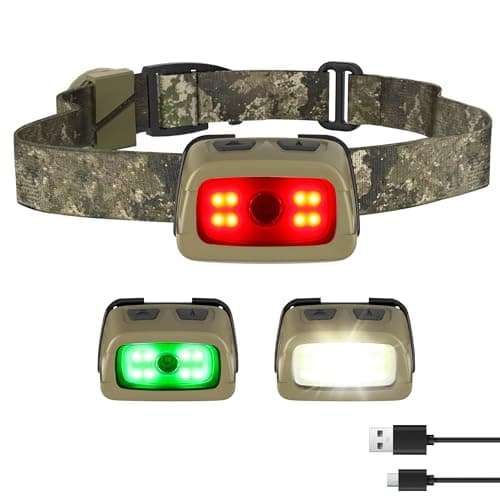
EverBrite Rechargeable Headlamp (Red/Green/White)
The pick for this specific question, and it is barely a gift in price terms. It offers red, green and white, which means the hunter does not have to resolve the blood-trailing argument before buying - they can try green on one trail and red on the next and keep whichever they prefer. Red is the mode that matters most in deer woods and a great many cheap headlamps simply do not have it, offering white, brighter white and a strobe instead. Rechargeable, and cheaper than most people spend on a card. Honest cons: it is an inexpensive light and the build reflects that; white output is modest next to the premium pick; and rechargeable-only means no fallback when the battery is flat in the cold.
#ad · Price as of October 5, 2026. We may earn a commission.
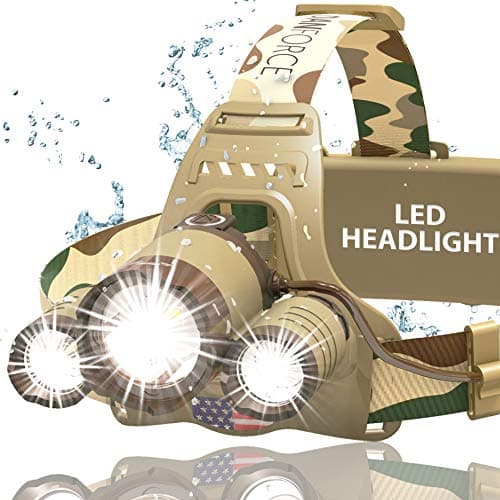
DanForce Rechargeable LED Headlamp
The safe middle, and the one to buy if you want one lamp to do everything. Rechargeable, genuinely bright, has a red mode, and zooms from a wide close flood to a narrow throw - which between them cover the two jobs a hunting light has: field dressing by the wide beam, then picking a trail out of the dark with the narrow one. It sits at the price where people are comfortable buying a gift they are not certain about. Honest cons: it is a general-purpose light rather than a hunting-branded one, so it arrives looking like kit rather than camo; and a zoom mechanism adds a moving part to something that lives outdoors.
#ad · Price as of October 5, 2026. We may earn a commission.
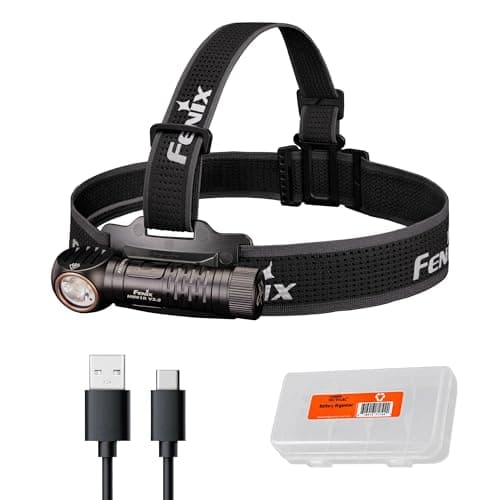
Fenix HM61R V3.0 Rechargeable Headlamp
The lamp where the red mode is engineered rather than added. Fenix publishes eleven lighting modes including a dedicated red light with three brightness levels plus a red flash, alongside a maximum of 1,800 lumens from separate spotlight and floodlight LEDs, a 640-foot beam distance, a hard-anodized A6061-T6 aluminum body, IP68 water resistance and a 4,000mAh 18650 cell that charges over USB-C. Three levels of red is the detail that matters here: it means the hunter can run red genuinely dim on the walk in and brighter for a close-up task without touching white. Honest cons: a real splurge in a category where a working light costs very little; the maximum output is a burst rather than a setting anyone hunts on; and it is sold as a work and inspection light, so it arrives looking like kit rather than hunting gear.
#ad · Price as of October 5, 2026. We may earn a commission.
How we chose these
We do not run a test lab and we have not measured a beam. Every output figure, mode count and construction detail above is the manufacturer's published specification, cited below, and the deer-vision material is sourced rather than asserted. Where the evidence does not settle a question — green versus red for blood trailing, and color choice for predators — this page says so instead of picking a side. Our method is on the how we choose page, and prices are live and dated.
Keep browsing
How many lumens for a hunting headlamp is the companion question and the more important one for most buyers, and best hunting headlamps ranks the field. What to pack in a hunting backpack explains why a second light is the most-forgotten item in hunting, and gifts for deer hunters starts from the person rather than the gear.
Frequently asked questions
Is red or green light better for deer hunting?
Red, and the reason is biology. Deer are dichromats - they lack the cone type that gives humans red sensitivity, and are comparatively far more sensitive to blue - so red is the dimmest thing in a deer's world that is still bright in yours. Red also preserves your own dark adaptation better than white, so you can switch it off and still see.
Can deer see red light?
They can detect it, but far less well than humans do. Deer have two cone types where humans have three, and the missing one is the red-sensitive one - which is the same reason hunter orange is glaring to people and unremarkable to deer. What a deer notices much more readily is blue, which is a warning about cool white LEDs rather than about red.
Is green light better for blood trailing?
Many experienced hunters think so, on the argument that green gives more ground contrast than red while still being less alarming than white. It is a preference rather than a settled finding, and we are not going to present it as proven. The practical answer is a lamp offering red, green and white so the hunter can decide for themselves.
What color light should I use for hogs or coyotes?
Both red and green are widely used and hunters disagree, so treat it as preference rather than fact. Two things matter more than color either way: a dim light is less alarming than a bright one, and a light held still is less alarming than a light that sweeps. Far more important, using artificial light to hunt at night is regulated differently in every state and for different species - check your state wildlife agency before you hunt at night.
Is it legal to hunt with a red or green light at night?
It depends entirely on your state and the species, and there is no national answer. Some states permit lights for hogs or coyotes but not other game, some require a permit, and some restrict colors or how a light may be mounted. Check your own state wildlife agency's current regulations, and treat blanket claims you read online as unverified.
Why can I not read a map under a red headlamp?
Because red print disappears under red light. Anything a hunter needs to read - a tag, a map, a regulations page - wants white or green. It is a small thing that catches people out in the dark, and it is one of the better arguments for owning a lamp with more than one color.
Sources
- onX Hunt - hunter orange explainer, covering deer color vision and why deer are less sensitive to red and orange wavelengths
- Fenix Lighting - HM61R V3.0 published specifications: 11 modes including a dedicated red light with three levels, 1,800 lumens maximum, 640 ft beam distance, IP68
- EverBrite - published product information for the rechargeable red / green / white headlamp
- DanForce - published product information for the rechargeable zoomable headlamp with red light
- National Deer Association - whitetail biology and behavior resources
- U.S. Fish & Wildlife Service - hunting overview; hunting regulations in the United States are set state by state