Gear Guides
Fenix vs Black Diamond: Which Headlamp Should You Buy?
One of these lamps lets you carry a spare battery. The other tells you exactly how much battery is left. That is the whole comparison, and which one matters depends on how far from the truck the hunter goes.
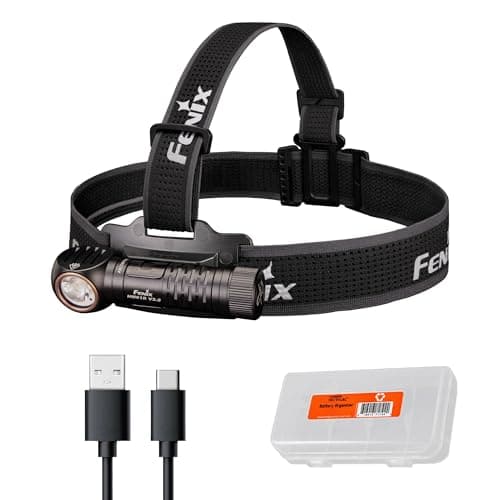
Buy the Fenix HM61R V3.0 if the hunter walks a long way in the dark. Its 18650 cell comes out, so a spare in a pocket turns a dead headlamp into a ten-second problem instead of the end of the hunt. Buy the Black Diamond Spot 400-R instead if the lamp mostly gets used within sight of the truck — it is lighter on the head, it costs substantially less, and its battery meter reports remaining runtime rather than just blinking at you when it is nearly over.
These two brands get compared constantly and almost never on the thing that separates them. Search results will hand you lumen counts: 1,800 for the Fenix against 400 for the Black Diamond, which reads like a knockout and is close to meaningless. A hunter spends almost the entire night in the dimmest mode that works, because a bright beam wrecks your own dark adaptation and carries a long way across open country. Nobody walks to a stand on 1,800 lumens.
What actually separates them is battery philosophy. Fenix built an industrial lamp around a cell you can replace. Black Diamond built an outdoor lamp around a cell you cannot, and then spent the engineering budget on telling you how much of it is left. Both are defensible. Only one of them is right for a particular hunter, and this page is about working out which.
Every figure here is the manufacturer's or a retailer's published specification, cited at the bottom. We have not measured a lumen or timed a battery, and where published sources disagree — and on the Black Diamond's waterproof rating they do — this page says so rather than picking the flattering number.
Fenix HM61R V3.0 Rechargeable Headlamp
The pick, and the reason is a compartment rather than a specification. The HM61R V3.0 runs a removable 18650 cell - Fenix ships it with a 4,000 mAh ARB-L18-4000 - and charges over USB-C, which means a second cell costs a small fraction of a second headlamp and converts the one unrecoverable failure a rechargeable lamp has into a trivial one. The rest of the sheet is generous to the point of being irrelevant for hunting: a published 1,800 lumens on the spot beam with levels down to 30, a separate flood that steps to 5 lumens, a red output at 70, 15 and 3 lumens, a published maximum runtime of 300 hours on the lowest setting, an IP68 rating and a 2 meter impact rating. The feature hunters end up using most is the magnetic tailcap - it sticks to a tailgate or a stand bracket and becomes a work light while you field dress with both hands, which is a job no headband-only lamp does well. Honest cons: it is roughly double the Black Diamond's money; at a published 167.6 grams with battery and headband it is noticeably heavier on the head, and you feel that on a two-mile walk in; and Fenix sells it as an industrial work headlamp, so there is no camo, no green beam and nothing on the box that says hunting - which matters if you are wrapping it.
#ad · Price as of November 4, 2026. We may earn a commission.
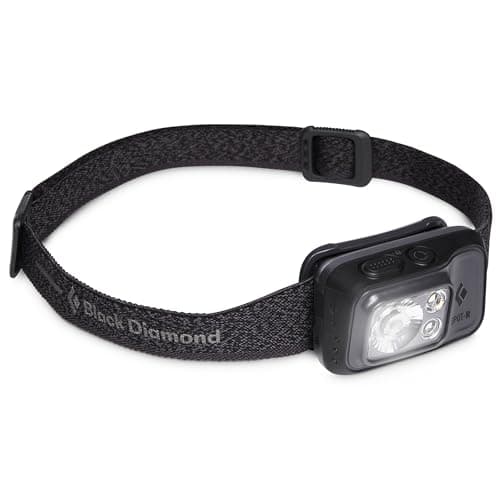
Black Diamond Spot 400-R Rechargeable Headlamp
The pick when the Fenix is more lamp and more money than the hunting justifies, which for a lot of whitetail hunters it is. Black Diamond publishes 400 lumens on high down to 6 on low, a red night-vision mode with its own dimming, brightness memory so it returns to the level you left it on, PowerTap for instant full output, and the feature that genuinely answers this page's central objection: a battery meter that tracks remaining runtime rather than warning you at the end. You cannot swap the cell, but you can stand at the tailgate and know whether it will see you through the sit, which removes most of the risk the sealed design creates. Retailer listings put the integrated cell at 1,500 mAh with roughly 4 hours on high and around 225 hours on low. It is also the lighter lamp by a wide margin and the one that disappears on your head. Honest cons: the battery is integrated, so the lamp's usable life is the battery's life and there is no field recovery; the published waterproof rating differs between listings - IP67 in some, IPX8 in others - so treat it as weather-sealed rather than proven submersible until you read the box; and it charges over micro-USB, which in 2026 means carrying a cable nothing else in the pack uses.
#ad · Price as of November 4, 2026. We may earn a commission.
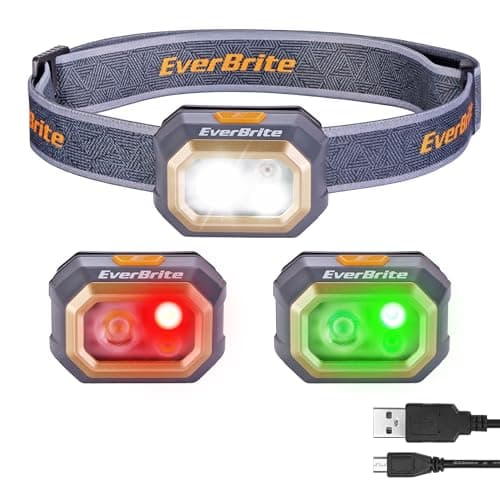
EverBrite 700-Lumen Rechargeable Headlamp (White/Red/Green)
Included because the honest answer to 'which one of these two' is sometimes 'neither, buy two cheap ones', and a buyer deserves to hear it. EverBrite publishes 700 lumens with white, red and green modes, stepless dimming, a memory function, a 60-degree tilt and six modes, in a rechargeable lamp that costs less than a box of broadheads. Every experienced hunter who has been caught out carries two lights, and this is the lamp that makes that rule affordable: you can own this and the Fenix for less than two mid-price lamps, and after that it stops mattering which one dies. It is also the only lamp here with a green mode, which is the color that preserves color discrimination for following a blood trail where red does not. Honest cons: a cheap sealed cell is the first component to degrade, so plan on two or three seasons rather than a decade; we could not verify a published IP rating anywhere, so treat it as not weather-rated; and stepless dimming means there are no repeatable clicks - you cannot set the same dim red by feel every time, which is the one thing stepped levels do better.
#ad · Price as of November 4, 2026. We may earn a commission.
The two lamps side by side
| Fenix HM61R V3.0 | Black Diamond Spot 400-R | |
|---|---|---|
| Battery | Removable 18650 (ARB-L18-4000, 4,000 mAh) | Integrated, retailer-listed 1,500 mAh |
| Charging | USB-C | Micro-USB |
| Published high output | 1,800 lm spot | 400 lm |
| Published low output | 5 lm flood, 3 lm red | 6 lm |
| Red mode | Three levels: 70 / 15 / 3 lm | Night-vision red with dimming |
| Published runtime | Up to 300 h on the lowest setting | About 4 h high, about 225 h low (retailer-listed) |
| Sealing | IP68, 2 m impact rating | IP67 or IPX8 depending on the listing |
| Weight | 167.6 g with battery and headband | Not published in a figure we could verify |
| Signature feature | Magnetic tailcap, spare-cell capability | Battery meter reporting remaining runtime |
Two cells in that table say what they say for a reason. Black Diamond's waterproof rating is listed differently by different retailers, and we are not going to resolve that disagreement by picking one. The Spot 400-R's weight is not published anywhere we could verify to the same standard as the Fenix figure, so the row says so instead of estimating a number that would then get quoted back at us.
The decision: recoverable or predictable
Rechargeable headlamps fixed a real problem. Nobody misses hunting for AAA cells in a kitchen drawer at four in the morning, nobody misses corroded contacts, and a lithium cell holds its voltage in cold far better than the alkalines most headlamps ship with. All of that is genuine, and it is why both lamps here are rechargeable.
It bought those things by sealing the battery inside the lamp, and that created a failure that a disposable-battery headlamp does not have. A lamp with spare AAAs in your pocket that dies on the walk out is thirty seconds of annoyance. A sealed rechargeable lamp that dies on the walk out is over, and you finish the night by phone light with one hand occupied.
There are exactly two good answers to that, and these two lamps are each one of them.
Fenix answers it by making the failure recoverable. The 18650 comes out. Buy one spare, keep it in the bino harness or a pack pocket, and the worst case costs you the time it takes to unscrew a tailcap. This is the cheapest redundancy available to a hunter, and it is why the Fenix tops our best rechargeable headlamp for hunting roundup too.
Black Diamond answers it by making the failure predictable. You cannot swap the cell, so instead the lamp tells you how much runtime is left before you commit to the walk. A meter that reports remaining hours rather than blinking a low-battery warning at the very end converts a surprise into a decision you make at the truck, where the charger is.
Where the Fenix wins
What we like
- The 18650 cell is removable - the only lamp of these two you can carry a spare for
- Published IP68 and a 2 meter impact rating, the toughest sealing figures on this page
- Magnetic tailcap turns it into a hands-free work light for field dressing at the tailgate
- Red at three published levels (70 / 15 / 3 lm), so you can set a genuinely dim red by feel
- USB-C, so it charges off the same cable as the phone and the rangefinder
- A published 300 hour maximum runtime on the lowest setting
Worth knowing
- Roughly twice the money of the Black Diamond, for a feature set most whitetail hunting never uses
- A published 167.6 g with battery and headband - heavier on the head, and you notice on a long walk in
- Marketed and packaged as an industrial work headlamp, which makes it a worse-looking gift
- No green mode, so it is the wrong lamp for blood trailing or predator hunting
- 1,800 lumens is a number a hunter should essentially never use
Where the Black Diamond wins
What we like
- A battery meter that reports remaining runtime, not just a low-battery blink at the end
- Brightness memory - it comes back on at the level you left it, which keeps your dark adaptation
- Dedicated red night-vision mode with its own dimming
- Lighter and lower-profile on the head than the Fenix
- Substantially cheaper, and a brand an outdoors person recognizes
- Retailer-listed runtime of around 225 hours on low, which is far more than a season of sits
Worth knowing
- Integrated cell - no spare, no field recovery, and the lamp's life is the battery's life
- Published waterproof rating differs between listings (IP67 in some, IPX8 in others)
- Micro-USB in 2026 means one more cable in the pack that charges nothing else
- 400 lumens is plenty for hunting but will feel thin to anyone who wanted a flashlight too
- No green mode, same as the Fenix
What about lumens?
The 1,800-against-400 gap is the first thing anyone notices and close to the last thing that should decide this. Headlamp output is sold the way horsepower is sold, and hunting uses it the way a tractor uses horsepower: almost never at the top.
Three reasons the big number does not earn its keep in the woods. Your own dark adaptation takes twenty to thirty minutes to build and a couple of seconds of white light to destroy, so the hunter who runs a bright beam on the walk in arrives unable to see anything the lamp is not pointed at. Bright light also travels — in open country a hunter on high beam is visible from a very long way off, to game and to anyone else hunting that block. And runtime collapses at the top setting on every lamp ever made: the Black Diamond's own published figures go from about 4 hours on high to around 225 on low.
What actually matters is the bottom of the range and how finely you can get there. The Fenix publishes a 5 lumen flood and a 3 lumen red; the Black Diamond publishes 6 lumens on low with a dimmable red. Those are the modes a hunter lives in, and they are nearly identical. If you want this argument in full, with the arithmetic, how many lumens for a hunting headlamp works through it.
Red, green, and what each one is for
Neither of these lamps has a green mode, which is worth knowing before you buy either for a hunter who needs one.
Redis for protecting your own night vision. It barely disturbs dark adaptation, so you can check a pack, tie a boot or find a release and still see by starlight half a minute later. It also carries less far than white, which announces you less on the walk in. Both lamps here do red, and the Fenix does it at three fixed levels where the Black Diamond does it dimmable — a real preference split rather than a better-and-worse.
Green is for telling colors apart in the dark, which in practice means following a blood trail, and it is the color predator and hog hunters favor for moving game at night. If that is the hunting, neither lamp on this page is the right answer and the budget pick above or a green-first lamp is. Red or green light for hunting covers the trade properly.
Buying either one as a gift
A headlamp is a quietly excellent hunting gift. Every hunter uses one, hardly any of them own a good one, and there is no size, fit or taste to get wrong. The only real risk is that it does not feel like a present — which is an argument for the nicer lamp rather than the sensible one.
If you are buying for somebody else, three practical notes. First, the Black Diamond is the better-looking gift of these two: it is a recognizable outdoor brand in retail packaging, where the Fenix arrives looking like something ordered for a job site. Second, if you buy the Fenix, buy the spare 18650 with it and wrap both — the spare is the entire point of that lamp and a recipient who does not know that will never buy one. Third, and this is the quietly best move: buy the cheap EverBrite alongside whichever you choose. Two lights is the rule experienced hunters follow, almost nobody buys the second one for themselves, and it costs very little to complete the gift properly.
For the whole category rather than this pair, the best rechargeable headlamp for hunting ranks five lamps on the same battery question, and best hunting headlamps includes the disposable-battery lamps this page leaves out. If a headlamp is not quite the present you had in mind, hunting stocking stuffers and best hunting gadgets and tools are the neighboring lists. And if the hunter you are buying for is cold rather than in the dark, the best heated hunting vest solves a bigger problem than any light does.
How we compared these
We did not test these lamps against each other. No one on our side has run both batteries flat or dunked either one. What this page does instead is take each manufacturer's published specifications and the retailer listings that carry the numbers the manufacturers leave out, note the places those sources disagree, and reason from the single design decision — removable cell against sealed cell with a meter — that explains the weight, the price and the field behavior of both lamps better than any spec row does. Every published figure is cited below. Where a figure was not published anywhere we could verify, this page says so instead of estimating. Our method is on the how we choose page, and prices come live from Amazon with the date they were captured.
Frequently asked questions
Is Fenix better than Black Diamond for hunting?
For a hunter who goes far from the truck, yes - the Fenix HM61R V3.0's 18650 cell is removable, so a spare in a pocket makes a dead lamp a ten-second problem. For a hunter who parks at a field edge and walks a few hundred yards, the Black Diamond Spot 400-R is the better buy: it is lighter, about half the money, and its battery meter reports remaining runtime so a dead lamp never surprises you in the first place.
Can you replace the battery in a Black Diamond Spot 400-R?
No. The Spot 400-R uses an integrated rechargeable cell, retailer-listed at 1,500 mAh and charged over micro-USB, and it is not user-replaceable. That is the central trade-off against the Fenix, and Black Diamond's answer to it is the battery meter that tracks remaining runtime rather than warning you only at the end.
Does the Fenix HM61R take a replaceable battery?
Yes - that is the main reason to buy it. The HM61R V3.0 runs a removable 18650 cell, shipped as a 4,000 mAh ARB-L18-4000, and charges over USB-C. A spare cell costs a small fraction of a second headlamp, which makes it the cheapest redundancy a hunter can carry.
Is 400 lumens enough for a hunting headlamp?
Easily. A hunter spends almost all their time in the dimmest usable mode, because bright white light destroys your own dark adaptation and travels a long way in open country. The published low settings are what matter - 6 lumens on the Black Diamond, a 5 lumen flood and 3 lumen red on the Fenix - and those are close to identical. The 1,800 lumen figure on the Fenix is a number a hunter will essentially never use.
Is the Black Diamond Spot 400-R waterproof?
Published sources disagree, which is worth knowing before you trust it in a duck blind. Some retailer listings give IP67, others give IPX8. Treat it as weather-sealed rather than proven submersible until you read the rating on the box you receive. The Fenix publishes IP68 along with a 2 meter impact rating, and is the safer lamp if it is going to get genuinely wet.
Which headlamp is the better gift?
The Black Diamond, slightly, because it arrives as a recognizable outdoor brand in retail packaging while the Fenix is sold as an industrial work headlamp. But the better move with either is to add the thing the recipient will not buy themselves: a spare 18650 if you choose the Fenix, or a cheap second headlamp alongside it. Experienced hunters carry two lights, and almost nobody buys the second one for themselves.
Sources
- Fenix - published product information for the HM61R V3.0: 1,800 lumens, spot plus flood, red light, magnetic tailcap, USB-C rechargeable work headlamp
- Fenix HM61R V3.0 - published 18650 battery (ARB-L18-4000, 4,000 mAh, replaceable), spot levels 1,800 / 600 / 150 / 30 lm, flood 200 / 30 / 5 lm, red 70 / 15 / 3 lm, 300 h maximum runtime, IP68, 2 m impact rating, 167.6 g with battery and headband, per the Knivesandtools retailer spec listing
- Black Diamond - published product information for the Spot 400-R: 400 lumens, red night vision, brightness memory, PowerTap, battery meter that tracks runtime, integrated rechargeable battery
- Black Diamond Spot 400-R - retailer-listed 1,500 mAh integrated Li-ion battery, micro-USB charging, 400 / 200 / 6 lm levels, approximately 4 h on high and 225 h on low, with waterproof rating listed as IP67 in some sources and IPX8 in others
- EverBrite - published product information for the 700-lumen rechargeable headlamp: 700 lumens, white / red / green modes, stepless dimming, memory function, 60 degree tilt, six modes