Gear Guides
Do Deer See Blaze Orange?
Not the way you do. A deer's retina has two photopigments where yours has three, and the missing one is the long-wavelength cone that makes orange look orange. The thing that gives you away is somewhere else entirely.
Deer do not see blaze orange as orange. A deer's retina carries two photopigments where a human's carries three, and the one it lacks is the long-wavelength cone that handles red and orange — so blaze orange reads to a deer as a muted, washed-out tone rather than as the screaming beacon it is to you. Wear the orange. It is the law in many states and it is not what gets you spotted.
That is the answer, and the research behind it is specific. The University of Georgia's deer research has been the main source on this for over thirty years: a 1992 study at UGA sedated deer, emitted different wavelengths of light into their eyes and measured the response, and later work has refined the picture. Published accounts of that research describe deer as able to perceive short-wavelength blue along with moderate wavelengths of green and yellow, while their eyes are not built to distinguish the longer wavelengths — red and orange. Dr. Gino D'Angelo, who led follow-up work at UGA, has described deer as seeing those longer wavelengths "more like a muted yellow or a muted brown".
One honest caveat, because it is the part most articles skip: you cannot convert a deer's color experience into a human photograph. The "this is what a deer sees" images circulating online are illustrations, not measurements, and researchers are openly uncomfortable with them — one published account notes that attempts to translate a deer's likely color perception into human terms "makes scientists squirm". What we can say with confidence is which wavelengths a deer can and cannot discriminate between, not what the experience looks like from inside.
What actually gives a hunter away
If orange is not the problem, three other things are — and all three are more actionable.
1. Ultraviolet, which is the real laundry problem.This is the one that matters and the one nobody checks. The UGA research found deer see further into the UV spectrum than was once believed, and deer lack the yellow lens pigment that filters UV and blue light out of human vision. Meanwhile most laundry detergents contain optical brighteners — compounds whose entire job is to absorb UV and re-emit it as visible light so that white shirts look whiter. Put those two facts together and a camo jacket washed in ordinary detergent can be the brightest thing in the woods to an animal whose vision is tuned to exactly that end of the spectrum. Wash hunting clothes in a detergent without brighteners; how to wash hunting clothes covers the routine, and it costs almost nothing.
2. Movement.A deer's eye is built for motion detection at the expense of fine detail. Published accounts of the UGA work put deer daylight acuity at roughly 20/100, with more recent estimates nearer 20/60 — meaning a deer cannot resolve the detail you can — while their field of view runs to roughly 300 to 310 degrees with about 65 degrees of binocular vision to the front. A nearly panoramic, motion-tuned, low-detail eye is a system optimised to catch things that move. Your hands moving to a rangefinder give you away; the color of your vest does not.
3. Low light, which is their advantage and your problem. Deer eyes carry significantly more rods than human eyes and are most sensitive under twilight conditions, which is precisely when you are walking in, climbing, settling and leaving. The practical consequence is that the two edges of the day when you are least able to see are the two when they are best able to.
So should you wear blaze orange?
Yes, and in a great many states during firearm seasons you are legally required to. The requirement varies by state, by season and sometimes by the type of land you are on — the square inches of orange required, whether it must be worn above the waist, and whether blaze pink is an accepted alternative are all state-level details that change. We are not able to check your state's rule for you, so look it up with your own wildlife agency before the season. What the research supports is the reassuring part: complying with that law costs you almost nothing in concealment.
The honest exception is bowhunting. Many states do not require orange during archery-only seasons, and the argument for skipping it there is not that deer see it — it is that archery requires close range, and at close range the thing that matters is your outline against the background, which a large flat block of any single tone works against. If you are in a treestand in gun season, wear it. If you are drawing a bow at fifteen yards in October, the broken-up camo pattern is doing real work.
Three things that follow from this
Each of these is a direct consequence of the research above rather than a general recommendation, and each shows a live price with the date it was captured.
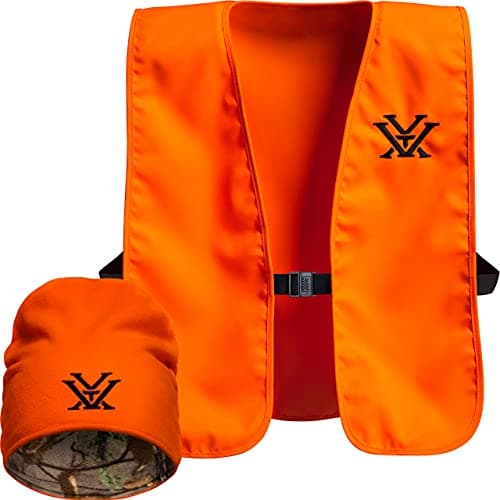
Vortex Blaze Orange Vest & Beanie Combo
The pick because it is the cheapest way to satisfy a gun-season orange requirement, and because everything on this page says it costs you very little to do so. A blaze orange vest and beanie combo covers the two places state rules most often specify - above the waist, and the head - and a vest goes over whatever jacket the hunter already owns, which means there is no sizing problem and no need to replace a coat. The reason to buy the combo rather than just the vest is that several states specify a minimum square-inch area or require the head covered, and the beanie makes compliance obvious rather than marginal. Honest cons: a vest over an insulated jacket is bulky and can snag on a bowstring, so it is a gun-season item; we cannot tell you whether this specific combination meets your state's square-inch rule, which you must check yourself; and blaze orange over good camo looks, to other hunters, exactly as conspicuous as it is meant to.
#ad · Price as of October 17, 2026. We may earn a commission.
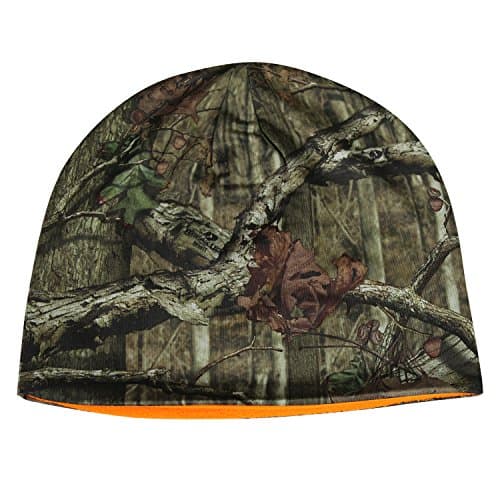
Mossy Oak Reversible Camo / Blaze Beanie
The pick for a hunter who hunts both archery and firearm seasons and does not want two sets of gear. It reverses from camo to blaze, so the same hat covers an October bow sit and a November gun sit - which is exactly the distinction this page draws, since the orange matters for other hunters' eyes rather than for the deer's. A beanie is also the single most useful cold-weather item per dollar, because an uncovered head is a large uninsulated radiator at the top of your body. One size, so there is no fit to get wrong, which makes it a safe gift. Honest cons: a reversible beanie is thinner than a dedicated insulated hat because it has to work inside out; a knit hat is not a substitute for whatever square-inch requirement your state sets, so check the rule rather than assuming a hat covers it; and the camo side is a printed pattern rather than a licensed-pattern garment.
#ad · Price as of October 17, 2026. We may earn a commission.
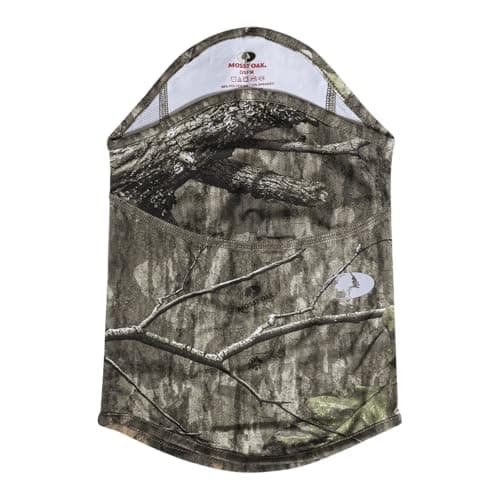
Mossy Oak Camo Face Mask / Neck Gaiter
Included because of the motion-and-outline conclusion rather than the color one. A human face is a large pale oval that moves every time you look at something, and it is the part of a hunter most likely to be picked up by an eye built for motion across a 300-degree field. A camo face mask or neck gaiter covers it, and it does a second job in cold weather by sealing the gap at the collar where a lot of body heat escapes. It is one size, it costs very little, and it is the cheapest concealment upgrade available to anybody already wearing camo. Honest cons: a mask over the face is warm and slightly claustrophobic, and most people pull it down at some point - usually the wrong point; it can interfere with a cheek weld on a long gun and with an anchor point on a bow, both of which need checking at home rather than in a stand; and glasses fog behind one in the cold.
#ad · Price as of October 17, 2026. We may earn a commission.
Deer vision, as published
| Property | Deer | Human | What it means for you |
|---|---|---|---|
| Photopigments in the retina | Two | Three | No long-wavelength cone, so no red or orange |
| Colors discriminated | Blue, plus green and yellow | Blue, green and red | Blue is the color to avoid, not orange |
| UV sensitivity | Sees further into UV; no yellow lens filter | UV filtered by yellow lens pigment | Detergent brighteners are the real risk |
| Daylight acuity (published estimates) | About 20/100, later estimates nearer 20/60 | 20/20 | They cannot resolve detail you can |
| Field of view | About 300-310 degrees | About 180 degrees | Very little of your approach is unobserved |
| Binocular vision | About 65 degrees to the front | Roughly 120 degrees | Depth perception is narrower than yours |
| Rods (low-light cells) | Significantly more than human | Fewer | Dawn and dusk belong to them |
Every figure in that table comes from published accounts of the University of Georgia deer research, cited at the bottom of the page. The acuity figures are deliberately given as a range rather than a single number because the published estimates have moved — roughly 20/100 from 2007 UGA work, nearer 20/60 in more recent estimates — and quoting one number as settled would misrepresent the state of the research.
The blue problem, which is the useful takeaway
If you only change one thing after reading this page, change it here. Deer discriminate short wavelengths well — blue is squarely inside what their two photopigments handle — and they see further into the UV than was once believed with no lens filter to damp it down. That makes the blue end of the spectrum the part of your clothing a deer is genuinely equipped to notice, while the orange end is the part it is least equipped to notice.
Practically: ordinary blue jeans are a worse choice than a blaze orange vest, and a camo jacket washed in brightener-heavy detergent is worse than either. The fix is free or close to it — a detergent without optical brighteners, and leaving the denim at home.
What this page is not
We do not run a test lab, we have not conducted vision research, and we have not photographed anything through a deer's eye. Every claim above is drawn from published accounts of the University of Georgia's deer vision research — the 1992 study, the 2007 acuity estimate, Bradley Cohen's 2014 work overseen by Karl Miller, and Dr. Gino D'Angelo's later photoreceptor work — all cited below. Where the research is unsettled we have said so rather than picking the tidier number, and we have deliberately not reproduced a "through a deer's eyes" image, because those are illustrations rather than measurements. There is no score and no award from us on this page. Our method is on the how we choose page.
We also cannot tell you your state's hunter-orange requirement. It varies by state, by season and sometimes by land type, the required area differs, and blaze pink is accepted in some places and not others. Check it with your own wildlife agency; it is the one thing on this page where being wrong carries a penalty.
Keep browsing
Best camo apparel is the roundup, and it carries the hunter-orange section in the context of a full outfit. What to wear deer hunting builds the outfit head to toe for a gun-season sit, and how to wash hunting clothes is the page that actually acts on the UV finding above. If the hunter sits in a blind rather than a tree, the dark-clothing point from the callout is covered in how to set up a ground blind.
Frequently asked questions
Do deer see blaze orange?
Not as orange. A deer's retina has two photopigments where a human's has three, and the missing one handles long wavelengths - red and orange. Published accounts of the University of Georgia research describe deer as perceiving short-wavelength blue plus moderate green and yellow, with red and orange appearing as a muted yellow or brown. So blaze orange does not stand out to a deer the way it does to you.
What color should you not wear deer hunting?
Blue, and anything washed in detergent containing optical brighteners. Deer discriminate short wavelengths well and see further into the ultraviolet than was once believed, with no yellow lens pigment to filter it - while optical brighteners exist specifically to absorb UV and re-emit it as visible light. Ordinary blue jeans and brightener-washed camo are both worse choices than a blaze orange vest.
Can deer see color at all?
Yes, just less of it than you. Two photopigments let a deer tell short wavelengths from long ones - blue from yellow, for instance - but not distinguish among the middle-to-long wavelengths, so yellow-green, green, yellow, orange and red are not separable to them the way they are to you. They are not colorblind; they simply have a narrower palette.
Do you have to wear blaze orange hunting?
In many states during firearm seasons, yes, and the detail varies a great deal: how many square inches, whether it must be above the waist, whether the head must be covered, and whether blaze pink counts are all state-level rules. We cannot check yours for you - look it up with your own wildlife agency. The good news from the research is that complying costs you almost nothing in concealment.
How well can deer see?
Poorly on detail, extremely well on motion and in low light. Published estimates of deer daylight acuity from UGA research run from about 20/100 to nearer 20/60, against 20/20 for a human - but their field of view is roughly 300 to 310 degrees with about 65 degrees of binocular vision, and their eyes carry significantly more rods than ours, making them most sensitive at twilight. That is an eye built to catch movement, which is what gives hunters away.
Does camo even work on deer?
It works, but not by matching colors a deer can see - it works by breaking up your outline. That is why solid dark clothing beats camo inside a ground blind, where the blind supplies the concealment and your only job is not to be a bright shape in a window, and why covering your face and hands matters more than the pattern on your jacket.
Sources
- MeatEater - Deer Vision: How Whitetails See Color, Light, and Movement, reporting University of Georgia research (Bradley Cohen 2014, overseen by Karl Miller; 2007 UGA acuity estimate of about 20/100 and later estimates nearer 20/60; 300-310 degree field of view with about 65 degrees binocular; deer lack a yellow lens filter for UV and blue light)
- Outdoor Life - What Colors Can Deer See, reporting the University of Georgia Deer Lab (two retinal photopigments vs three in humans; short-wavelength blue plus moderate green and yellow perceived; Dr. Gino D'Angelo on red and orange appearing as a muted yellow or brown; the 1992 UGA study; more rods than human eyes)
- Vortex - published product information for the blaze orange vest and beanie combo
- Mossy Oak - published product information for the reversible camo / blaze beanie
- Mossy Oak - published product information for the camo face mask / neck gaiter