Gear Guides
Hunting vs Golf Rangefinder: What's Actually Different?
They look identical, they cost about the same, and there's probably one in a golf bag in the house already. Here's what genuinely separates them — and whether you can get away with the one you've got.
Pick up a hunting rangefinder and a golf rangefinder and you would struggle to tell them apart. Same monocular shape, same rubber armor, same single button on top, same price bracket. They use the same underlying technology: fire a laser pulse at something, time the reflection, do the arithmetic, show a number. It is entirely reasonable to look at the golf rangefinder already sitting in someone's golf bag and wonder why you'd buy a second one.
The differences are real, though, and they're not marketing. They come down to what each device is designed to ignore, what it does with sloping ground, and how it's built to survive. This comparison lays out exactly what separates them, answers the practical question of whether you can use one for the other, and ends with a clear verdict on which to buy for a hunter.
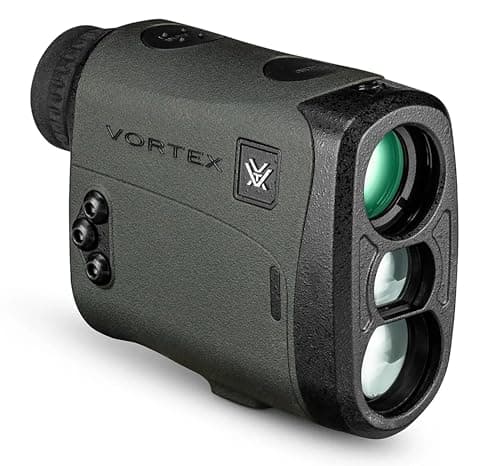
Vortex Sonora HD 1800 Laser Rangefinder
The hunting answer at the premium end. Long range, angle-compensated readings that account for shooting up or down a slope, and Vortex's warranty behind it. If you've decided a hunting-specific rangefinder is the right gift and you want it to be the one they keep for a decade, this is the pick.
#ad · Price as of October 24, 2026. We may earn a commission.
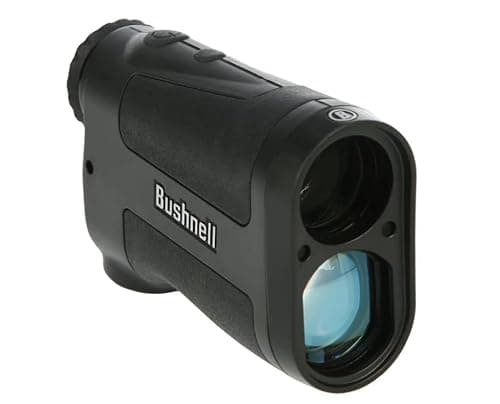
Bushnell Legend 6x24 1200-Yard Rangefinder
The hunting answer for most gift-givers. A recognized name, simple operation, published angle compensation, and range far beyond what typical hunting shots require — without flagship money. If the person in your life already has a golf rangefinder and you want to give them the right tool for the woods, start here.
#ad · Price as of October 24, 2026. We may earn a commission.
The short answer
A golf rangefinder will physically work for hunting, but it's the wrong tool in three specific ways — and one of them is a rules problem, not a preference. Golf units are designed to lock onto the nearest small, clean target and to ignore everything behind it. Hunting units are designed to see through intervening brush and report the thing behind it. Golf units are usually built to conceal slope adjustment (because using it in competition is against the rules of golf), while hunting units display the angle-compensated number prominently. And golf units come in bright colors designed to be found on a fairway, which is the opposite of what a hunter wants. If you're buying for a hunter, buy a hunting rangefinder. Everything below is the detail behind that.
How we compared them
This is a comparison of two design philosophies rather than two specific products, because that's the question people are actually asking — usually while holding a golf rangefinder and wondering if they can save a hundred dollars. It's built from the published design intent of the two categories, the way each is used in the field, and the practical gift-fit question at the end. We've stayed away from lab claims and lumen-style number wars, because none of that decides this. Our full method is on the how we choose page.
How they compare
| Attribute | Hunting rangefinder | Golf rangefinder |
|---|---|---|
| What it prioritizes | The distant object — ignores intervening brush and branches to range the animal behind them | The nearest small target — locks the flagstick and ignores trees and terrain behind it |
| Slope / angle | Displays the angle-compensated shooting distance prominently; it's a headline feature | Often present but switchable off or hidden, because slope readings are not allowed in competition play |
| Typical range | Long — commonly quoted well past 1,000 yards, though real-world range on a deer is shorter | Shorter and entirely sufficient for a course; rarely a limiting factor for golf |
| Finish and color | Camo or subdued black, made not to be seen | Bright, high-visibility colors so it isn't lost on a fairway |
| Build and weather | Built for rain, snow, mud and being dropped out of a treestand | Weather-resistant to a fair-weather standard; usually not built for the same abuse |
| As a gift | The right tool, and it reads as someone who understood the hobby | Fine as a stopgap, but a hunter will notice it's borrowed from another sport |
Notice that neither column is a failure. Both are good at their own job. What differs is the assumption each one makes about what you're pointing it at — and in the woods, that assumption is the whole ballgame.
Target priority: the difference that actually matters
This is the one to understand, because everything else is cosmetic by comparison.
A golfer stands on a fairway with a clear line to a thin flagstick, and beyond it is a treeline. The rangefinder's job is to report the flag and ignore the trees — so golf units are tuned to prefer the nearest reasonable target and to reject the big thing behind it. That behavior is often called first-target or near-target priority, and it is exactly right for golf.
Now put that same device in a hunter's hands. They are looking through a screen of branches, brush and standing grass at an animal thirty yards beyond it. A device that prefers the nearest object will happily range the twig eight yards in front of them. Hunting rangefinders are tuned the other way — to see past clutter and report the distant object — often described as distant-target or brush mode. That single design decision is why borrowing a golf unit gets frustrating in real hunting conditions, and it's not something you can work around by holding it differently.
Slope, and why golf hides it
Both sports face the same physics. If you measure the straight-line distance to something below or above you, that diagonal is longer than the horizontal distance gravity actually acts over. A golfer hitting downhill and a bowhunter shooting from a treestand have exactly the same problem, and the same maths fixes it.
The difference is cultural, not technical. Under the rules of golf, using slope-adjusted distances during competition is not permitted — so golf rangefinders that offer it are typically built so the feature can be switched off and visibly seen to be off. Hunting has no such restriction, so hunting units display the compensated number front and center and treat it as a selling point. Our how to choose a rangefinder guide goes through what angle compensation does in more depth.
Where the golf rangefinder wins
What we like
- It's already in the house — the cheapest rangefinder is the one you don't buy
- Fine for open-country ranging where nothing is between the hunter and the target
- Genuinely useful for scouting: pacing out shooting lanes, marking distances to trails and field edges before the season
- Bright colors make it very hard to lose
Worth knowing
- Tuned to prefer the nearest object, so brush and branches between hunter and animal cause false readings
- Slope adjustment is often hidden, switchable off, or absent entirely
- Bright coloring is the opposite of what a hunter wants in the field
- Usually not built for the rain, cold and rough handling of a hunting season
That third point is worth taking seriously and is the honest reason not to rush out and buy. Ranging shooting lanes from a stand before the season — marking the distance to a trail crossing, a field edge, a specific tree — is one of the highest-value things a rangefinder does, and a golf unit does it perfectly well on a quiet afternoon with nothing in the way. If someone in the house owns one and the hunter has never tried it, that's a free afternoon's worth of useful work.
Where the hunting rangefinder wins
What we like
- Sees past brush and reports the distant target, which is the actual hunting situation
- Angle-compensated distance shown clearly, which matters from a treestand or on a slope
- Camo or subdued finish that doesn't announce the hunter
- Built for weather and rough handling across a whole season
- Long advertised range gives real headroom for open-country hunting
Worth knowing
- It's a second purchase if a golf unit already exists in the household
- The long advertised ranges are mostly irrelevant to a hunter shooting inside 200 yards
- Camo finish makes it genuinely easy to lose in leaf litter — a tether or harness is worth adding
The verdict
If you are buying a gift for someone who hunts, buy a hunting rangefinder. The target-priority difference alone decides it: a device that prefers the nearest object is the wrong device to point into brush, and that is where most hunting shots live. The camo finish, weather sealing and prominent angle compensation all point the same way.
If the question is instead "we already own a golf rangefinder, do we need to spend money today?" — no, not urgently. Use it for pre-season scouting, where it works fine, and put a hunting rangefinder on the list for the next occasion. And if the hunter you're buying for doesn't yet own good binoculars, buy those first: they get used continuously through a sit while a rangefinder gets used in seconds. Our best hunting rangefinders roundup has the picks at every budget, and do you need a rangefinder for hunting answers the question one step further back.
Frequently asked questions
Can you use a golf rangefinder for hunting?
It will work, but it's tuned the wrong way. Golf rangefinders prefer the nearest small target and ignore what's behind it, which is right for a flagstick and wrong for an animal standing behind brush — you'll often range a twig instead. They're genuinely useful for pre-season scouting in the open, and frustrating in typical hunting cover.
What is the main difference between a hunting and a golf rangefinder?
Target priority. Hunting models are built to see past intervening brush and report the distant object, while golf models are built to lock the nearest clean target and reject the background. Beyond that, hunting units show angle-compensated distance prominently, use camo or subdued finishes, and are built for weather and rough handling.
Why do golf rangefinders hide the slope feature?
Because using slope-adjusted distances during competitive play is not permitted under the rules of golf. Models that offer it are usually built so it can be switched off and visibly seen to be off. Hunting has no such restriction, so hunting rangefinders display the compensated number as a headline feature.
Can you use a hunting rangefinder for golf?
Yes, and it's the easier direction to borrow in. A hunting rangefinder has more than enough range for a course and will read a flagstick fine in the open. The catch is that its preference for distant targets can make it read the treeline behind the flag, and its slope reading may not be legal for competition play.
Is a rangefinder worth buying for a hunter who mostly shoots close range?
Yes, though for a different reason than you'd expect. Even close-range hunters get a lot of value from ranging their shooting lanes before the season — marking the distance to a trail crossing or field edge so no estimating is needed in the moment. That use alone justifies a modest model.