Gear Guides
Work Sharp vs Lansky: Which Knife Sharpener Should You Buy?
Two respected American sharpener brands that solve the same problem in opposite ways - one by guiding the abrasive, the other by clamping the knife. Here is which philosophy suits which person, and the four products worth your money.
Ask a hunter which knife sharpener to buy and two names come back more than any others: Work Sharp and Lansky. Both are long-established American brands, both are genuinely good, and comparing them model to model misses the point, because the two companies disagree about something more fundamental than grit numbers.
The disagreement is about what should be held steady. Almost every sharpening failure comes from the same cause: the person cannot keep the blade at a consistent angle against the stone, so they round the edge over instead of grinding a bevel. Lansky's answer is to clamp the knife and run the abrasive along a fixed rod, so the angle is locked by the jig. Work Sharp's answer is to build the angle into the tool itself — guides you drag the blade against, or a powered belt with an adjustable stop — so the knife stays in your hand and the tool does the geometry.
Neither is better. They suit different people, different places and very different budgets. This page picks four products across both brands, says which kind of hunter each one is for, and is honest about what each gives up. If you want the wider field including other brands, our best hunting knife sharpeners roundup covers it.
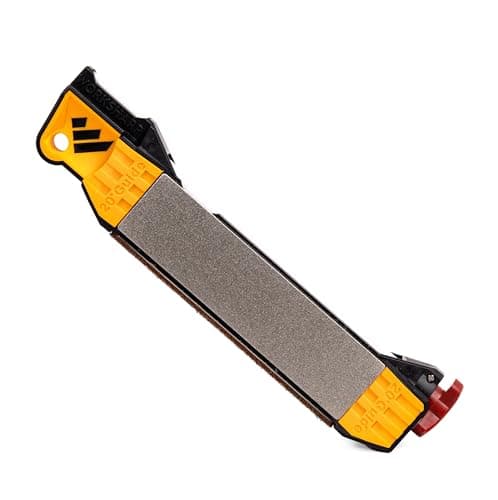
- 1Work Sharp Guided Field SharpenerIf you are buying one sharpener and you want it to be the right one, this is it. Work Sharp publishes four abrasive surfaces on the Guided Field Sharpener - coarse 220 and fine 600 grit diamond plates, a ceramic rod with a hook groove, a second ceramic rod for serrations and a leather strop - plus 20-degree and 25-degree angle guides and a broadhead wrench, in a package the company lists at 4.6 ounces. That is unusual: most tools can either rescue a blunt edge or refine a decent one, and this does both, in a pack pocket, in the woods. It is the Work Sharp philosophy at its clearest - the angle lives in the tool, the knife stays in your hand. Honest cons: it costs several times what a pocket pull-through does; the fixed 20 and 25-degree guides will not match every blade a hunter owns; and the leather strop needs compound and a little patience to do its job properly.Best for: Best overall, and the one to gift
- 2
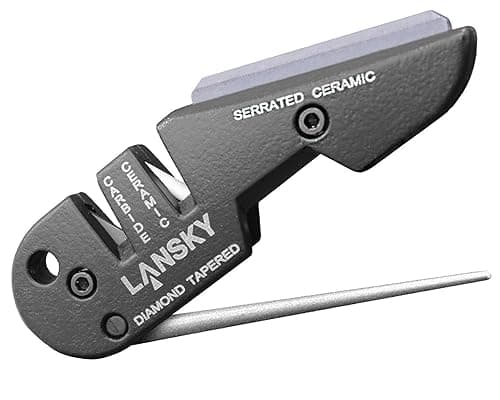 Lansky BladeMedic 4-in-1 Pocket SharpenerThe Lansky answer for the field, and the most useful emergency tool in this comparison. Lansky's published breakdown is tungsten carbide to set an edge on a badly dull blade in a few strokes, ceramic rods to polish it, a serrated-blade sharpener and a tapered diamond rod for reconditioning - and Lansky specifically calls that tapered rod out as suitable for gut hooks, which matters if the knife you are buying for has one. It is four inches of metal that lives in a pocket and turns a field-dressing job that is going badly into one that is going fine. Honest cons: carbide removes a lot of steel quickly, so this sets an edge rather than finishing one; it will not produce the polished edge a stone or strop will; and it is a fix, not a sharpening system.Best for: Best pocket rescue tool
 - 3
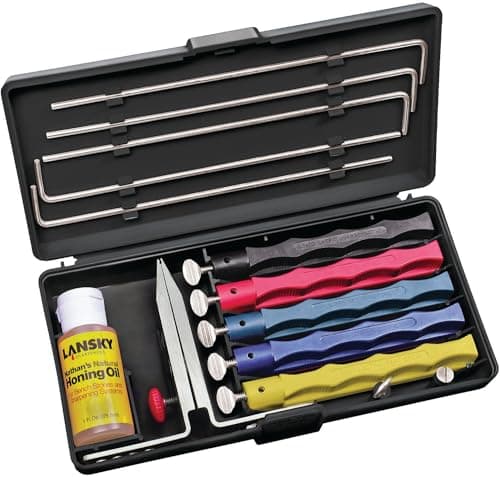 Lansky Deluxe 5-Stone Sharpening SystemThis is Lansky's philosophy in its purest form and the right gift for a hunter who has decided they ought to be able to sharpen a knife and keeps failing at it. The blade clamps into a guide with published settings at 17, 20, 25 and 30 degrees - Lansky recommends 25 degrees for hunting and outdoor knives - and the kit includes five hones from a 70-grit extra-coarse up to a 1000-grit ultra-fine ceramic, plus honing oil and a case. Because the jig holds the angle, the skill requirement essentially disappears: work through the stones in order and a neglected blade comes back genuinely sharp, repeatably. Honest cons: it is a bench tool and belongs on a table, not in a pack; a full progression takes real time; and clamping a knife by the spine does not suit every blade shape.Best for: Best for learning to sharpen properly
 - 4
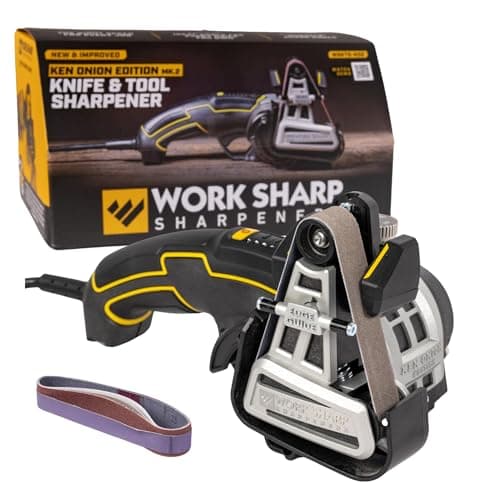 Work Sharp Ken Onion Knife & Tool SharpenerThe big-swing version of this gift and the right answer for a house with a drawer of blunt knives rather than one prized blade. Work Sharp publishes an adjustable guide from 15 to 30 degrees, a variable-speed motor and a set of five 3/4-inch by 12-inch belts from P120 extra-coarse to 6000 extra-fine, and lists it as sharpening hunting and pocket knives, kitchen knives, serrated blades, scissors, and axes and other tools. In an evening, everything in the kitchen and the camp hatchet all cut again. Honest cons: it costs more than most knives on this site; the belts are a consumable you keep buying; and a powered belt removes steel fast, which is unforgiving on a knife somebody cares about until you have practised on one they do not.Best for: Splurge, for a household of dull steel
| # | Gift | Best for | Price |
|---|---|---|---|
| 1 | Work Sharp Guided Field SharpenerIf you are buying one sharpener and you want it to be the right one, this is it. Work Sharp publishes four abrasive surfaces on the Guided Field Sharpener - coarse 220 and fine 600 grit diamond plates, a ceramic rod with a hook groove, a second ceramic rod for serrations and a leather strop - plus 20-degree and 25-degree angle guides and a broadhead wrench, in a package the company lists at 4.6 ounces. That is unusual: most tools can either rescue a blunt edge or refine a decent one, and this does both, in a pack pocket, in the woods. It is the Work Sharp philosophy at its clearest - the angle lives in the tool, the knife stays in your hand. Honest cons: it costs several times what a pocket pull-through does; the fixed 20 and 25-degree guides will not match every blade a hunter owns; and the leather strop needs compound and a little patience to do its job properly. | Best overall, and the one to gift | $39.95View on Amazon |
| 2 | Lansky BladeMedic 4-in-1 Pocket SharpenerThe Lansky answer for the field, and the most useful emergency tool in this comparison. Lansky's published breakdown is tungsten carbide to set an edge on a badly dull blade in a few strokes, ceramic rods to polish it, a serrated-blade sharpener and a tapered diamond rod for reconditioning - and Lansky specifically calls that tapered rod out as suitable for gut hooks, which matters if the knife you are buying for has one. It is four inches of metal that lives in a pocket and turns a field-dressing job that is going badly into one that is going fine. Honest cons: carbide removes a lot of steel quickly, so this sets an edge rather than finishing one; it will not produce the polished edge a stone or strop will; and it is a fix, not a sharpening system. | Best pocket rescue tool | $16.37View on Amazon |
| 3 | Lansky Deluxe 5-Stone Sharpening SystemThis is Lansky's philosophy in its purest form and the right gift for a hunter who has decided they ought to be able to sharpen a knife and keeps failing at it. The blade clamps into a guide with published settings at 17, 20, 25 and 30 degrees - Lansky recommends 25 degrees for hunting and outdoor knives - and the kit includes five hones from a 70-grit extra-coarse up to a 1000-grit ultra-fine ceramic, plus honing oil and a case. Because the jig holds the angle, the skill requirement essentially disappears: work through the stones in order and a neglected blade comes back genuinely sharp, repeatably. Honest cons: it is a bench tool and belongs on a table, not in a pack; a full progression takes real time; and clamping a knife by the spine does not suit every blade shape. | Best for learning to sharpen properly | $44.93View on Amazon |
| 4 | Work Sharp Ken Onion Knife & Tool SharpenerThe big-swing version of this gift and the right answer for a house with a drawer of blunt knives rather than one prized blade. Work Sharp publishes an adjustable guide from 15 to 30 degrees, a variable-speed motor and a set of five 3/4-inch by 12-inch belts from P120 extra-coarse to 6000 extra-fine, and lists it as sharpening hunting and pocket knives, kitchen knives, serrated blades, scissors, and axes and other tools. In an evening, everything in the kitchen and the camp hatchet all cut again. Honest cons: it costs more than most knives on this site; the belts are a consumable you keep buying; and a powered belt removes steel fast, which is unforgiving on a knife somebody cares about until you have practised on one they do not. | Splurge, for a household of dull steel | $169.95View on Amazon |
Prices from Amazon as of Sep 17, 2026 and change often — the button always opens the current listing. Some links earn us a commission at no extra cost to you.
Work Sharp Guided Field Sharpener
If you are buying one sharpener and you want it to be the right one, this is it. Work Sharp publishes four abrasive surfaces on the Guided Field Sharpener - coarse 220 and fine 600 grit diamond plates, a ceramic rod with a hook groove, a second ceramic rod for serrations and a leather strop - plus 20-degree and 25-degree angle guides and a broadhead wrench, in a package the company lists at 4.6 ounces. That is unusual: most tools can either rescue a blunt edge or refine a decent one, and this does both, in a pack pocket, in the woods. It is the Work Sharp philosophy at its clearest - the angle lives in the tool, the knife stays in your hand. Honest cons: it costs several times what a pocket pull-through does; the fixed 20 and 25-degree guides will not match every blade a hunter owns; and the leather strop needs compound and a little patience to do its job properly.
#ad · Price as of Sep 17, 2026. We may earn a commission.
Lansky BladeMedic 4-in-1 Pocket Sharpener
The Lansky answer for the field, and the most useful emergency tool in this comparison. Lansky's published breakdown is tungsten carbide to set an edge on a badly dull blade in a few strokes, ceramic rods to polish it, a serrated-blade sharpener and a tapered diamond rod for reconditioning - and Lansky specifically calls that tapered rod out as suitable for gut hooks, which matters if the knife you are buying for has one. It is four inches of metal that lives in a pocket and turns a field-dressing job that is going badly into one that is going fine. Honest cons: carbide removes a lot of steel quickly, so this sets an edge rather than finishing one; it will not produce the polished edge a stone or strop will; and it is a fix, not a sharpening system.
#ad · Price as of Sep 17, 2026. We may earn a commission.
Lansky Deluxe 5-Stone Sharpening System
This is Lansky's philosophy in its purest form and the right gift for a hunter who has decided they ought to be able to sharpen a knife and keeps failing at it. The blade clamps into a guide with published settings at 17, 20, 25 and 30 degrees - Lansky recommends 25 degrees for hunting and outdoor knives - and the kit includes five hones from a 70-grit extra-coarse up to a 1000-grit ultra-fine ceramic, plus honing oil and a case. Because the jig holds the angle, the skill requirement essentially disappears: work through the stones in order and a neglected blade comes back genuinely sharp, repeatably. Honest cons: it is a bench tool and belongs on a table, not in a pack; a full progression takes real time; and clamping a knife by the spine does not suit every blade shape.
#ad · Price as of Sep 17, 2026. We may earn a commission.
Work Sharp Ken Onion Knife & Tool Sharpener
The big-swing version of this gift and the right answer for a house with a drawer of blunt knives rather than one prized blade. Work Sharp publishes an adjustable guide from 15 to 30 degrees, a variable-speed motor and a set of five 3/4-inch by 12-inch belts from P120 extra-coarse to 6000 extra-fine, and lists it as sharpening hunting and pocket knives, kitchen knives, serrated blades, scissors, and axes and other tools. In an evening, everything in the kitchen and the camp hatchet all cut again. Honest cons: it costs more than most knives on this site; the belts are a consumable you keep buying; and a powered belt removes steel fast, which is unforgiving on a knife somebody cares about until you have practised on one they do not.
#ad · Price as of Sep 17, 2026. We may earn a commission.
The short answer
Buy Work Sharp if the sharpener has to travel, or if there is a lot of steel to get through. Buy Lansky if the goal is one knife, sharpened properly, at a bench. For a gift where you do not know which of those describes the recipient, the Work Sharp Guided Field Sharpener is the safest single purchase on this page, because it works in a pack and at a kitchen table and it both repairs and refines.
How the two systems actually differ
| Work Sharp | Lansky | |
|---|---|---|
| What holds the angle | The tool — moulded guides, or a powered belt with an adjustable stop | A clamp on the knife itself, with the hone running on a fixed rod |
| Where you use it | Field tools live in a pack; the powered unit lives on a bench | Pocket tool in a pocket; the clamped system on a bench |
| Skill required | Low — you drag the blade through a guide | Very low once clamped, but setup takes a few minutes |
| Angle options | Fixed 20° and 25° on the field tool; 15°–30° adjustable on the powered unit | Published 17°, 20°, 25° and 30° settings on the clamped system |
| Speed | Fast, and very fast on the powered belt | Deliberate — a full stone progression takes time |
| Best at | One tool that both repairs and refines; volume | A repeatable, precise bevel on a single knife |
Why the angle is the whole argument
It is worth understanding what both companies are selling, because it explains why either approach beats a plain stone for most people.
A knife edge is two flat bevels meeting in a line. Sharpening means grinding those bevels back until they meet cleanly again. If the angle wobbles between strokes — twenty degrees, then twenty-five, then eighteen — you grind a convex curve instead of a flat bevel, and a curve has no fine meeting line. That is the mechanism behind "I sharpened it and it got worse", and it is why freehand sharpening takes genuine practice.
Lansky removes the variable by fixing the knife in space. Work Sharp removes it by fixing the abrasive. Either way, the person doing the work stops being the source of error, which is the entire value proposition for a hunter who sharpens a knife twice a year. The full technique walkthrough is in how to sharpen a hunting knife.
Which one for which person
They hunt away from home — public land, a lease, backcountry. Work Sharp Guided Field Sharpener. It is the only pick here that repairs a genuinely dull blade and finishes it, in a pack, without a bench.
They already own a knife and it stopped cutting two seasons ago. Lansky BladeMedic, or the Work Sharp field tool if the budget allows. Either brings it back.
They want to learn, and have tried and failed. Lansky Deluxe 5-Stone. The clamp is the teacher.
They process their own game and there is a lot of steel involved. Ken Onion edition. It is the one that handles volume.
They use a replaceable-blade knife.None of the above — they do not sharpen anything. Buy spare blades, or see Gerber Vital vs Havalon Piranta for that whole category.
How we chose these
We do not run a test lab and we do not pretend to. Every grit figure, angle setting and component list on this page is the manufacturer's own published specification, cited in the sources below, and the comparison is built around what each design does rather than around an invented bake-off. Our method is on the how we choose page, and prices are pulled live from Amazon and stamped with the date they were captured.
Keep browsing
For the full category including the cheap pocket options, best hunting knife sharpeners ranks everything we would recommend. If you are still choosing the knife itself, best hunting knives and best hunting knives under $50 are the two places to start, and how to choose a hunting knife explains blade shapes and steels without the jargon.
Frequently asked questions
Is Work Sharp better than Lansky?
Neither is better - they solve the same problem differently. Work Sharp builds the angle into the tool, so the knife stays in your hand and the sharpener travels well. Lansky clamps the knife and runs the hone on a fixed rod, which is more precise and repeatable but belongs on a bench. Buy Work Sharp for the field and for volume, Lansky for one knife done properly.
Which Work Sharp should I buy for hunting knives?
The Guided Field Sharpener. Work Sharp publishes four abrasive surfaces on it - 220 and 600 grit diamond plates, two ceramic rods and a leather strop - plus 20 and 25-degree guides and a broadhead wrench at a listed 4.6 ounces, which means it can both rescue a blunt blade and refine a decent one from inside a pack pocket. The powered Ken Onion edition is the answer only if there is a lot of steel to get through.
What angle should a hunting knife be sharpened at?
Around 25 degrees per side is the usual recommendation for hunting and outdoor knives, and it is the figure Lansky publishes for them. A slightly coarser, more toothy edge at that angle cuts hide and hair better and lasts longer than a highly polished shallow edge, so a hunting knife does not want the finest grit in the box.
Is a clamp sharpening system worth it?
For someone who wants to learn and keeps failing, yes. Almost every sharpening failure comes from the angle wobbling between strokes, which grinds a rounded edge instead of a flat bevel. A clamp removes that variable entirely, so the result is repeatable without any skill in your hands. The trade is setup time and a bench to do it on.
Do carbide pull-through sharpeners damage knives?
They remove steel quickly and aggressively, which is why they are the right tool for setting an edge on a badly dull blade and the wrong one for maintaining a knife somebody cares about. Use carbide to rescue, ceramic or a stone to finish. For an expensive blade, skip the carbide stage entirely.
Is a knife sharpener a good gift for a hunter?
One of the best on this site. Nearly every hunter owns a knife and very few own a sharpener that works, which is why so many hunting knives will not cut by their third season. It also pairs perfectly with a knife, so a blade plus a sharpener makes a complete gift for less than the cost of one mid-range knife.
Sources
- Work Sharp - Guided Field Sharpener: published abrasive stages, 20 and 25-degree guides, broadhead wrench and 4.6 oz listed weight
- Work Sharp - Ken Onion Edition knife & tool sharpener: published 15-30 degree adjustable guide, variable speed, five belts P120 to 6000
- Lansky - BladeMedic four-in-one: carbide, ceramic, serrated-blade and tapered diamond rod (listed as suitable for gut hooks)
- Lansky - Deluxe 5-Stone system: published 17/20/25/30-degree clamp settings and five hones, with 25 degrees recommended for hunting knives