Gear Guides
How to Sharpen a Hunting Knife (Plain-English Guide)
A dull knife is the most common complaint hunters have about a gift. Here's how to keep any hunting knife keen and safe — explained the way you'd explain it to a friend, no special skills required.
Here's a little secret about hunting knives: the fanciest blade in the world is useless if it's dull, and a dull edge is the single most common complaint hunters have about a gift. The good news is that keeping a knife sharp is far easier than most people think — you don't need years of practice or a bench full of stones. With the right pocket tool and a couple of simple ideas, anyone can keep a hunting knife keen enough to do clean, safe work.
This guide walks through it in plain English: why a sharp knife actually matters (including the safety part that surprises people), the one idea about angle that makes everything click, how a guided pocket sharpener does the hard part for you, the difference between honing and sharpening, the knives that skip sharpening entirely, and the handful of mistakes worth avoiding. Whether you're a hunter yourself or a gift-giver who wants to include the tool that makes a knife truly complete, you'll leave knowing exactly what to do.
Why a sharp knife matters (yes, for safety)
It sounds backward, but a sharp knife is a safer knife than a dull one. A keen edge bites where you place it and cuts with light, controlled pressure, so the blade goes where you intend. A dull edge, on the other hand, skates and slips, and it tempts you to push harder — and a knife that suddenly slips under heavy force is exactly how people get hurt. For a hunter, sharpness also means cleaner, faster work: field dressing and skinning go smoothly, the cuts are neat, and the meat stays in better shape. So keeping an edge isn't fussiness or vanity — it's the difference between a knife that works with the hunter and one that fights them. If the person you're shopping for has a knife they love, keeping it sharp is the kindest thing you can help them do for it.
The one idea that makes sharpening click: angle
If sharpening has ever felt like a dark art, it's almost always because of one thing: angle. Sharpening simply means grinding the very edge of the blade against something abrasive until it comes back to a fine point — and the secret is holding the blade at a consistentangle against that abrasive the whole time. Hold it too steep or let the angle wander, and you round the edge off instead of sharpening it. That's the entire reason freehand sharpening on a stone takes practice: you're trying to keep a steady angle by feel.
Here's the liberating part — you don't have to. Modern guided sharpenershold the correct angle for you, which removes the only genuinely hard part of the job. That's why, for a hunter or a gift-giver who isn't a sharpening hobbyist, a guided pocket sharpener is the confident choice: it turns a skill into a two-minute chore. If you want the wider context on choosing knives and their upkeep, our how to choose a hunting knife guide covers steel and edges in plain terms.
Using a guided pocket sharpener, step by step
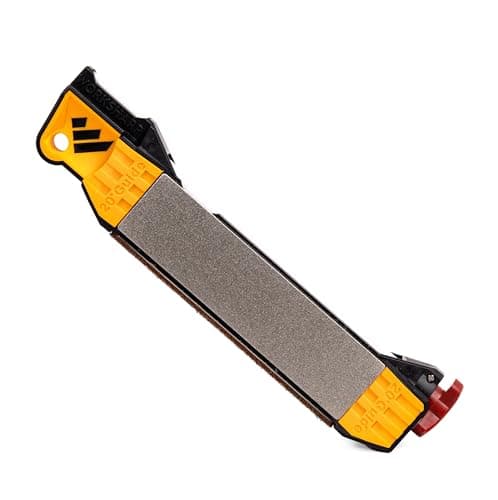
A guided field sharpener like the Work Sharp Guided Field Sharpener packs everything into a pocket-size tool: coarse and fine sharpening surfaces set at preset angles, usually a ceramic rod for finishing, and often a small honing surface too. You don't have to judge the angle — the tool does it. The routine is short and forgiving:
First, if the edge is quite dull, run the blade through or along the coarse surface a handful of times per side, using light, even strokes and letting the guide set the angle. Then switch to the fine surface and repeat with a few more light strokes per side to refine the edge. Finish on the ceramic rod or honewith a few gentle passes to polish the edge and align it. Keep the pressure light throughout — sharpening is about consistency, not muscle — and alternate sides evenly so the edge stays centered. A quick test: the blade should slice through a piece of paper cleanly, or "bite" when you rest it lightly on a fingernail. That's it. Once the edge is set, most maintenance is just a few finishing strokes now and then, not a full sharpening.
Honing vs. sharpening: what's the difference?
People use these words interchangeably, but they're two different things, and knowing which you need saves a lot of effort.
| Sharpening | Honing | |
|---|---|---|
| What it does | Removes a little metal to grind a new, keen edge | Straightens and realigns an edge that's rolled over slightly |
| When you need it | When the blade is genuinely dull and won't bite | For quick touch-ups to keep a sharp edge performing |
| How often | Occasionally — a few times a season with normal use | Often — even during a job, as a fast refresh |
The practical takeaway: you sharpen now and then to restore a dull edge, and you honefrequently to keep a sharp edge at its best between sharpenings. A good guided field sharpener handles both, which is exactly why it's such a useful all-in-one tool to own or to give.
The knives that skip sharpening entirely
Worth knowing before you fret over sharpening technique: some hunting knives are designed so you never sharpen them at all. Replaceable-blade knivestake a snap-in surgical blade, and when it dulls you simply pop in a fresh one and you're instantly back to scalpel-sharp. They're especially popular for skinning and processing game, where a perfect edge matters most — you can read more in our best hunting knives roundup, which covers both traditional and replaceable-blade styles.
That doesn't make sharpening skills pointless, though. Most hunters still own at least one traditional fixed blade or folder — a Buck, a Morakniv, an heirloom knife — and those keep their edge only if someone sharpens them. So the two approaches happily coexist: a replaceable-blade knife for fuss-free field work, and a sharpener for the classic knives worth maintaining.
Common mistakes to avoid
A few easy-to-avoid missteps trip people up more than anything about technique. Steer clear of these and you're most of the way there.
What we like
- Use a guided sharpener so the angle stays consistent for you
- Keep the pressure light and let the abrasive do the work
- Alternate sides evenly to keep the edge centered
- Finish with a few honing strokes, then wipe the blade clean and dry
Worth knowing
- Pressing too hard — it rounds the edge instead of sharpening it
- Letting the angle wander on a freehand stone before you've got the feel
- Waiting until a blade is bone-dull, which makes the job much longer
- Storing a knife wet — moisture dulls and pits an edge over time
None of this is complicated once you've done it once. The biggest favor you can do a hunting knife is simply notletting it get badly dull in the first place — a quick touch-up now and then keeps it effortlessly sharp, and a guided tool makes that a two-minute habit rather than a project.
Two brand names come up more than any others once you start looking, and they disagree about something fundamental: Work Sharp vs Lansky explains it. Work Sharp builds the angle into the tool so the knife stays in your hand and the sharpener travels; Lansky clamps the knife so the angle physically cannot wander, which is the more precise answer and belongs on a bench. Either removes the one variable — you — that causes almost every sharpening failure described above.
Frequently asked questions
How do I sharpen a hunting knife if I've never done it?
Use a guided pocket sharpener, which holds the correct angle for you — the only genuinely hard part of sharpening. Run the blade a few light strokes on the coarse surface if it's dull, then the fine surface, then finish on the ceramic rod, keeping the pressure light and alternating sides. Test it by slicing paper cleanly.
What angle should I sharpen a hunting knife at?
Most hunting knives do well in the rough range of a moderate edge angle, but the practical answer for most people is to let a guided sharpener set the angle for you. Consistency matters far more than the exact number — a steady, repeatable angle is what actually produces a keen edge.
What's the difference between honing and sharpening?
Sharpening removes a little metal to grind a new edge on a dull blade and is done occasionally. Honing straightens and realigns an edge that has rolled over slightly, and is done often as a quick touch-up. You sharpen to restore a dull knife and hone to keep a sharp one performing between sharpenings.
Is a sharp knife really safer than a dull one?
Yes. A sharp edge bites where you place it and cuts with light, controlled pressure, so the blade goes where you intend. A dull edge skates and tempts you to push harder, and a knife that slips under heavy force is a common way people get hurt. Keeping an edge is a safety habit, not just performance.
Do replaceable-blade knives need sharpening?
No. Replaceable-blade knives take a snap-in surgical blade, and when it dulls you swap in a fresh one instead of sharpening — you're instantly back to scalpel-sharp. They're popular for skinning and processing game. Traditional fixed blades and folders, however, still need occasional sharpening to keep their edge.