Gear Guides
The Best Knife Sharpeners for Hunting Knives
Almost every hunter owns a knife they like and no honest way to keep it sharp. A sharpener is the cheapest gift on this site that fixes a problem they actually have - here are the ones worth giving, and the one detail to check before you buy.
A hunting knife is the most-given gift in this entire category, which means an enormous number of hunters own a good blade and a drawer full of ones that have gone blunt. Sharpening is the unglamorous half of owning a knife, and it's the half most people skip — partly because nobody taught them, and partly because the tool that would make it easy costs less than a tank of fuel and never occurs to anyone as a present.
That's exactly what makes a sharpener such a good gift. It's cheap, it has no sizing problem, no fit problem and no taste problem, and it makes the knife they already love work properly again. This guide ranks the sharpeners worth giving — from a palm-size stone that costs about as much as lunch up to a powered belt machine for someone with a lot of dull steel — explains the sharpening-angle detail that decides whether the gift lands, and shows a live price on each.
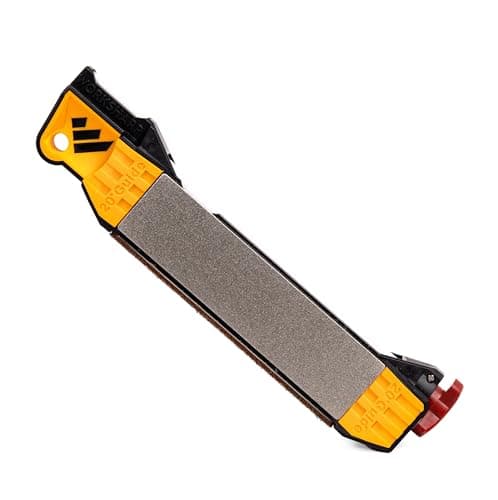
- 1Work Sharp Guided Field SharpenerThe one to buy if you're buying one. Work Sharp publishes four abrasive surfaces on this tool - coarse 220 and fine 600 grit diamond plates, a ceramic rod with a hook groove, a second ceramic rod for serrations, and a leather strop - plus 20-degree and 25-degree angle guides and a broadhead wrench, in a package the company lists at 4.6 ounces. That combination means it can take a genuinely blunt knife back to sharp AND put a polished finish on it, in a pack pocket, in the woods, which almost nothing else here does. Honest cons: it costs several times what the pocket tools below do, the fixed 20-degree and 25-degree guides won't match every blade a hunter owns, and the leather strop is the one step that rewards practice rather than working perfectly the first time.Best for: Best overall
- 2
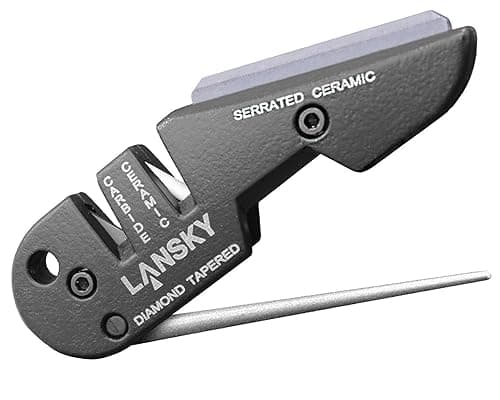 Lansky BladeMedic 4-in-1 Pocket SharpenerFour sharpeners in a four-inch metal body, and the most useful emergency tool on this page. Lansky's published breakdown is tungsten carbide to set an edge on a badly dull blade in a few strokes, ceramic rods to polish it, a serrated-blade sharpener, and a tapered diamond rod for reconditioning - and Lansky specifically calls that tapered rod out as good for gut hooks, which is the part that matters if you're buying for someone whose knife has one. It lives in a pocket and it rescues a field-dressing job that's going badly. Honest cons: carbide takes off a lot of steel fast, so this is a fix-it tool rather than a finishing tool, it won't give the polished edge a stone or strop will, and be aware that Amazon's own listing title misspells the brand as "Lanksy" - it is the genuine Lansky PS-MED01.Best for: Best pocket fix
 - 3
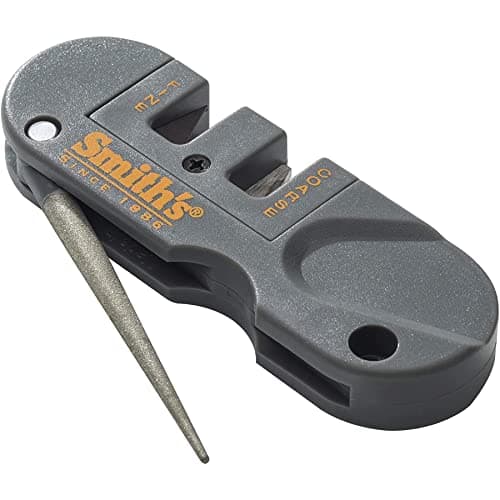 Smith's PP1 Pocket Pal Knife SharpenerThe cheapest thing on this page that a hunter will genuinely keep. Smith's lists it at 3.5 inches long, an inch wide and about an ounce, with pre-set carbide and ceramic pull-through slots so the angle is decided for you, plus a fold-out tapered diamond rod for serrations and hooks; the carbides and ceramics are reversible and replaceable when they wear. There is no learning curve at all - you pull the blade through a few times and it cuts again, which is the entire point for someone who has never sharpened anything. Honest cons: pull-through carbide scrapes metal away rather than grinding a precise bevel, so it leaves a rougher edge than a stone and it is not what you want used on an expensive knife. Treat it as a maintenance tool and a great add-on, not the main present.Best for: Best stocking stuffer
 - 4
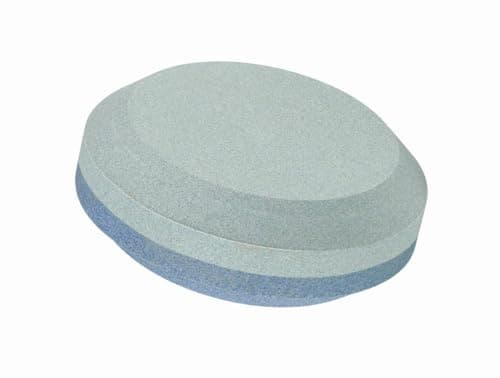 Lansky Puck Dual-Grit Tool SharpenerThe pick nobody thinks of and plenty of hunters need. It's a round, palm-size dual-grit stone - Lansky publishes a coarse 120-grit side and a medium 280-grit side in a three-inch puck - shaped so you can hold it safely against a wide edge. That makes it the tool for everything a knife sharpener physically cannot reach: a hatchet, a machete for cutting shooting lanes, a shovel, a set of mower blades. If the person you're buying for has a camp axe that hasn't been touched in five years, this is a startlingly good gift for the money. Honest cons: it is deliberately coarse, so it is not the way to finish a hunting knife, it does nothing for serrations, and it's a bare stone rather than a gadget, which makes it a weak gift on its own - pair it with something.Best for: Axes and tools
 - 5
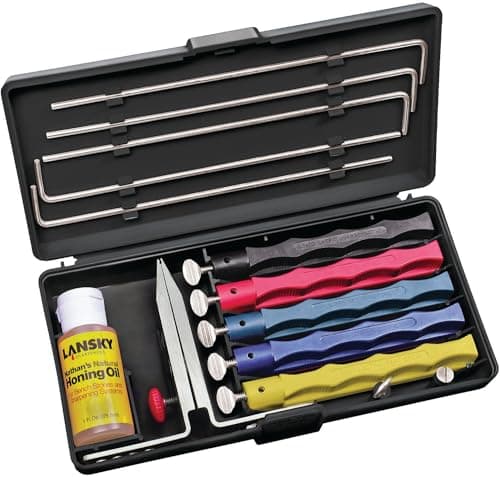 Lansky Deluxe 5-Stone Sharpening SystemThis is the gift for a hunter who has decided they should be able to sharpen properly and keeps failing at it, because it removes the thing everyone gets wrong: holding a consistent angle. The knife clamps into a guide with published settings at 17, 20, 25 and 30 degrees - Lansky recommends 25 degrees for hunting and outdoor knives - and the kit includes five hones running from a 70-grit extra-coarse up to a 1000-grit ultra-fine ceramic, plus honing oil and a case. Work through them in order and a neglected blade comes back genuinely sharp, repeatably, without any skill in your hands. Honest cons: it is a bench tool, not a field tool, setup and a full progression take real time, and the clamp is happiest on ordinary blade shapes - very short, very long or heavily curved blades are more awkward than the box suggests.Best for: Best for learning
 - 6
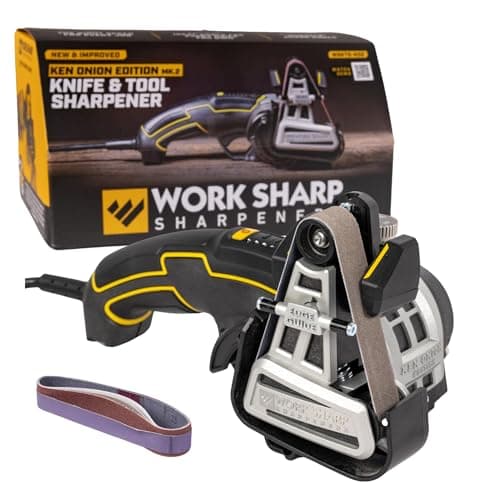 Work Sharp Ken Onion Knife & Tool SharpenerThe big-swing version of this gift, and the right answer for a household with a lot of dull steel rather than one prized knife. Work Sharp publishes an adjustable guide from 15 to 30 degrees, a variable-speed motor, and a set of five 3/4-inch by 12-inch belts from P120 extra-coarse to 6000 extra-fine, and lists it as sharpening hunting and pocket knives, kitchen knives, serrated blades, scissors, and axes and other tools. In practice that means a drawer of blunt knives, the camp hatchet and the kitchen set all come back sharp in one evening. Honest cons: it costs more than most of the knives on this site, the belts are consumables you'll keep buying, and a powered belt removes steel quickly and unforgivingly - a careless first session can round a tip or overheat a thin blade. Give it to someone who will read the guide, not someone who won't.Best for: Splurge
| # | Gift | Best for | Price |
|---|---|---|---|
| 1 | Work Sharp Guided Field SharpenerThe one to buy if you're buying one. Work Sharp publishes four abrasive surfaces on this tool - coarse 220 and fine 600 grit diamond plates, a ceramic rod with a hook groove, a second ceramic rod for serrations, and a leather strop - plus 20-degree and 25-degree angle guides and a broadhead wrench, in a package the company lists at 4.6 ounces. That combination means it can take a genuinely blunt knife back to sharp AND put a polished finish on it, in a pack pocket, in the woods, which almost nothing else here does. Honest cons: it costs several times what the pocket tools below do, the fixed 20-degree and 25-degree guides won't match every blade a hunter owns, and the leather strop is the one step that rewards practice rather than working perfectly the first time. | Best overall | $39.95View on Amazon |
| 2 | Lansky BladeMedic 4-in-1 Pocket SharpenerFour sharpeners in a four-inch metal body, and the most useful emergency tool on this page. Lansky's published breakdown is tungsten carbide to set an edge on a badly dull blade in a few strokes, ceramic rods to polish it, a serrated-blade sharpener, and a tapered diamond rod for reconditioning - and Lansky specifically calls that tapered rod out as good for gut hooks, which is the part that matters if you're buying for someone whose knife has one. It lives in a pocket and it rescues a field-dressing job that's going badly. Honest cons: carbide takes off a lot of steel fast, so this is a fix-it tool rather than a finishing tool, it won't give the polished edge a stone or strop will, and be aware that Amazon's own listing title misspells the brand as "Lanksy" - it is the genuine Lansky PS-MED01. | Best pocket fix | $16.38View on Amazon |
| 3 | Smith's PP1 Pocket Pal Knife SharpenerThe cheapest thing on this page that a hunter will genuinely keep. Smith's lists it at 3.5 inches long, an inch wide and about an ounce, with pre-set carbide and ceramic pull-through slots so the angle is decided for you, plus a fold-out tapered diamond rod for serrations and hooks; the carbides and ceramics are reversible and replaceable when they wear. There is no learning curve at all - you pull the blade through a few times and it cuts again, which is the entire point for someone who has never sharpened anything. Honest cons: pull-through carbide scrapes metal away rather than grinding a precise bevel, so it leaves a rougher edge than a stone and it is not what you want used on an expensive knife. Treat it as a maintenance tool and a great add-on, not the main present. | Best stocking stuffer | $14.20View on Amazon |
| 4 | Lansky Puck Dual-Grit Tool SharpenerThe pick nobody thinks of and plenty of hunters need. It's a round, palm-size dual-grit stone - Lansky publishes a coarse 120-grit side and a medium 280-grit side in a three-inch puck - shaped so you can hold it safely against a wide edge. That makes it the tool for everything a knife sharpener physically cannot reach: a hatchet, a machete for cutting shooting lanes, a shovel, a set of mower blades. If the person you're buying for has a camp axe that hasn't been touched in five years, this is a startlingly good gift for the money. Honest cons: it is deliberately coarse, so it is not the way to finish a hunting knife, it does nothing for serrations, and it's a bare stone rather than a gadget, which makes it a weak gift on its own - pair it with something. | Axes and tools | $12.85View on Amazon |
| 5 | Lansky Deluxe 5-Stone Sharpening SystemThis is the gift for a hunter who has decided they should be able to sharpen properly and keeps failing at it, because it removes the thing everyone gets wrong: holding a consistent angle. The knife clamps into a guide with published settings at 17, 20, 25 and 30 degrees - Lansky recommends 25 degrees for hunting and outdoor knives - and the kit includes five hones running from a 70-grit extra-coarse up to a 1000-grit ultra-fine ceramic, plus honing oil and a case. Work through them in order and a neglected blade comes back genuinely sharp, repeatably, without any skill in your hands. Honest cons: it is a bench tool, not a field tool, setup and a full progression take real time, and the clamp is happiest on ordinary blade shapes - very short, very long or heavily curved blades are more awkward than the box suggests. | Best for learning | $45.57View on Amazon |
| 6 | Work Sharp Ken Onion Knife & Tool SharpenerThe big-swing version of this gift, and the right answer for a household with a lot of dull steel rather than one prized knife. Work Sharp publishes an adjustable guide from 15 to 30 degrees, a variable-speed motor, and a set of five 3/4-inch by 12-inch belts from P120 extra-coarse to 6000 extra-fine, and lists it as sharpening hunting and pocket knives, kitchen knives, serrated blades, scissors, and axes and other tools. In practice that means a drawer of blunt knives, the camp hatchet and the kitchen set all come back sharp in one evening. Honest cons: it costs more than most of the knives on this site, the belts are consumables you'll keep buying, and a powered belt removes steel quickly and unforgivingly - a careless first session can round a tip or overheat a thin blade. Give it to someone who will read the guide, not someone who won't. | Splurge | $179.95View on Amazon |
Prices from Amazon as of October 24, 2026 and change often — the button always opens the current listing. Some links earn us a commission at no extra cost to you.
Work Sharp Guided Field Sharpener
The one to buy if you're buying one. Work Sharp publishes four abrasive surfaces on this tool - coarse 220 and fine 600 grit diamond plates, a ceramic rod with a hook groove, a second ceramic rod for serrations, and a leather strop - plus 20-degree and 25-degree angle guides and a broadhead wrench, in a package the company lists at 4.6 ounces. That combination means it can take a genuinely blunt knife back to sharp AND put a polished finish on it, in a pack pocket, in the woods, which almost nothing else here does. Honest cons: it costs several times what the pocket tools below do, the fixed 20-degree and 25-degree guides won't match every blade a hunter owns, and the leather strop is the one step that rewards practice rather than working perfectly the first time.
#ad · Price as of October 24, 2026. We may earn a commission.
Lansky BladeMedic 4-in-1 Pocket Sharpener
Four sharpeners in a four-inch metal body, and the most useful emergency tool on this page. Lansky's published breakdown is tungsten carbide to set an edge on a badly dull blade in a few strokes, ceramic rods to polish it, a serrated-blade sharpener, and a tapered diamond rod for reconditioning - and Lansky specifically calls that tapered rod out as good for gut hooks, which is the part that matters if you're buying for someone whose knife has one. It lives in a pocket and it rescues a field-dressing job that's going badly. Honest cons: carbide takes off a lot of steel fast, so this is a fix-it tool rather than a finishing tool, it won't give the polished edge a stone or strop will, and be aware that Amazon's own listing title misspells the brand as "Lanksy" - it is the genuine Lansky PS-MED01.
#ad · Price as of October 24, 2026. We may earn a commission.
Smith's PP1 Pocket Pal Knife Sharpener
The cheapest thing on this page that a hunter will genuinely keep. Smith's lists it at 3.5 inches long, an inch wide and about an ounce, with pre-set carbide and ceramic pull-through slots so the angle is decided for you, plus a fold-out tapered diamond rod for serrations and hooks; the carbides and ceramics are reversible and replaceable when they wear. There is no learning curve at all - you pull the blade through a few times and it cuts again, which is the entire point for someone who has never sharpened anything. Honest cons: pull-through carbide scrapes metal away rather than grinding a precise bevel, so it leaves a rougher edge than a stone and it is not what you want used on an expensive knife. Treat it as a maintenance tool and a great add-on, not the main present.
#ad · Price as of October 24, 2026. We may earn a commission.
Lansky Puck Dual-Grit Tool Sharpener
The pick nobody thinks of and plenty of hunters need. It's a round, palm-size dual-grit stone - Lansky publishes a coarse 120-grit side and a medium 280-grit side in a three-inch puck - shaped so you can hold it safely against a wide edge. That makes it the tool for everything a knife sharpener physically cannot reach: a hatchet, a machete for cutting shooting lanes, a shovel, a set of mower blades. If the person you're buying for has a camp axe that hasn't been touched in five years, this is a startlingly good gift for the money. Honest cons: it is deliberately coarse, so it is not the way to finish a hunting knife, it does nothing for serrations, and it's a bare stone rather than a gadget, which makes it a weak gift on its own - pair it with something.
#ad · Price as of October 24, 2026. We may earn a commission.
Lansky Deluxe 5-Stone Sharpening System
This is the gift for a hunter who has decided they should be able to sharpen properly and keeps failing at it, because it removes the thing everyone gets wrong: holding a consistent angle. The knife clamps into a guide with published settings at 17, 20, 25 and 30 degrees - Lansky recommends 25 degrees for hunting and outdoor knives - and the kit includes five hones running from a 70-grit extra-coarse up to a 1000-grit ultra-fine ceramic, plus honing oil and a case. Work through them in order and a neglected blade comes back genuinely sharp, repeatably, without any skill in your hands. Honest cons: it is a bench tool, not a field tool, setup and a full progression take real time, and the clamp is happiest on ordinary blade shapes - very short, very long or heavily curved blades are more awkward than the box suggests.
#ad · Price as of October 24, 2026. We may earn a commission.
Work Sharp Ken Onion Knife & Tool Sharpener
The big-swing version of this gift, and the right answer for a household with a lot of dull steel rather than one prized knife. Work Sharp publishes an adjustable guide from 15 to 30 degrees, a variable-speed motor, and a set of five 3/4-inch by 12-inch belts from P120 extra-coarse to 6000 extra-fine, and lists it as sharpening hunting and pocket knives, kitchen knives, serrated blades, scissors, and axes and other tools. In practice that means a drawer of blunt knives, the camp hatchet and the kitchen set all come back sharp in one evening. Honest cons: it costs more than most of the knives on this site, the belts are consumables you'll keep buying, and a powered belt removes steel quickly and unforgivingly - a careless first session can round a tip or overheat a thin blade. Give it to someone who will read the guide, not someone who won't.
#ad · Price as of October 24, 2026. We may earn a commission.
How we chose these
We don't run an edge-testing lab and we're not going to pretend otherwise. These picks come from each maker's published specifications — abrasives, grits, angle settings, sizes — combined with how well each tool suits a specific job a hunter actually has, and how sensible it is as a present rather than as a purchase. The full method is on our how we choose page, and every price here is pulled live rather than typed in by hand.
One honest note about the list: two brands, Lansky and Work Sharp, take five of the six places. That isn't a sponsorship — it's that this is a small, old category where a handful of companies have owned the useful ends of it for decades, and padding the list with a fifth-choice brand to look balanced would make it a worse guide.
Why a sharpener is a better gift than it sounds
A dull knife is not just slower. It's the reason field dressing turns into sawing, the reason a blade skids off a hide instead of biting, and — the part people find counterintuitive — it's more dangerous than a sharp one, because a blade that won't cut has to be forced, and a forced blade is the one that slips.
Ask around and you'll find most hunters know this and still don't own a real sharpener. They own a knife somebody gave them, and either a kitchen steel that only straightens an edge rather than cutting a new one, or nothing at all. So a sharpener is one of the very few inexpensive gifts that fixes an actual, recurring, slightly embarrassing problem in the recipient's life — which is a much better definition of a good present than "expensive."
The four kinds of sharpener, in plain English
Pull-through. A handle with V-shaped slots you drag the blade through. The angle is decided for you, so there is nothing to learn. Fast, cheap and genuinely useful for maintenance, but the carbide inserts scrape metal off rather than grinding a clean bevel, so the edge is rougher and the knife wears faster. Great as a spare or a stocking stuffer.
Rods and pocket tools. Small carbide, ceramic or diamond surfaces in a pocketable body. This is the field-repair category — the thing that lives in a pack and turns a knife that has stopped working back into one that works, halfway through a job. Diamond rods are also the only practical way to reach inside serrations and gut hooks.
Guided systems. A clamp holds the knife, a rod holds the stone, and the angle stays the same on every single stroke. This is what turns sharpening from a skill into a procedure, and it's the honest answer for the large number of people who have tried a bench stone and produced a duller knife than they started with.
Powered belt sharpeners. A motor drives a flexible abrasive belt past an angle guide. Enormously fast, capable of reprofiling an edge that a hand tool would take an hour on, and equally capable of ruining a good knife in about four seconds if you rush. Best for volume, and for someone who will actually read the instructions.
The angle rule — the one thing to check
The single number that matters in sharpening is the angle between the blade and the stone, and it's the detail that decides whether your gift gets used or shelved. Lansky publishes a clear guide with its clamp settings: 17 degrees for razors and scalpels, 20 degrees for kitchen cutlery and fillet knives, 25 degrees as the recommended angle for hunting and outdoor knives that need a durable edge, and 30 degrees for heavy-duty cutting.
The practical takeaway for a gift-buyer is simple. A hunting knife wants a sturdier, slightly wider angle than a kitchen knife, because it is levered, twisted and driven through hide, cartilage and the occasional bone — a delicate razor edge just folds over. So a sharpener that offers a hunting-appropriate angle, or a range that includes it, is the right gift; a sharpener locked to a fine kitchen angle is not. Every pick on this page either sets a hunting-suitable angle for you or lets you dial one in.
You do not need to know what angle their specific knife is ground at, and you shouldn't try to find out by asking — it ruins the surprise for no benefit. Any of these will work on a normal hunting knife.
What the grit numbers mean
Grit is just how coarse the abrasive is, and lower numbers are coarser. A 120-grit stone removes metal quickly and leaves a rough edge; a 1000-grit ceramic removes almost nothing and leaves a polished one. Sharpening properly means starting coarse enough to actually cut a new edge, then working finer to refine it.
That's why the kits on this page list several grits: the Lansky Deluxe set runs from a 70-grit extra-coarse hone up to a 1000-grit ultra-fine ceramic, and the Work Sharp Ken Onion belt set runs from P120 extra-coarse to 6000 extra-fine. It's also why the pocket tools are honest about being a fix rather than a finish — one carbide slot is a single, very coarse step with nothing after it.
For a gift you don't need to memorize any of this. Just know that more grit steps means a better final edge and more time spent, and one step means fast and rough. Both are legitimate; they suit different people. Our guide to sharpening a hunting knife walks through the actual sequence if the person you're buying for wants to learn it.
Match the sharpener to the hunter
They have never sharpened anything. Buy a pull-through or a pocket tool. Something with a preset angle and no technique requirement will get used; a bench stone will sit in a drawer being a quiet reproach. The Smith's Pocket Pal and the Lansky BladeMedic both fit here, and either makes a good add-on to a knife.
They sharpen, badly, and know it. This is the biggest group and the guided clamp system is the answer. It takes the one variable they keep getting wrong and removes it entirely, which is a much kinder gift than another stone they'll struggle with.
They sharpen well already. Don't buy them a system — they have opinions and probably better gear than you'd pick. Buy the field tool instead. Even hunters with a full bench setup at home carry something small in the pack, and the Work Sharp Guided Field Sharpener is a genuine upgrade on whatever most of them are carrying.
They hunt with an axe, a hatchet or a machete. Add the puck. It costs almost nothing and it covers the edges every other tool on this list is the wrong shape for.
What a sharpener won't fix
Two honest limits, because they save disappointment. First, a chipped, bent or badly damaged edge is a reprofiling job, not a sharpening job — a pocket tool will not rescue it, and even a guided system will take a long session with the coarsest hone. Second, a genuinely bad knife stays a bad knife. Soft steel that will not hold an edge sharpens easily and goes dull again immediately, and no sharpener changes that.
If the knife itself is the weak link, the sharpener is the wrong present. Start with our best hunting knives guide instead, or with the replaceable-blade options in best skinning knives — those swap in a fresh surgical edge rather than being sharpened at all, which suits some hunters far better.
Keep browsing
If you haven't settled on the knife yet, start with the best hunting knives roundup and add a sharpener to whichever one you choose. If you want to understand what you're buying before you commit, how to choose a hunting knife covers blade shapes and steel in plain language, and the hunting knife gift guide is the shortcut if you just want to be told what to buy.
Torn between the two brands that dominate this page? Work Sharp vs Lansky sets out the difference properly: Work Sharp builds the angle into the tool so the knife stays in your hand, Lansky clamps the knife so the angle cannot move. One travels, one is precise, and which you want depends entirely on the person opening the box.
Frequently asked questions
What is the best knife sharpener for hunting knives?
For most gift-buyers the Work Sharp Guided Field Sharpener is the best single answer: it carries coarse and fine diamond plates, ceramic rods for serrations, a leather strop and 20-degree and 25-degree angle guides in a pack-size tool, so it can both rescue a blunt blade and finish it properly. If the budget is tighter, a Lansky BladeMedic does the emergency job for a fraction of the price.
Is a knife sharpener a good gift for a hunter?
It's one of the best-value gifts you can give. Almost every hunter owns a knife and most don't own a proper sharpener, there's no size or fit to get wrong, and it fixes a recurring problem rather than adding another object. It works best paired with a knife, or given to someone whose knife you know they like.
What angle should a hunting knife be sharpened at?
Wider than a kitchen knife. Lansky's published guidance puts 25 degrees as the recommended angle for hunting and outdoor knives that need a durable edge, with 20 degrees suiting kitchen cutlery and fillet knives and 17 degrees reserved for razors and scalpels. A hunting edge is levered and twisted through hide and cartilage, so a slightly sturdier angle lasts longer than a fine one.
Are pull-through knife sharpeners bad for knives?
They're a trade-off rather than a disaster. Carbide pull-through slots scrape metal away instead of grinding a clean bevel, so they leave a rougher edge and wear the blade faster than a stone would. That's a fair price for a tool that needs no skill and costs very little - just use one for maintenance and everyday knives rather than on an expensive blade.
Do you need a special sharpener for serrated blades and gut hooks?
Yes, and it's the detail most cheap sharpeners miss. Flat stones can't reach inside a serration or around the inside curve of a gut hook - you need a tapered round rod that fits the curve. Lansky lists the BladeMedic's tapered diamond rod as suitable for gut hooks, the Smith's Pocket Pal folds out a diamond rod for the same job, and the Work Sharp field sharpener includes both a hook groove and a serration rod.
Can one sharpener handle both knives and an axe?
Not usually, because the shapes fight each other. A knife sharpener is built for a thin blade drawn along an edge, while an axe or machete needs a stone you can work across a wide, heavy bevel - which is exactly what the Lansky Puck's round dual-grit design is for. The powered Work Sharp Ken Onion is the one pick here that Work Sharp lists as covering both knives and axes.
Sources
- Work Sharp - Guided Field Sharpener published specifications (abrasives, 20/25-degree guides, 4.6 oz)
- Work Sharp - Ken Onion Edition Knife & Tool Sharpener specifications (15-30 degrees, belt grits)
- Lansky - BladeMedic 4-in-1 sharpener product page (carbide, ceramic, serrated, diamond rod)
- Lansky - The Puck dual-grit sharpener product page (120/280 grit, tools it suits)
- Lansky - Deluxe 5-Stone Sharpening System (LKCLX) hones and 17/20/25/30-degree clamp settings
- Smith's Consumer Products - Pocket Pal knife sharpener (carbide/ceramic slots, fold-out diamond rod, size)