Gear Guides
The Best Bino Harness Under $100
A harness is the cheapest upgrade in hunting optics and the one most hunters skip. Here are the four worth owning under a hundred dollars, what the premium models add, and the honest answer to whether you need to spend more.
The verdict: the Vortex GlassPakis the pick under a hundred dollars, and it would still be the pick with the ceiling lifted. It is for any hunter who owns full-size binoculars and currently carries them on the neck strap that came in the box: a proper harness with a full-coverage lid, mesh side pockets, two bino tether straps included rather than sold separately, and Vortex's unlimited, unconditional, transferable lifetime warranty — on a harness. The budget pick is the Allen Company adjustable binocular strap, which is not a harness at all and we will say so plainly: it moves the weight off the neck and does nothing else, for the price of lunch.
The reason this page exists is that a harness is the one optics purchase where the sub-$100 field is genuinely competitive with the expensive one. A premium harness buys you a better fit for a specific binocular, a quieter lid, and published interior dimensions so you can check compatibility before you order — real things, worth real money to a hunter who glasses for a living. What it does not buy is a different outcome: binoculars on your chest, reachable with one hand, not swinging into a rifle. Every pick below delivers that.
One warning that applies to every harness at every price, and it is the single most common way this purchase goes wrong: "fits most binoculars" is not a specification. Two 10x42s from different brands can differ by an inch in height and half an inch in depth, and a harness slightly too big is a worse problem than one slightly tight, because loose glass clicks against the case on every step. Measure the binoculars before buying for someone else. Prices are pulled live and dated; the button always opens the current listing.
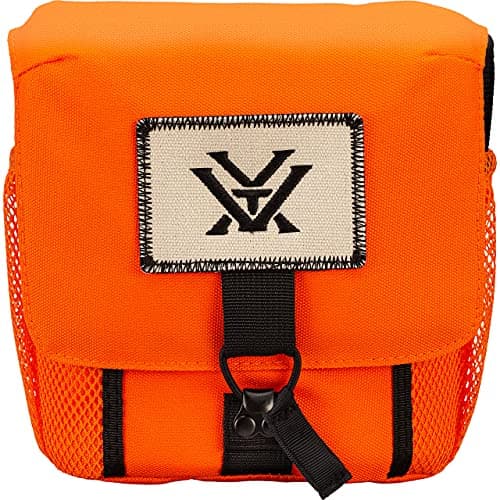
- 1Vortex Glasspak Binocular HarnessIf you buy one harness, buy this one. The GlassPak is a full harness rather than a strap: binoculars sit in a padded case on the chest under a lid that comes off a bungee and tab, so they are protected from rain and brush and reachable with one hand without looking down. Vortex publishes its dimensions and weight, includes two bino tether straps in the box rather than selling them separately, and backs the whole thing with the VIP warranty - unlimited, unconditional, transferable, no receipt required - which on a nylon product is close to absurd value. It is also the cheapest genuine harness in our catalogue, which makes the usual trade-off disappear. Honest cons: the lid-on-a-bungee design is quick but not the quietest way to open a harness, which matters to a bowhunter at close range; the case is sized for mainstream full-size binoculars and will not swallow an oversized pair, so measure first; and there is no dedicated rangefinder pocket, only mesh side pockets.Best for: Best overall under $100 - and the cheapest full harness
- 2
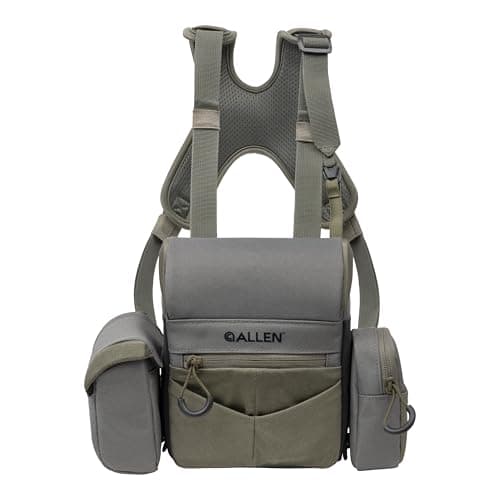 Allen Company Altitude Bino HarnessThe pick for a western or open-country hunter, because it solves two problems with one purchase. The Altitude is a chest harness with a dedicated tethered rangefinder pouch, which is the right arrangement for anyone who glasses and then ranges: both instruments live on the chest, both come out one-handed, and the tether means the rangefinder does not go down a hillside when a cold hand fumbles it. Retailers publish a fit for common sizes including 10x42, 8x42, 10x30 and 8x30, so you have something to check against rather than a slogan. Honest cons: the same part number has been sold elsewhere under a different name, which makes reviews confusing and specifications harder to pin down - we flag it rather than pretend otherwise; a rangefinder pouch adds bulk a timber hunter will not use; and at this price the fabric is serviceable rather than plush.Best for: Best if they carry a rangefinder too
- 3
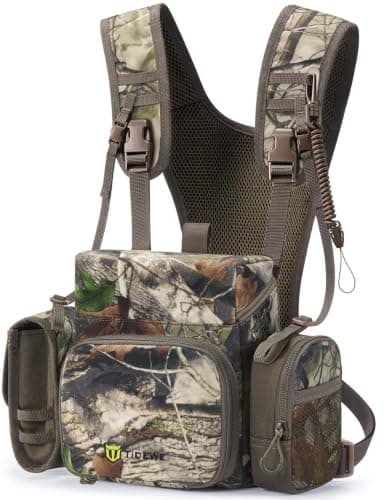 TIDEWE Binocular Harness Chest PackFor the hunter who wants their glass covered rather than just carried. The TIDEWE is an enclosed camo chest pack with a magnetic lid closure and two detachable pouches on a MOLLE-style arrangement, which is the configuration that keeps rain and snow off the objective lenses and lets a hunter add a pouch for a call, a tag or a phone. Magnetic closures are also the quietest common way to open a harness, which is a genuine advantage for a bowhunter. Honest cons: the brand's own listings have disagreed about the closure type, so treat the published description with some caution; reviewers report it leans off the chest when both pouches are loaded, which is the usual penalty for a modular design; and more fabric and more pouches mean more weight than the GlassPak.Best for: Best fully enclosed camo option
- 4
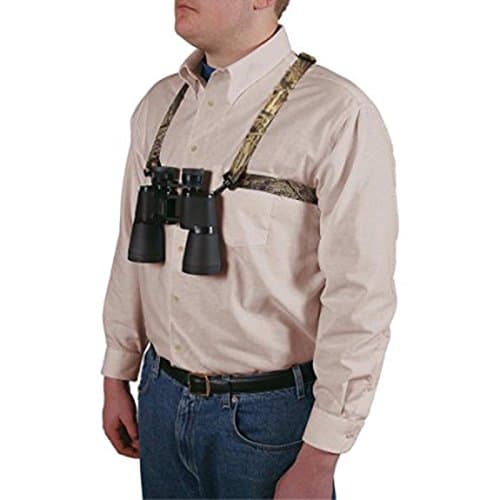 Allen Company Adjustable Binocular StrapThe honest cheap answer, labelled honestly. This is an adjustable strap system that takes the weight of binoculars off the back of the neck and spreads it across the shoulders, and that is the entire feature list - there is no case, no lid, no rain cover and no protection from brush. But the neck-strap problem it fixes is real: a neck strap is why binoculars press, swing and eventually get left in the pack, and for a few dollars this removes that single complaint. For a hunter who glasses occasionally, or as a stocking-stuffer alongside a pair of binoculars, it does the job. Honest cons: unprotected binoculars still swing forward when you bend over, which is how objective lenses get scratched and how glass bangs into a rifle; there is nowhere to put a rangefinder; and nothing keeps rain off the lenses, which is the main reason to own a real harness.Best for: Budget pick - cheapest fix, and not actually a harness
| # | Gift | Best for | Price |
|---|---|---|---|
| 1 | Vortex Glasspak Binocular HarnessIf you buy one harness, buy this one. The GlassPak is a full harness rather than a strap: binoculars sit in a padded case on the chest under a lid that comes off a bungee and tab, so they are protected from rain and brush and reachable with one hand without looking down. Vortex publishes its dimensions and weight, includes two bino tether straps in the box rather than selling them separately, and backs the whole thing with the VIP warranty - unlimited, unconditional, transferable, no receipt required - which on a nylon product is close to absurd value. It is also the cheapest genuine harness in our catalogue, which makes the usual trade-off disappear. Honest cons: the lid-on-a-bungee design is quick but not the quietest way to open a harness, which matters to a bowhunter at close range; the case is sized for mainstream full-size binoculars and will not swallow an oversized pair, so measure first; and there is no dedicated rangefinder pocket, only mesh side pockets. | Best overall under $100 - and the cheapest full harness | $29.00View on Amazon |
| 2 | Allen Company Altitude Bino HarnessThe pick for a western or open-country hunter, because it solves two problems with one purchase. The Altitude is a chest harness with a dedicated tethered rangefinder pouch, which is the right arrangement for anyone who glasses and then ranges: both instruments live on the chest, both come out one-handed, and the tether means the rangefinder does not go down a hillside when a cold hand fumbles it. Retailers publish a fit for common sizes including 10x42, 8x42, 10x30 and 8x30, so you have something to check against rather than a slogan. Honest cons: the same part number has been sold elsewhere under a different name, which makes reviews confusing and specifications harder to pin down - we flag it rather than pretend otherwise; a rangefinder pouch adds bulk a timber hunter will not use; and at this price the fabric is serviceable rather than plush. | Best if they carry a rangefinder too | $69.99View on Amazon |
| 3 | TIDEWE Binocular Harness Chest PackFor the hunter who wants their glass covered rather than just carried. The TIDEWE is an enclosed camo chest pack with a magnetic lid closure and two detachable pouches on a MOLLE-style arrangement, which is the configuration that keeps rain and snow off the objective lenses and lets a hunter add a pouch for a call, a tag or a phone. Magnetic closures are also the quietest common way to open a harness, which is a genuine advantage for a bowhunter. Honest cons: the brand's own listings have disagreed about the closure type, so treat the published description with some caution; reviewers report it leans off the chest when both pouches are loaded, which is the usual penalty for a modular design; and more fabric and more pouches mean more weight than the GlassPak. | Best fully enclosed camo option | $69.99View on Amazon |
| 4 | Allen Company Adjustable Binocular StrapThe honest cheap answer, labelled honestly. This is an adjustable strap system that takes the weight of binoculars off the back of the neck and spreads it across the shoulders, and that is the entire feature list - there is no case, no lid, no rain cover and no protection from brush. But the neck-strap problem it fixes is real: a neck strap is why binoculars press, swing and eventually get left in the pack, and for a few dollars this removes that single complaint. For a hunter who glasses occasionally, or as a stocking-stuffer alongside a pair of binoculars, it does the job. Honest cons: unprotected binoculars still swing forward when you bend over, which is how objective lenses get scratched and how glass bangs into a rifle; there is nowhere to put a rangefinder; and nothing keeps rain off the lenses, which is the main reason to own a real harness. | Budget pick - cheapest fix, and not actually a harness | $17.99View on Amazon |
Prices from Amazon as of November 24, 2026 and change often — the button always opens the current listing. Some links earn us a commission at no extra cost to you.
Vortex Glasspak Binocular Harness
If you buy one harness, buy this one. The GlassPak is a full harness rather than a strap: binoculars sit in a padded case on the chest under a lid that comes off a bungee and tab, so they are protected from rain and brush and reachable with one hand without looking down. Vortex publishes its dimensions and weight, includes two bino tether straps in the box rather than selling them separately, and backs the whole thing with the VIP warranty - unlimited, unconditional, transferable, no receipt required - which on a nylon product is close to absurd value. It is also the cheapest genuine harness in our catalogue, which makes the usual trade-off disappear. Honest cons: the lid-on-a-bungee design is quick but not the quietest way to open a harness, which matters to a bowhunter at close range; the case is sized for mainstream full-size binoculars and will not swallow an oversized pair, so measure first; and there is no dedicated rangefinder pocket, only mesh side pockets.
#ad · Price as of November 24, 2026. We may earn a commission.
Allen Company Altitude Bino Harness
The pick for a western or open-country hunter, because it solves two problems with one purchase. The Altitude is a chest harness with a dedicated tethered rangefinder pouch, which is the right arrangement for anyone who glasses and then ranges: both instruments live on the chest, both come out one-handed, and the tether means the rangefinder does not go down a hillside when a cold hand fumbles it. Retailers publish a fit for common sizes including 10x42, 8x42, 10x30 and 8x30, so you have something to check against rather than a slogan. Honest cons: the same part number has been sold elsewhere under a different name, which makes reviews confusing and specifications harder to pin down - we flag it rather than pretend otherwise; a rangefinder pouch adds bulk a timber hunter will not use; and at this price the fabric is serviceable rather than plush.
#ad · Price as of November 24, 2026. We may earn a commission.
TIDEWE Binocular Harness Chest Pack
For the hunter who wants their glass covered rather than just carried. The TIDEWE is an enclosed camo chest pack with a magnetic lid closure and two detachable pouches on a MOLLE-style arrangement, which is the configuration that keeps rain and snow off the objective lenses and lets a hunter add a pouch for a call, a tag or a phone. Magnetic closures are also the quietest common way to open a harness, which is a genuine advantage for a bowhunter. Honest cons: the brand's own listings have disagreed about the closure type, so treat the published description with some caution; reviewers report it leans off the chest when both pouches are loaded, which is the usual penalty for a modular design; and more fabric and more pouches mean more weight than the GlassPak.
#ad · Price as of November 24, 2026. We may earn a commission.
Allen Company Adjustable Binocular Strap
The honest cheap answer, labelled honestly. This is an adjustable strap system that takes the weight of binoculars off the back of the neck and spreads it across the shoulders, and that is the entire feature list - there is no case, no lid, no rain cover and no protection from brush. But the neck-strap problem it fixes is real: a neck strap is why binoculars press, swing and eventually get left in the pack, and for a few dollars this removes that single complaint. For a hunter who glasses occasionally, or as a stocking-stuffer alongside a pair of binoculars, it does the job. Honest cons: unprotected binoculars still swing forward when you bend over, which is how objective lenses get scratched and how glass bangs into a rifle; there is nowhere to put a rangefinder; and nothing keeps rain off the lenses, which is the main reason to own a real harness.
#ad · Price as of November 24, 2026. We may earn a commission.
What a harness actually fixes
Hunters who have never used one assume a harness is about comfort. It is really about whether the binoculars get used at all.
It stops the swing.On a neck strap, binoculars swing forward every time you bend, climb, kneel or shoulder a rifle — into the gun, into a tree, into the ground. A chest harness holds them flat against the body so nothing moves.
It takes the weight off the neck. A full-size 42mm pair is heavy enough that after a few hours on a strap the hunter is aware of it, and awareness turns into putting them in the pack.
It keeps them reachable.Binoculars in a pack are binoculars you will not use for the one three-second look that mattered. This is the real argument, and it is why a harness is on our elk page as a pick rather than a footnote — see best binoculars for elk hunting.
It keeps weather off the lenses. Only the enclosed versions do this, and in rain or snow it is the difference between glassing and wiping.
Open-top, enclosed, or just a strap?
Three formats, three different buyers.
A strap system— the Allen above — is the cheapest and does one thing: moves weight off the neck. Right for an occasional glasser, wrong for anyone hunting in weather.
An open-top or lidded harness like the GlassPak is the mainstream answer: fast access, protection from brush and rain, nothing to fight with. For most hunters this is the correct purchase and the end of the decision.
A fully enclosed pack like the TIDEWE adds a sealed lid, modular pouches and the quietest opening, at the cost of weight and bulk. Right for bowhunters, for genuinely wet climates, and for anyone who wants the harness to carry other small items too.
Where the rangefinder rides
This is the detail that separates harnesses once you have decided on a format, and it matters more the further you hunt from the truck. A rangefinder in a trouser pocket is a rangefinder you will not get to in time; one clipped to a pack strap swings; one in a tethered pouch on the harness comes out one-handed and does not go down a slope when you drop it.
If the hunter owns a rangefinder, the Altitude's dedicated pouch is worth more than the GlassPak's better warranty. If they do not own one yet, buy the GlassPak and read do you need a rangefinder for hunting before adding one — for a lot of hunting, the honest answer is no.
What you give up by staying under $100
Here is the straight comparison, because the premium harnesses are good and pretending otherwise would be dishonest.
Published interior dimensions and per-brand fit charts. The premium makers tell you exactly what fits, which removes the guesswork that is the main risk in this whole category. Under $100 you often get a size claim rather than a measurement.
A quieter opening. Magnetic and fleece-lined front-folding lids are quieter than a bungee-and-tab lid. At twenty yards with a bow in hand that is a real difference.
Fabric and finish. Softer face materials, better zips, fewer squeaks after two seasons.
What you do notgive up: the harness working. The weight comes off your neck, the glass stops swinging, and it is reachable with one hand — which is the entire reason to buy one. Our full field, including the two premium options above this ceiling, is in best bino harness for hunting.
How to measure before you buy
Thirty seconds now saves a return later. Measure the binoculars across the widest point with the eyecups out and the hinge set the way the hunter uses it, then measure height from the bottom of the barrels to the top of the eyecups, then depth front to back. Compare those three numbers against the harness's published interior dimensions — and if the maker publishes no dimensions, treat the fit as unknown rather than fine.
Buying a harness as a gift without access to the binoculars? Two safe routes: buy the strap system, which fits anything, or buy the GlassPak, which is sized for mainstream full-size binoculars and carries a warranty that makes an exchange painless. What not to do is guess at an enclosed pack sized for a specific model.
How we chose these
We do not run a test lab. Every construction detail above is the manufacturer's or retailer's own published description, cited in the sources below, with the inconsistent claims flagged rather than smoothed over. The picks are judged on the four things a harness is bought to fix — does the glass fit, can it be opened silently with one hand, where does the rangefinder ride, and what happens in rain — plus warranty, because a nylon product that gets replaced for free outlasts a nicer one that does not. Method: how we choose. Prices are live and dated.
Match the harness to the hunter
They own binoculars and a neck strap. GlassPak. This is the default answer and it is the right one most of the time.
They hunt the West and carry a rangefinder. The Allen Altitude.
They bowhunt, or hunt somewhere genuinely wet. The TIDEWE enclosed pack, for the magnetic lid and the weather seal.
You are spending under twenty dollars, or you cannot measure their glass. The Allen strap. It is honest about what it is and it fixes the neck.
Keep browsing
The full harness field including the premium options is in best bino harness for hunting, and what is a bino harness explains the category from scratch if you are buying for someone else. For the glass itself, start at best hunting binoculars, with the budget field in best hunting binoculars under $200 and the format question in 8x42 vs 10x42 binoculars.
Frequently asked questions
Is a bino harness worth it?
It is the cheapest meaningful upgrade in hunting optics. The problem it solves is not comfort but use: on a neck strap, binoculars swing into a rifle, press on the neck and eventually get put in the pack, and a hunter who is not glassing is hunting with their eyes. A harness holds them flat on the chest, reachable with one hand, for a fraction of what the glass cost.
What is the best bino harness under $100?
The Vortex GlassPak, which is also the cheapest genuine harness in our catalogue. It is a padded chest case with a full-coverage lid, mesh side pockets, two bino tether straps included rather than sold separately, and Vortex's unlimited, unconditional, transferable VIP warranty - unusual on a nylon product. Its limitations are no dedicated rangefinder pocket and a bungee-and-tab lid that is quick rather than silent.
Do you need to spend more than $100 on a bino harness?
No. Above this ceiling you get published interior dimensions and per-brand fit charts, a quieter magnetic or fleece-lined lid, and nicer fabric - all real, and worth it to a hunter who glasses for hours and shoots a bow at close range. What you do not get is a different outcome: the weight off the neck, the glass not swinging, one-handed access.
How do you know a harness will fit your binoculars?
Measure, because 'fits most binoculars' is not a specification - two 10x42s from different brands can differ by an inch in height and half an inch in depth. Measure width with the eyecups out, height from the bottom of the barrels to the top of the eyecups, and depth front to back, then compare against the harness's published interior dimensions. If no dimensions are published, treat the fit as unknown.
What is the difference between a bino harness and a binocular strap?
A strap system only redistributes weight from the neck to the shoulders - there is no case, lid or rain protection, and the binoculars still swing forward when you bend over. A harness holds them in a padded case flat against the chest, protects the lenses from brush and weather, and keeps them reachable with one hand. The strap is a few dollars; the harness is the real fix.
Can a bino harness carry a rangefinder as well?
Some can, and it matters more the further you hunt from the truck. A rangefinder in a pocket is one you will not reach in time, and one clipped to a pack strap swings; a dedicated tethered pouch on the harness comes out one-handed and does not go down a hillside when a cold hand fumbles it. Of the picks here, the Allen Altitude is the one built for that.
Sources
- Vortex Optics - GlassPak binocular harness: published dimensions, weight, included tether straps and VIP warranty terms
- Allen Company - Altitude bino harness with tethered rangefinder pouch, published fit list
- TIDEWE - binocular harness chest pack, published description (magnetic closure, detachable pouches)
- Allen Company - adjustable binocular strap, published description