Gear Guides
The Best Knife Sharpener Under $25
Under twenty-five dollars you cannot buy a sharpening system, but you can buy the thing that saves a field-dressing job at four in the afternoon. There are exactly three of these worth owning, they do three different jobs, and most hunters should own two of them.
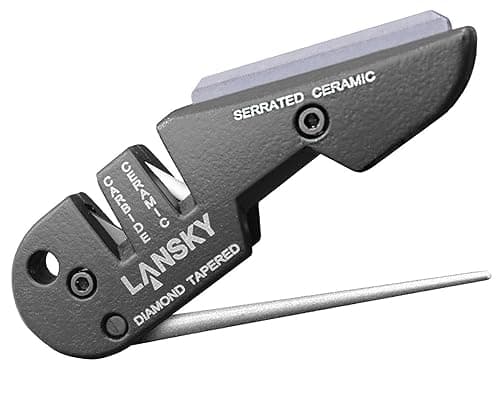
The verdict: the Lansky BladeMedic is the one to buy, and it is for the hunter who wants one thing in the pack that can rescue any blade in the field. Lansky publishes it as a 4-in-1 pocket sharpener, and the fourth tool is why it wins: a tapered serrated rod that fits inside a gut hook and between serrations, which the other two picks here physically cannot reach. The budget pick is the Lansky Puck, the cheapest item on this page, and it is here for a job neither of the others does at all — axes, machetes, shovels and mower blades, which is the sharpening nobody owns a tool for.
Set expectations honestly first. Under $25 you are buying a field tool, not a sharpening system. These three will take a working blade back to usefully sharp, hold an edge through a job, and save a hunt. None of them will put a true polished edge on a knife, none holds a consistent angle the way a clamped system does, and all of them remove more steel than a stone would. If the goal is to learn to sharpen properly, that is a different purchase and it is above this ceiling.
There are exactly three of these.That is not a shortlist — it is every sharpener in our catalogue that sits under $25 with a live price today, and we have not padded the page to five. The useful finding is that they are not three versions of the same product: one is for field repair, one is for the hunter with no technique, and one is for the tools a knife sharpener cannot touch. Prices are pulled live and dated.
- 1Lansky BladeMedic 4-in-1 Pocket SharpenerThe pick, and the one to buy if you only buy one. Lansky publishes the BladeMedic as a 4-in-1 pocket sharpener, and the combination is genuinely thought through rather than a spec-sheet count: tungsten carbide for fast steel removal when a blade is properly dull, ceramic rods for finishing and realigning an edge that has rolled rather than worn, a diamond tapered rod, and a serrated rod. That last one is the reason it is first on this page, because it is the only tool here that physically fits inside a gut hook or between the teeth of a serrated blade - a gut hook is a curve with a sharpened inside edge, and a flat stone or a pull-through slot cannot reach into it. For a hunter whose knife has a gut hook, this is not a nice-to-have, it is the only option under $25. It is also pocket-size and genuinely usable with cold hands, which is when you will need it. Honest cons: carbide pull-through slots are aggressive and remove real steel every pass - used often or carelessly, they will shorten the life of a good blade, so they are for rescue rather than routine. The angle is fixed by the tool, so you get Lansky's angle rather than your knife's, and on a blade ground to something different that mismatch is permanent. The small handle gives limited leverage on a big fixed blade. And no pull-through produces the edge a stone does; this is a field tool and it is honest about it.Best for: Best overall - for the hunter who wants one tool in the pack
- 2
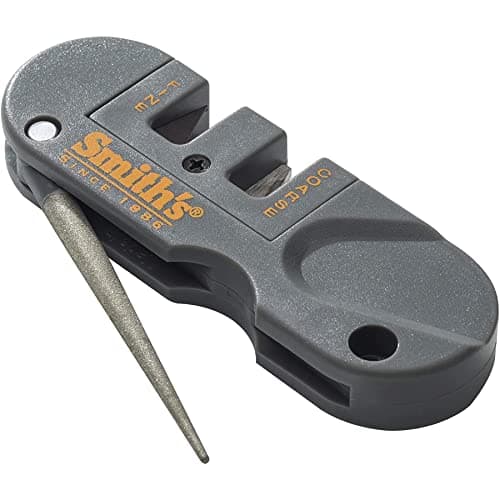 Smith's PP1 Pocket Pal Knife SharpenerThe pick for the gift recipient or the new hunter who will not learn a technique and should not be sold one. Smith's publishes the PP1 Pocket Pal as a pocket-size sharpener with carbide and ceramic stages plus a tapered diamond rod, and the reason it is the easy-mode choice is that the slots do the angle for you - you pull the blade through two or three times and it is sharper, with no skill and no decision to make. That matters more than it sounds. The single biggest cause of dull hunting knives is not that sharpeners are unavailable, it is that the hunter does not feel competent to use one and therefore does not, and a tool that works on the first try breaks that cycle. It is also the smallest and cheapest thing on this page that solves the main problem, which makes it the natural stocking stuffer to pair with a knife. Honest cons: pull-through slots are the least precise way to sharpen anything, and the carbide stage in particular takes off a visible amount of steel - a quality knife sharpened this way for ten years will have a noticeably different profile. The fixed angle will not match every blade. It cannot reach a gut hook or serrations. And the small body means you are pulling a blade towards a tool you are holding in your other hand, which calls for sensible care about where your fingers are.Best for: Best for no technique - for the hunter who has never sharpened anything
- 3
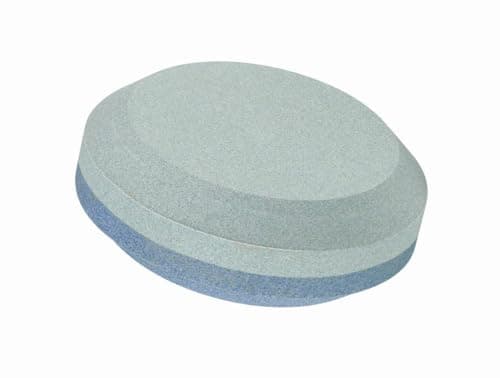 Lansky Puck Dual-Grit Tool SharpenerThe cheapest item on this page and the only one that addresses a problem the others cannot touch. Lansky publishes the Puck as a dual-grit multi-purpose tool sharpener, and the shape is the whole design: a palm-size disc with a coarse face and a fine face, meant to be held flat against a large convex edge and worked in circles. That is the correct geometry for an axe, a hatchet, a machete, a brush hook, a shovel or a mower blade - all of which are things a hunting camp actually depends on and none of which fits in a pull-through slot. For a deer camp, a food-plot tractor shed or anyone who clears their own shooting lanes, this is the sharpening tool that is genuinely missing from the drawer. It is also effectively indestructible, needs no technique beyond keeping it flat, and costs less than a box of shells. Honest cons: it is poor at knives, which is worth being blunt about - the flat disc is awkward on a small blade and will not produce a fine edge on a thin one, so this is not a substitute for either pick above. The coarse face is very aggressive and will chew an edge if you stay on it too long. Stone dust and metal swarf make a mess, so this is a shed tool, not a kitchen one. And it does nothing for serrations or gut hooks.Best for: Budget pick - the cheapest, and the only one for axes and machetes
| # | Gift | Best for | Price |
|---|---|---|---|
| 1 | Lansky BladeMedic 4-in-1 Pocket SharpenerThe pick, and the one to buy if you only buy one. Lansky publishes the BladeMedic as a 4-in-1 pocket sharpener, and the combination is genuinely thought through rather than a spec-sheet count: tungsten carbide for fast steel removal when a blade is properly dull, ceramic rods for finishing and realigning an edge that has rolled rather than worn, a diamond tapered rod, and a serrated rod. That last one is the reason it is first on this page, because it is the only tool here that physically fits inside a gut hook or between the teeth of a serrated blade - a gut hook is a curve with a sharpened inside edge, and a flat stone or a pull-through slot cannot reach into it. For a hunter whose knife has a gut hook, this is not a nice-to-have, it is the only option under $25. It is also pocket-size and genuinely usable with cold hands, which is when you will need it. Honest cons: carbide pull-through slots are aggressive and remove real steel every pass - used often or carelessly, they will shorten the life of a good blade, so they are for rescue rather than routine. The angle is fixed by the tool, so you get Lansky's angle rather than your knife's, and on a blade ground to something different that mismatch is permanent. The small handle gives limited leverage on a big fixed blade. And no pull-through produces the edge a stone does; this is a field tool and it is honest about it. | Best overall - for the hunter who wants one tool in the pack | $16.38View on Amazon |
| 2 | Smith's PP1 Pocket Pal Knife SharpenerThe pick for the gift recipient or the new hunter who will not learn a technique and should not be sold one. Smith's publishes the PP1 Pocket Pal as a pocket-size sharpener with carbide and ceramic stages plus a tapered diamond rod, and the reason it is the easy-mode choice is that the slots do the angle for you - you pull the blade through two or three times and it is sharper, with no skill and no decision to make. That matters more than it sounds. The single biggest cause of dull hunting knives is not that sharpeners are unavailable, it is that the hunter does not feel competent to use one and therefore does not, and a tool that works on the first try breaks that cycle. It is also the smallest and cheapest thing on this page that solves the main problem, which makes it the natural stocking stuffer to pair with a knife. Honest cons: pull-through slots are the least precise way to sharpen anything, and the carbide stage in particular takes off a visible amount of steel - a quality knife sharpened this way for ten years will have a noticeably different profile. The fixed angle will not match every blade. It cannot reach a gut hook or serrations. And the small body means you are pulling a blade towards a tool you are holding in your other hand, which calls for sensible care about where your fingers are. | Best for no technique - for the hunter who has never sharpened anything | $13.99View on Amazon |
| 3 | Lansky Puck Dual-Grit Tool SharpenerThe cheapest item on this page and the only one that addresses a problem the others cannot touch. Lansky publishes the Puck as a dual-grit multi-purpose tool sharpener, and the shape is the whole design: a palm-size disc with a coarse face and a fine face, meant to be held flat against a large convex edge and worked in circles. That is the correct geometry for an axe, a hatchet, a machete, a brush hook, a shovel or a mower blade - all of which are things a hunting camp actually depends on and none of which fits in a pull-through slot. For a deer camp, a food-plot tractor shed or anyone who clears their own shooting lanes, this is the sharpening tool that is genuinely missing from the drawer. It is also effectively indestructible, needs no technique beyond keeping it flat, and costs less than a box of shells. Honest cons: it is poor at knives, which is worth being blunt about - the flat disc is awkward on a small blade and will not produce a fine edge on a thin one, so this is not a substitute for either pick above. The coarse face is very aggressive and will chew an edge if you stay on it too long. Stone dust and metal swarf make a mess, so this is a shed tool, not a kitchen one. And it does nothing for serrations or gut hooks. | Budget pick - the cheapest, and the only one for axes and machetes | $12.76View on Amazon |
Prices from Amazon as of November 24, 2026 and change often — the button always opens the current listing. Some links earn us a commission at no extra cost to you.
Lansky BladeMedic 4-in-1 Pocket Sharpener
The pick, and the one to buy if you only buy one. Lansky publishes the BladeMedic as a 4-in-1 pocket sharpener, and the combination is genuinely thought through rather than a spec-sheet count: tungsten carbide for fast steel removal when a blade is properly dull, ceramic rods for finishing and realigning an edge that has rolled rather than worn, a diamond tapered rod, and a serrated rod. That last one is the reason it is first on this page, because it is the only tool here that physically fits inside a gut hook or between the teeth of a serrated blade - a gut hook is a curve with a sharpened inside edge, and a flat stone or a pull-through slot cannot reach into it. For a hunter whose knife has a gut hook, this is not a nice-to-have, it is the only option under $25. It is also pocket-size and genuinely usable with cold hands, which is when you will need it. Honest cons: carbide pull-through slots are aggressive and remove real steel every pass - used often or carelessly, they will shorten the life of a good blade, so they are for rescue rather than routine. The angle is fixed by the tool, so you get Lansky's angle rather than your knife's, and on a blade ground to something different that mismatch is permanent. The small handle gives limited leverage on a big fixed blade. And no pull-through produces the edge a stone does; this is a field tool and it is honest about it.
#ad · Price as of November 24, 2026. We may earn a commission.
Smith's PP1 Pocket Pal Knife Sharpener
The pick for the gift recipient or the new hunter who will not learn a technique and should not be sold one. Smith's publishes the PP1 Pocket Pal as a pocket-size sharpener with carbide and ceramic stages plus a tapered diamond rod, and the reason it is the easy-mode choice is that the slots do the angle for you - you pull the blade through two or three times and it is sharper, with no skill and no decision to make. That matters more than it sounds. The single biggest cause of dull hunting knives is not that sharpeners are unavailable, it is that the hunter does not feel competent to use one and therefore does not, and a tool that works on the first try breaks that cycle. It is also the smallest and cheapest thing on this page that solves the main problem, which makes it the natural stocking stuffer to pair with a knife. Honest cons: pull-through slots are the least precise way to sharpen anything, and the carbide stage in particular takes off a visible amount of steel - a quality knife sharpened this way for ten years will have a noticeably different profile. The fixed angle will not match every blade. It cannot reach a gut hook or serrations. And the small body means you are pulling a blade towards a tool you are holding in your other hand, which calls for sensible care about where your fingers are.
#ad · Price as of November 24, 2026. We may earn a commission.
Lansky Puck Dual-Grit Tool Sharpener
The cheapest item on this page and the only one that addresses a problem the others cannot touch. Lansky publishes the Puck as a dual-grit multi-purpose tool sharpener, and the shape is the whole design: a palm-size disc with a coarse face and a fine face, meant to be held flat against a large convex edge and worked in circles. That is the correct geometry for an axe, a hatchet, a machete, a brush hook, a shovel or a mower blade - all of which are things a hunting camp actually depends on and none of which fits in a pull-through slot. For a deer camp, a food-plot tractor shed or anyone who clears their own shooting lanes, this is the sharpening tool that is genuinely missing from the drawer. It is also effectively indestructible, needs no technique beyond keeping it flat, and costs less than a box of shells. Honest cons: it is poor at knives, which is worth being blunt about - the flat disc is awkward on a small blade and will not produce a fine edge on a thin one, so this is not a substitute for either pick above. The coarse face is very aggressive and will chew an edge if you stay on it too long. Stone dust and metal swarf make a mess, so this is a shed tool, not a kitchen one. And it does nothing for serrations or gut hooks.
#ad · Price as of November 24, 2026. We may earn a commission.
Three tools, three different jobs
The reason this page has three picks rather than five is that there are three of them, and the reason it is still worth reading is that they do not overlap as much as the price suggests.
| The job | What you want | What will not do it |
|---|---|---|
| Rescue a dull knife mid-field-dressing | A carbide pull-through | A stone, which needs time and light |
| Sharpen inside a gut hook | A tapered serrated or diamond rod | Any flat stone or slot - it cannot reach |
| Serrated blade teeth | A tapered rod, same tool | Pull-through slots, which only hit the high points |
| Hand it to someone with no technique | A two-stage pull-through | A clamped system, which they will not use |
| An axe, machete or mower blade | A dual-grit puck | Both of the knife sharpeners above |
| Learn to sharpen properly | A guided system with hones | Everything on this page - it is above this budget |
For most hunters the sensible outcome of this page is two purchases rather than one: the BladeMedic in the pack and the Puck in the shed. Together they still come to less than a single mid-range sharpener.
What a pull-through actually does to your knife
Worth understanding, because the internet argument about carbide sharpeners is overheated in both directions. A carbide slot works by scraping steel off both sides of the edge at a fixed angle. That is fast, it needs no skill, and it genuinely works. It also removes more material per pass than a stone does, and it leaves a rougher edge.
The practical rule:use the carbide stage when a blade is properly dull, then finish on the ceramic. Do not run a knife through carbide every time you use it — that is how a good blade loses its profile over a decade. For a working hunting knife that gets used hard a few weeks a year, this is a non-issue. For an heirloom fixed blade, use the ceramic and the rod and leave the carbide alone.
Most of the time a knife that feels dull is not worn, it is rolled — the very edge has bent over. That needs realignment, not grinding, which is what a ceramic stage or a rod does. We go through this properly in how to sharpen a hunting knife.
The gut hook problem
If the knife in question has a gut hook, the shortlist on this page collapses to one. A gut hook is a curved notch with the cutting edge on the inside of the curve, so no flat abrasive and no slot can contact it — you need a tapered round or serrated rod small enough to sit inside the hook. The BladeMedic has one. The other two cannot do it at any price.
That is also the reason a lot of hunters conclude gut hooks are useless: they go dull in the first season and never get sharpened again, because the sharpener in the drawer cannot reach them. If you want the case for and against the feature itself, see what is a gut hook knife.
When to spend more than $25
There are two honest reasons to go above this ceiling, and neither is “sharper.”
You want to learn. A clamped system with multiple hones holds the same angle every stroke, which is what actually teaches the skill and what produces a genuinely fine edge. That is a real upgrade and it is not available at this price.
You have a drawer full of dull knives. A powered belt sharpener takes a decade of neglect back to sharp in an evening, which no pocket tool will do. Both routes are covered in best hunting knife sharpeners, the parent roundup, and the head-to-head is in Work Sharp vs Lansky.
What you should not do is buy a sharpener you find intimidating and leave it in a cupboard. The best sharpener is the one that is in the pack when the blade quits, which is the entire argument for this price bracket.
Match the tool to the knife
One tool in the pack, any blade, including a gut hook. The Lansky BladeMedic.
A hunter or gift recipient with no sharpening technique. The Smith's Pocket Pal.
Axes, machetes, shooting-lane tools, mower blades. The Lansky Puck. Nothing else here touches these.
An expensive fixed blade you care about. Use the ceramic stage and the rod, skip the carbide, and plan to buy a guided system eventually.
Most hunters, honestly. The BladeMedic and the Puck. Both, for less than one mid-range sharpener.
Frequently asked questions
What is the best knife sharpener under $25?
The Lansky BladeMedic, because it is the only one at this price that can sharpen every kind of blade a hunter carries - Lansky publishes it as a 4-in-1 tool, and the tapered serrated rod is the part that matters, since it is the only abrasive here that physically fits inside a gut hook or between serrations. If the recipient has never sharpened anything, the Smith's Pocket Pal is the easier tool. For axes and machetes, neither works and the Lansky Puck is the answer.
Are cheap knife sharpeners any good?
For the job they are built for, yes. A carbide pull-through genuinely takes a dull blade back to usefully sharp in seconds with no skill, which is exactly what you want at four in the afternoon with a deer on the ground. What they do not do is produce a fine polished edge or hold your knife's original angle, and they remove more steel per pass than a stone does. Treat them as field repair tools rather than as a sharpening system and they are excellent value.
Will a pull-through sharpener ruin my knife?
Not in one use, and not in a hunting season - but it is a real consideration over years. A carbide slot scrapes steel off both sides of the edge at a fixed angle, so repeated use removes material and gradually imposes that angle on your blade. The sensible rule is to use the carbide stage only when a blade is properly dull and to finish on the ceramic. On a working hunting knife this barely matters; on an heirloom fixed blade, stick to the ceramic and the rod.
How do you sharpen a gut hook?
With a tapered round or serrated rod small enough to sit inside the curve - and that is the only way, because a gut hook has its cutting edge on the inside of a notch where no flat stone or pull-through slot can make contact. Of the sharpeners under $25, only the Lansky BladeMedic has a rod that fits. This is also why so many gut hooks end up permanently dull: the sharpener in the drawer physically cannot reach them.
What can sharpen an axe or a machete?
A dual-grit puck, held flat against the edge and worked in circles - the Lansky Puck is the pick here and it is the cheapest item on this page. The reason a knife sharpener does not work is geometry: an axe or machete edge is large and convex, and it does not fit in a slot. The same tool handles a hatchet, a brush hook, a shovel or a mower blade, which makes it the most useful thing in a deer camp that nobody owns.
Is a ceramic or carbide sharpener better?
They do different jobs and most good tools have both. Carbide removes steel fast and is what you want when a blade is genuinely worn dull. Ceramic removes very little and realigns an edge that has rolled over - which is what is actually wrong with most knives that feel dull. The right sequence is carbide only if needed, then ceramic to finish. Using carbide every time is how a good blade loses its profile.
Should I buy a sharpener or a better knife?
The sharpener, almost every time, and it is not a close call. A cheap knife kept sharp outperforms an expensive knife that is dull, and the overwhelming majority of hunting knives in use are dull. If you are buying for someone who already owns a knife, a sharpener is the upgrade to the knife they have. If you are buying both, pair them - a knife and a sharpener together is a better gift than either alone.
Sources
- Amazon listing - Lansky BladeMedic PS-MED01: published as a 4-in-1 pocket sharpener with carbide, ceramic, a diamond tapered rod and a serrated rod
- Amazon listing - Smith's PP1 Pocket Pal: published as a pocket sharpener with carbide and ceramic stages plus a tapered diamond rod
- Amazon listing - Lansky Puck: published as a dual-grit multi-purpose tool sharpener for axes, machetes and garden tools