Gear Guides
Do You Need Ear Protection for Hunting?
Hunters are the one group of shooters who routinely go without - not out of carelessness, but for a reason that used to be genuinely good. It stopped being good about fifteen years ago, and this is what changed.
The short answer is yes, and almost every hunter already knows it. The interesting question is why so many still do not wear any, because the reason is not stupidity or bravado. It is that hunting is the one shooting activity where you genuinely need to hear.
At a range, hearing protection costs you nothing you want. In the woods, a conventional muff takes away the footstep in the leaves, the twig, the birds going quiet — the whole reason a person is sitting out there in the cold. For decades the honest trade was: protection or awareness, pick one. Most hunters picked awareness, fired two or three shots a season, and told themselves that was fine.
What a gunshot actually does
It is worth being precise, because the usual framing — "it is loud" — understates it. Hearing damage from continuous noise, like a factory floor, accumulates over hours. Damage from impulse noise, like a gunshot, does not need hours. The CDC states plainly that loud impulse noise can cause immediate and permanent damage to hearing, and that noise-induced hearing loss does not come back — the structures involved do not regenerate.
That is the part that catches people out. "I only shoot a couple of times a year" is an argument about cumulative exposure, and it is the wrong model for this kind of noise. A rifle fired next to an unprotected ear is not a small dose of a long-term risk; it is a single event that can do permanent damage on its own. The National Institute on Deafness and Other Communication Disorders describes the same mechanism for sudden, very loud sounds.
What to look for, then
Once you accept that, choosing becomes simple, because there are only four real decisions.
Electronic or passive. This is the one that matters. An electronicprotector has microphones that amplify quiet sound and electronics that cut that amplification the instant a shot arrives — so the hunter hears better than with bare ears right up to the moment of the shot, and does not hear the shot at full value. That is what removed the old trade-off. A passive protector just blocks, which is right at a range and wrong on a stand.
Rating, with a caveat.The Noise Reduction Rating on the box is a lab figure measured under ideal fit. NIOSH recommends derating published values in real use — roughly 25 per cent for earmuffs, and substantially more for earplugs — so treat the number as a comparison tool, not a promise.
Fit, which beats rating.A high-rated muff that does not seal — perched on a hat brim, or sized for an adult and worn by a child — protects worse than a modest one that does. Buy for the head it is going on.
Shape, because it decides whether it gets worn. A muff has to clear the stock of a long gun when the gun comes up. If it does not, the hunter takes it off, and the best protector in the world does nothing in a pocket.
Those four criteria produce four sensible answers, which are the products below. Prices are live from Amazon.
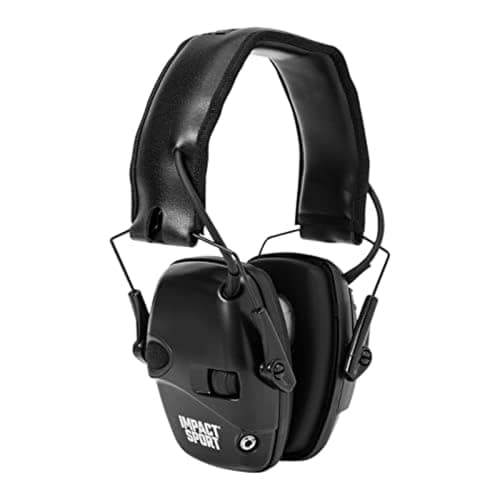
Howard Leight Impact Sport Electronic Earmuff
The default recommendation and the one most hunters end up owning. Honeywell publishes NRR 22 dB in both on and off modes, 4x amplification of quiet sound, and electronics that shut the amplification off the moment an impulse sound reaches 82 dB - which is exactly the mechanism described above. Two AAA batteries, a four-hour auto shut-off, and a cutaway at the bottom of the cup so it clears the stock of a long gun. Honest cons: 22 dB is mid-pack protection, the cells are not rechargeable, and it is a Med/Large muff that sits loose on a smaller head.
#ad · Price as of Sep 17, 2026. We may earn a commission.
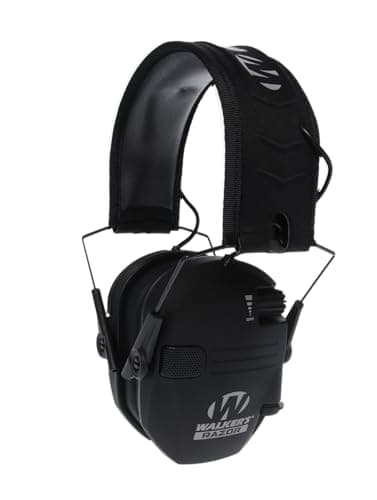
Walker's Razor Slim Electronic Muff
The same idea at a lower price and in a slimmer shape. Walker's publishes NRR 23 dB, two hi-gain omnidirectional microphones, sound-activated compression that clamps a spike in 0.02 seconds, independent volume for each ear and an audio input jack. The ultra-low-profile cups fold flat and are genuinely easier to shoot under, which is the practical reason to pick it over the Impact Sport. Honest cons: less room inside the cup means less comfort over a full day, thin headband padding, and an audible hiss from the amplification that pricier sets do not have.
#ad · Price as of Sep 17, 2026. We may earn a commission.
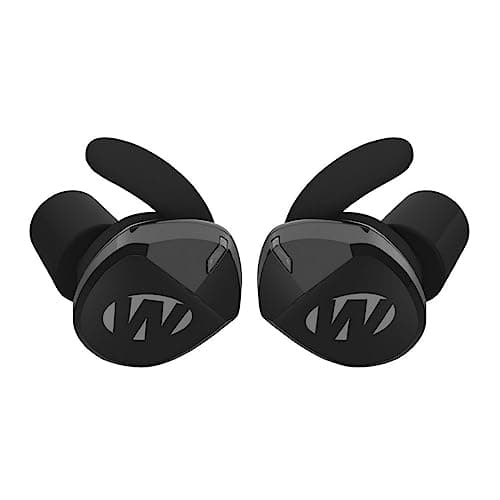
Walker's Silencer 2.0 Electronic Earbuds
For the hunter who has tried muffs and genuinely will not wear them. Nothing sits between the cheek and the stock, nothing snags on a hood or a hat brim, and nothing has to come off to raise a gun - which for some shooters is the difference between wearing protection and quietly not wearing it. These are rechargeable electronic earbuds with sound-activated compression and Bluetooth, and Walker's publishes an NRR of 24 dB for the Silencer 2.0 line. Honest cons: buds are easy to lose, they need charging rather than a fresh AAA from the glovebox, and the fit is fussy - an imperfect seal makes the rating meaningless.
#ad · Price as of Sep 17, 2026. We may earn a commission.
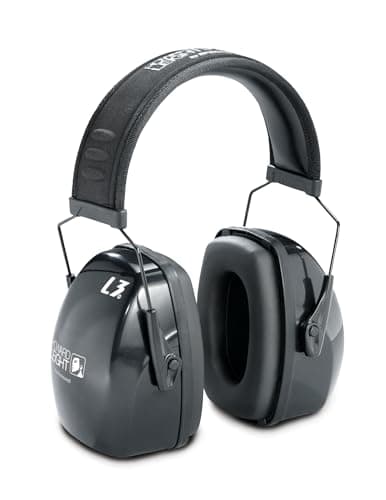
Howard Leight Leightning L3 Shooting Earmuff
The answer for sighting in before the season, for a wet blind, and for the spare pair that lives in the truck. Honeywell rates the Leightning L3 at NRR 30 dB - substantially more raw attenuation than anything electronic here - with no batteries to die and no circuitry to soak. Snap-in cushions and a steel-wire telescopic headband mean it survives a decade of abuse. Honest cons: it is passive, so it removes the approaching deer along with the muzzle blast, which makes it the wrong pair for sitting in the woods, and the deeper cups catch on a stock more readily.
#ad · Price as of Sep 17, 2026. We may earn a commission.
"But I only fire two shots a season"
This is the most common objection and it rests on a real misunderstanding, so it deserves a straight answer rather than a lecture.
Workplace noise rules — the kind OSHA publishes — are built around average exposure over a working day, because that is the right model for machinery. Applied to hunting, that arithmetic does say two shots a year is nothing. But impulse noise is not modelled that way for good reason: the damage mechanism is different. A pressure spike can injure the inner ear in the instant it arrives, independent of how much noise came before or after it.
So the honest version is: shooting rarely reduces your total exposure, and it does not reduce the risk from any individual shot. The hunter who has fired two shots a season for thirty years has taken sixty of those events.
There is a second thing worth knowing. Plenty of hunters have their worst exposure not while hunting at all, but at the range in late summer, sighting in a rifle across a bench next to other people doing the same — dozens of shots in an hour, often under a roof that reflects the noise straight back. If somebody is going to own one pair of hearing protection, that is the session it matters most for.
Is it a legal requirement?
No. Hunting regulations in the United States are set state by state and cover seasons, tags, methods of take, blaze orange and so on; hearing protection is not mandated for hunters the way it is for workers in a loud industrial environment. OSHA's noise rules apply to employers and employees, not to a person in a treestand.
Two related points that areworth checking locally, because both vary and neither is something a gift-buyer should assume. Some ranges require protection to be worn on the firing line regardless of what you do in the field. And suppressors — which are the other approach to this problem — are legal in most states and prohibited in some, with federal paperwork either way. If that is where somebody's thinking is heading, it is a conversation for a local dealer and their state wildlife agency, not a gift decision.
What about young hunters?
This is the case where the answer is least ambiguous and most often got wrong. An adult-sized muff on a child's head does not seal, and a protector that does not seal is not protection at any published rating. Buying a smaller person the adult pair "to grow into" is the one version of this purchase that actively fails.
Youth-specific electronic muffs exist, built around smaller head sizes from the start rather than by shrinking an adult headband, and they are covered in our best hearing protection for hunting roundup. If you are buying for a young hunter more broadly, hunting gifts for kids and gifts for teenagers are the right starting points.
Muffs, plugs or buds?
Muffs are the default for hunting because they go on and come off in a second, they are hard to lose, and an electronic muff is the cheapest way to get amplification. The downside is bulk against a gun stock and against a hat.
Plain foam plugsare cheap, effective when inserted properly — which is the catch, since NIOSH derates plugs far more heavily than muffs precisely because people insert them badly — and completely block the sound a hunter wants. Fine in a pocket as a backup, poor as a plan.
Electronic earbuds give the amplification of a muff with none of the bulk, which is the right answer for someone who will not tolerate muffs. They cost more, they need charging, and they are easy to lose.
For the full field including the premium Bluetooth option and the youth sizes, see the hearing protection roundup. For a direct head-to-head between the two muffs most people choose between, there is Howard Leight vs Walker's Razor.
How we chose the picks above
We do not run a test lab and we are not going to invent one. Every rating and feature quoted here is the manufacturer's own published specification, and the statements about impulse noise and derating come from the CDC, NIDCD and NIOSH publications cited below rather than from us. Nothing on this page is medical advice — it is a buying guide, and anyone worried about their hearing should talk to an audiologist rather than a gift site. Our full method is on the how we choose page.
Keep browsing
If you are buying this as a present, add a pack of AAA batteries so it works the afternoon it is unwrapped. Hearing protection sits well beside a knife under fifty dollars or a stocking stufferto make a fuller gift, and it is one of the few things that suits any hunter regardless of what they hunt — see hunting gifts for men and best hunting gifts for beginners for what else pairs with it.
Frequently asked questions
Do you need ear protection for hunting?
Yes. The CDC states that loud impulse noise such as a gunshot can cause immediate and permanent hearing damage, and noise-induced hearing loss does not recover. The reason hunters skip it is that conventional protection removes the sound they are there to hear - which is exactly the problem electronic muffs were built to solve.
Is ear protection legally required for hunting?
No. Hunting regulations are set state by state and cover seasons, tags, methods of take and blaze orange; hearing protection is not mandated for hunters the way it is for workers under OSHA's occupational noise rules. Individual ranges often do require it on the firing line, so check locally.
Can hunting with no ear protection damage your hearing?
Yes, and it does not take repeated exposure. Impulse noise damages hearing differently from continuous noise - a single pressure spike can injure the inner ear in the instant it arrives. 'I only fire two shots a season' is an argument about average exposure, which is the wrong model for gunfire.
What kind of ear protection is best for hunting?
An electronic earmuff. It amplifies quiet sound so the hunter hears better than with bare ears, then cuts that amplification the moment a shot arrives - Honeywell publishes a cut at an 82 dB impulse on the Impact Sport, and Walker's publishes a 0.02-second compression response on the Razor Slim. Passive muffs block more but remove the approaching animal too.
Is NRR 22 enough for hunting?
It is the common rating for electronic hunting muffs and it is a reasonable choice, with two caveats. NIOSH recommends derating published earmuff ratings by roughly 25 per cent for real-world fit, and a well-seated 22 dB muff protects better than a higher-rated one that does not seal. Fit matters more than the number.
Do kids need different hearing protection for hunting?
Yes. An adult muff on a child's head does not seal, and an unsealed protector offers little protection whatever its rating - so buying an adult pair to grow into is the version of this purchase that actively fails. Youth-specific electronic muffs are built around smaller head sizes from the start.
Sources
- CDC / NIOSH - Noise-induced hearing loss: impulse noise can cause immediate and permanent damage; NIHL does not recover
- NIDCD (National Institute on Deafness and Other Communication Disorders) - Noise-Induced Hearing Loss
- NIOSH - Criteria for a Recommended Standard: Occupational Noise Exposure (1998), on NRR labelling and recommended derating
- OSHA - Occupational noise exposure overview (context: workplace average-exposure rules, which do not apply to hunters)
- Honeywell Howard Leight - Impact Sport electronic earmuff (R-02524) published specifications
- Walker's Game Ear - Razor Slim electronic ear muff published specifications