Gear Guides
What NRR Do I Need for Hunting?
Everybody repeats that fit matters more than the number. True, and useless on its own. Here is the actual arithmetic: what a gunshot measures, what the label is worth after derating, and which ratings clear the line.
The short answer: for a single firearm you need a protector whose derated attenuation is worth about 10 dB or more, which in practice means almost any properly fitted earmuff. For a shotgun, a busy firing line, or several guns in one blind, you want the highest rating you will genuinely keep on — NRR 30 passive if you do not need to hear, or a doubled-up combination if you do.
That answer needs the arithmetic behind it, because "fit matters more than the number" is the most repeated and least useful sentence in hearing protection. It is true. It also does not tell you whether to buy the 22 dB muff or the 30 dB one. So this page does the sum, using published figures only, and shows exactly where each rating lands.
Three numbers do all the work:
What a gunshot measures.The American Speech-Language-Hearing Association's published noise chart puts firearms at roughly 140 dB peak and a shotgun at roughly 150 dB peak, and lists both as not safe for any period of time.
The line you need to get under.OSHA's noise standard states that exposure to impulsive or impact noise should not exceed 140 dB peak sound pressure level. That is the regulatory ceiling, and it is a sensible target for a hunter even though hunting is not an occupational setting.
What the label on the box is worth. An NRR is a laboratory figure measured on a perfectly fitted protector. NIOSH recommends derating it for real-world use: subtract 25 percent for earmuffs, 50 percent for slow-recovery foam earplugs, and 70 percent for other earplugs. That derating is the whole reason the printed number misleads people.
The arithmetic, done
Take the published ratings of the protectors on this site, derate them the way NIOSH recommends, and subtract the result from a shotgun's published 150 dB peak. The target is to land under 140 dB.
| Protector | Label NRR | Derate | Real-world worth | Shotgun at 150 dB becomes |
|---|---|---|---|---|
| Howard Leight Leightning L3 (passive muff) | 30 dB | -25% | 22.5 dB | 127.5 dB |
| Peltor Sport Tactical 500 (electronic muff) | 26 dB | -25% | 19.5 dB | 130.5 dB |
| Walker's Razor Slim (electronic muff) | 23 dB | -25% | 17.3 dB | 132.7 dB |
| Howard Leight Impact Sport (electronic muff) | 22 dB | -25% | 16.5 dB | 133.5 dB |
| Walker's Silencer 2.0 (electronic in-ear) | 24 dB | -50% | 12 dB | 138 dB |
| No protection | - | - | 0 dB | 150 dB |
Three conclusions fall straight out of that table, and they are the actual answer to the question.
1. Every one of those protectors clears the line, and none of them clears it by much.Even the 30 dB passive muff only brings a shotgun down to around 127 dB. There is no earmuff on the market that makes a gunshot quiet; there are earmuffs that make it survivable. Anyone who shoots without protection because "it is only one shot" is taking 150 dB directly, which is ten decibels above the limit that is deemed unsafe for any duration at all.
2. The gap between a 22 dB muff and a 30 dB muff is six decibels of real attenuation. Six decibels is worth having, and it is far smaller than the gap between a protector that seals and one that does not. A muff pushed off the ear by a hood, a hat brim or the arm of a pair of glasses does not lose a few decibels; it loses most of them, because sound takes the easiest path in.
3. In-ear protection carries a harsher derating for a reason you should take seriously.The Silencer 2.0 publishes a higher label figure than either electronic muff and is worth less after derating, because plugs depend entirely on correct insertion and nobody — including the wearer — can see whether they got it right. That is not an argument against in-ear protection, which has real advantages under a hood or against a shotgun stock. It is an argument for muffs when you are buying for a child, a beginner, or anybody whose fit you cannot verify.
So what NRR should you actually buy?
| Your situation | Target | Why |
|---|---|---|
| One rifle, a few shots a season, in the woods | Any well-fitted electronic muff (NRR 22+) | Clears the limit, and lets you hear game |
| Shotgun, repeatedly, in a duck blind | NRR 23-24 and a form factor that stays sealed | A shotgun is the loud end; a hood breaks a muff's seal |
| Several guns firing close together | Plugs or buds under a passive muff | The only way to genuinely stack attenuation |
| Indoor or busy outdoor range | Passive NRR 30, or doubled up | You do not need to hear, so take the raw blocking |
| A child in the blind | A youth-sized muff, whatever its rating | An adult muff on a child's head does not seal at all |
| Sighting in before season | Passive NRR 30 | Bench shooting needs blocking, not amplification |
The row people get wrong is the last two. A youth muff with a modest rating that seals on a child's head outperforms a 30 dB adult muff that sits off their ears, every single time — best hearing protection for youth hunters is built around exactly that point. And a hunter who only ever wears protection in the woods is skipping the noisiest day of their year, which is the afternoon at the bench sighting the rifle in.
Three protectors that bracket the range
If you want the specific pairs behind the arithmetic above, these three cover the honest span from maximum blocking to maximum usability. All three are in our product registry, all three publish the NRR figures used in the table, and each shows a live price with the date it was captured.
Howard Leight Leightning L3 Shooting Earmuff
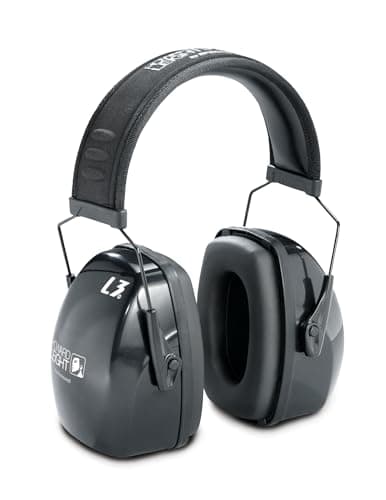
The pick when blocking is the only job and hearing the woods does not matter: sighting a rifle in at the bench, an indoor range, or standing next to other people's centerfire rifles for an afternoon. Honeywell rates the Leightning L3 at NRR 30 dB using an Air Flow Control design, which is the highest published figure among the protectors on this site, and after NIOSH's 25 percent earmuff derating it is still worth about 22.5 dB in the real world. No batteries, no circuitry, no hiss, and a steel-wire telescopic headband that survives a decade in a truck. Honest cons: it blocks the approaching deer and the conversation along with the muzzle blast, which makes it a poor woods muff and a poor choice for a beginner being coached; the deeper cups catch a long-gun stock on the mount more than slim cups do; and a hood or a thick hat over it breaks the seal, at which point the 30 dB figure stops meaning anything.
#ad · Price as of October 17, 2026. We may earn a commission.
Howard Leight Impact Sport Electronic Earmuff
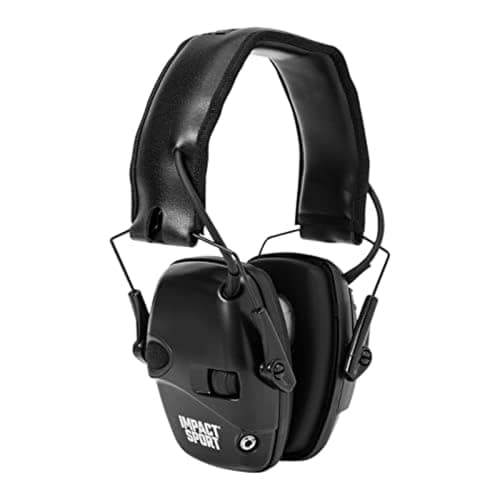
The pick for hunting itself, and the reason the table's lowest rating is also our usual recommendation. Honeywell publishes NRR 22 dB in both on and off mode, 4x amplification of quiet sound, and electronics that shut the amplification off the instant an impulse reaches 82 dB - so the hunter hears the woods right up to the shot and never hears the shot at full value. Derated, 22 dB is worth about 16.5 dB, which takes a published 150 dB shotgun peak to roughly 133.5 dB and a 140 dB rifle peak to about 123.5 dB: comfortably under OSHA's 140 dB impulse limit. That is the point - a rating that clears the line on a protector that stays on your head beats a higher rating that does not. Honest cons: 22 dB is the lowest published figure on this page; it is the Med/Large size and sits loose on a small head; and the 2 AAA cells are not rechargeable.
#ad · Price as of October 17, 2026. We may earn a commission.
Walker's Silencer 2.0 Electronic Earbuds
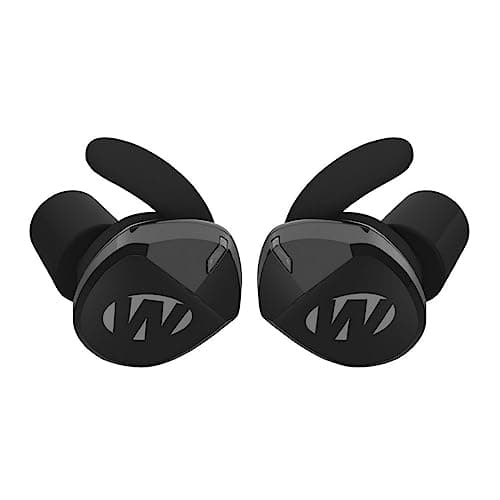
The pick when a muff genuinely does not work - under a parka hood, against a shotgun comb, or for a shooter who has quietly stopped wearing protection because muffs ruin their gun mount. Walker's publishes NRR 24 dB for the Silencer 2.0 line, higher than either electronic muff here, with sound-activated compression, Bluetooth and three fin sizes in the box. The honest framing is the one this page exists to give you: because NIOSH derates earplugs by 50 percent rather than 25, that 24 dB label is worth about 12 dB in practice - less than the 22 dB muff - and it still clears OSHA's impulse limit against a shotgun by a smaller margin. Buy it for the fit advantage, not for the bigger number. Honest cons: in-ear protection depends completely on insertion that nobody can verify, which makes it the wrong choice for a child or a beginner; buds are easy to lose; and they need charging rather than a fresh AAA.
#ad · Price as of October 17, 2026. We may earn a commission.
Does doubling up actually add the two ratings together?
No, and this is worth stating plainly because the arithmetic is tempting. Wearing NRR 30 muffs over NRR 33 plugs does not give you 63 dB of protection. Combined attenuation is not additive — once the outer protector is doing its job, sound starts reaching the inner ear through bone conduction and through the head rather than through the ear canal, and that sets a practical ceiling. The honest version is that doubling up gives you a useful extra increment over the better of the two protectors, not a sum. It is still the right call in a crowded pit blind or on an indoor range, which is why it appears twice in the table above.
What NRR does not tell you
How it performs at the frequencies that matter. NRR is a single number compressed out of attenuation measured across a frequency range. A gunshot is an impulse with most of its energy concentrated high, and two protectors with the same NRR can behave differently against it.
How fast the electronics clamp.For an electronic protector, the response time matters as much as the rating. Walker's publishes 0.02-second sound-activated compression on the Razor Slim; Howard Leight publishes electronics that cut amplification at an 82 dB impulse threshold on the Impact Sport; 3M's Sport Tactical 500 measures the energy in each shot and sets the suppression length accordingly rather than using a fixed clamp. None of that is captured in the NRR.
Whether you will wear it. Which, for a hunter, is the number that decides everything else.
Where these numbers come from
We do not run a test lab and we have not measured a decibel. Every NRR figure, amplification claim and compression time on this page is the manufacturer's own published specification; the gunshot peak levels are ASHA's published noise chart; the 140 dB impulse limit is OSHA's own standard; and the derating percentages are NIOSH's recommendation from its 1998 criteria document. All six are cited below. The arithmetic in the table is simply those published figures multiplied out — it is not a measurement, and nothing on this page carries a score or an award from us. Our method is on the how we choose page.
One limitation stated plainly: derating by a flat percentage is a rule of thumb that NIOSH offers for exactly this purpose, not a prediction of what your ears receive. Your actual attenuation depends on the seal you get, and the seal depends on your head, your glasses, your hat and your hood. That is the real reason the fit advice keeps coming first.
Keep browsing
Best hunting hearing protection ranks all six pairs we cover with their published ratings, earplugs vs earmuffs for hunting settles the form-factor argument, and best hearing protection for duck hunting is the page for the hunt where a hood, a hat and a shotgun stock all fight the protector at once. If you are not yet convinced any of this matters, do you need ear protection for hunting is the place to start.
Frequently asked questions
What NRR do I need for hunting?
For a single firearm, a protector worth about 10 dB or more after derating, which any properly fitted earmuff clears. Work it from the published figures: ASHA lists firearms at roughly 140 dB peak and shotguns at roughly 150 dB, OSHA says impulse noise should not exceed 140 dB peak, and NIOSH recommends derating a labeled NRR by 25 percent for muffs. A 22 dB muff is worth about 16.5 dB real, which takes a shotgun to roughly 133.5 dB.
Is NRR 22 enough for shooting?
Yes, for hunting with a properly fitted muff. Derated by 25 percent it is worth about 16.5 dB, which brings a published 150 dB shotgun peak down to roughly 133.5 dB and a 140 dB rifle peak to about 123.5 dB - both under OSHA's 140 dB impulse limit. For an indoor range, a busy firing line, or several guns in one blind, go higher or double up.
Is NRR 30 better than NRR 22 for hunting?
On paper yes, by about six decibels of real attenuation after derating. In the woods it is usually the worse buy, because a passive 30 dB muff blocks the footsteps, the conversation and the approaching animal along with the muzzle blast, so hunters take it off - and a protector around your neck has an NRR of zero. Keep the 30 dB pair for sighting in and the range.
Can you add the NRR of earplugs and earmuffs together?
No. Combined attenuation is not additive: once the outer protector is working, sound reaches the inner ear through the head and through bone conduction rather than through the ear canal, which sets a practical ceiling. Doubling up gives a useful extra increment over the better of the two, not a sum - but it is still the right call in a crowded pit blind or on an indoor range.
Why is the real NRR lower than the number on the box?
Because the label is a laboratory figure measured on a perfectly fitted protector, and almost nobody achieves a laboratory fit in the field. NIOSH recommends derating for real-world use: subtract 25 percent for earmuffs, 50 percent for slow-recovery foam plugs and 70 percent for other plugs. That is also why a plug with a higher label can be worth less in practice than a muff with a lower one.
What NRR does a child need for hunting?
Whatever a protector that seals on their head happens to be rated at. An adult muff on a child's head does not seal, and an unsealed protector does not deliver a reduced rating - it delivers almost nothing, because sound takes the easiest path in. Buy a youth-sized muff first and treat its NRR as a secondary consideration.
Sources
- American Speech-Language-Hearing Association - Loud Noise Dangers noise chart: firearms approximately 140 dB peak, shotgun approximately 150 dB peak, both listed as not safe for any period of time
- OSHA 29 CFR 1910.95, Table G-16 footnote - exposure to impulsive or impact noise should not exceed 140 dB peak sound pressure level
- NIOSH - Criteria for a Recommended Standard: Occupational Noise Exposure (1998), on NRR labeling and recommended derating of 25% for earmuffs, 50% for slow-recovery foam earplugs and 70% for other earplugs
- Howard Leight Shooting Sports - Leightning L3 shooting earmuff (R-03318): NRR 30 dB, Air Flow Control
- Honeywell Howard Leight - Impact Sport electronic earmuff (R-02524): NRR 22 dB on and off, 4x amplification, 82 dB compression threshold
- Walker's Game Ear - Silencer 2.0 electronic earbuds: published NRR 24 dB, sound-activated compression
- Walker's Game Ear - Razor Slim electronic ear muff: NRR 23 dB, 0.02-second sound-activated compression
- 3M - Peltor Sport Tactical 500 (TAC500-OTH): NRR 26 dB, Dynamic Suppression Time, Clear Voice Tracking