Gear Guides
Howard Leight Impact Sport vs Peltor Sport Tactical 500
One of these costs roughly twice the other and protects about four decibels better on paper. The real difference is not the rating - it is what each one does to the sound in between the shots.
Buy the Howard Leight Impact Sport if the person hunts. Buy the Peltor Sport Tactical 500 if they shoot a lot — ranges, clays, coaching, practice days — because what the extra money buys is not protection, it is better handling of the sound between the shots. On published ratings the gap is four decibels: Honeywell rates the Impact Sport at NRR 22 dB and 3M publishes NRR 26 dB for the Sport Tactical 500 (TAC500-OTH).
Four decibels is a real difference and a small one, and it is not the reason to spend the money. The reason is how the electronics behave. The Impact Sport uses a fixed approach: it amplifies quiet sound roughly fourfold and cuts the amplification the instant an impulse reaches 82 dB. That is the whole trick, and for a hunter sitting in the woods and taking one or two shots a season, it is enough trick.
The Sport Tactical 500 does something more sophisticated. 3M's Dynamic Suppression Time measures the energy in each shot and sets how long to suppress accordingly rather than clamping for a fixed interval, and Clear Voice Tracking works to pull speech out of background noise instead of amplifying everything equally. On a firing line with other people shooting and somebody talking to you, those two features are the difference between hearing a conversation and hearing mush. On a quiet stand at dawn, they are mostly idle.
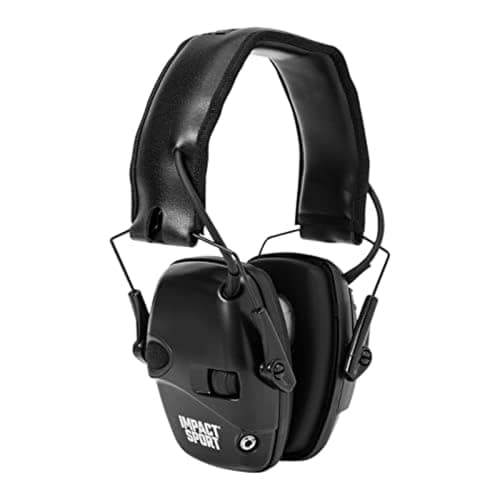
Howard Leight Impact Sport Electronic Earmuff
The default pair, and the one to put in a box for someone else. Honeywell publishes NRR 22 dB in both on and off modes, 4x amplification of quiet sound, and electronics that shut the amplification off the moment an impulse sound reaches 82 dB - so the hunter hears the woods right up to the shot and never hears the shot at full value. It runs on two AAA batteries with an automatic four-hour shut-off, and the cutaway at the bottom of the earcup exists specifically to clear the stock of a long gun. The gift argument is boring and decisive: it is the muff most hunters already recognise, and a flat AAA can be replaced at any gas station on the way to the woods. Honest cons: 22 dB is the lower published figure of the two on this page; the cells are not rechargeable; this is the Med/Large size and can sit loose on a small head; and the amplification is a blunt instrument next to the Peltor's.
#ad · Price as of October 10, 2026. We may earn a commission.
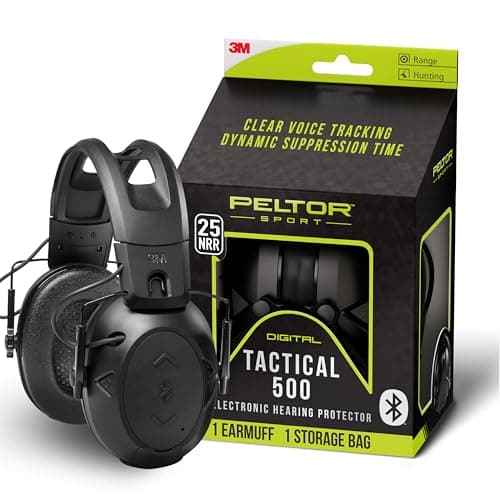
Peltor Sport Tactical 500 Bluetooth Earmuffs
The pick for the shooter rather than the sitter. 3M's electronics are the genuine differentiator: Dynamic Suppression Time measures the energy in each gunshot and sets the suppression length accordingly rather than using a fixed clamp, and Clear Voice Tracking works to pull speech out of background noise instead of amplifying everything equally - which is exactly what a busy firing line or a coaching session needs. It adds Bluetooth for calls, low-profile cups with long-gun cutouts, a vented headband for wearing over a cap, and recessed microphones to cut wind noise. On protection, 3M's own documentation for the TAC500-OTH publishes NRR 26 dB while this listing states 25 dB - either way it is the better-rated pair here. Honest cons: it costs roughly twice the Impact Sport; it is heavier on the head over a long day; the Bluetooth is a range-and-driving feature far more than a woods one; and more electronics means more to fail in the wet.
#ad · Price as of October 10, 2026. We may earn a commission.
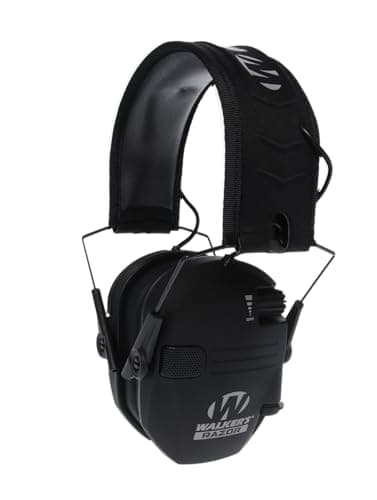
Walker's Razor Slim Electronic Muff
Worth knowing about before you choose between the two above, because it undercuts both and is the pair that made electronic protection normal. Walker's publishes NRR 23 dB - a decibel above the Impact Sport - with two hi-gain omnidirectional microphones, sound-activated compression that clamps a spike in 0.02 seconds, independent volume per ear and an audio input jack. Its real argument is physical rather than electronic: the ultra-low-profile cups fold flat and are genuinely easier to mount a long gun under than a standard muff. Honest cons: slim cups mean less room inside and less comfort on a full day; the headband padding is thin; and the amplification has an audible hiss that the Peltor does not.
#ad · Price as of October 10, 2026. We may earn a commission.
Head to head on published specs
| Impact Sport | Sport Tactical 500 | Razor Slim | |
|---|---|---|---|
| Published NRR | 22 dB (on and off) | 26 dB (3M; listing states 25) | 23 dB |
| How it handles a shot | Amplification cuts at 82 dB impulse | Dynamic Suppression Time - duration set by shot energy | Compression clamps in 0.02 s |
| Voice handling | 4x amplification of everything quiet | Clear Voice Tracking separates speech from noise | Hi-gain mics, audible hiss |
| Bluetooth | No | Yes | No (audio input jack) |
| Cup profile | Standard, with long-gun cutaway | Low profile, with long-gun cutouts | Ultra low profile, folds flat |
| Price band | Mid | Roughly double the Impact Sport | Lowest here |
Read the second and third rows, not the first. Both pairs protect adequately; they differ in what they do to the sound you want to hear. That is the purchase decision, and it follows directly from how often the person is around gunfire.
Which one, by who they are
| The person | Buy | Because |
|---|---|---|
| A hunter who takes a shot or two a season | Impact Sport | The extra electronics sit idle on a quiet stand |
| Somebody who shoots clays or at a range regularly | Sport Tactical 500 | Speech separation and shot-by-shot suppression earn their money |
| Someone coaching a new shooter | Sport Tactical 500 | Being heard clearly over a live line is the whole job |
| A gift, where you do not know their habits | Impact Sport | Recognisable, AAA cells anywhere, half the price |
| A hunter who hates muffs under a gun | Razor Slim | The slimmest cups here, and the cheapest |
| A child or young shooter | Neither - see the youth page | Adult muffs do not seal on a small head |
That last row matters more than it looks. A hearing protector that does not seal has no effective rating at all, which is why the best hearing protection for youth hunters is a separate page rather than a smaller size of this one.
What neither of these does
Neither pair blocks as much raw sound as a good passive muff. The passive Howard Leight Leightning L3 is rated NRR 30 dB — substantially more attenuation than anything powered here — because it has no amplification to give back. That makes it the better choice at an indoor range, in hard rain, and as the spare in the truck, and the worse choice on a stand where hearing the woods is the point. Earplugs vs earmuffs for hunting covers the form-factor version of that trade-off.
And neither solves the problem of a muff colliding with a cheek weld. If the hunter has quietly stopped wearing protection because the cups push their head off the stock, electronic earbuds are the fix rather than a different muff — ranked on best hearing protection for hunting.
Buying either as a gift
Hearing protection is one of the few hunting gifts that is unambiguously good for the recipient and almost impossible to get wrong on sizing — a headband adjusts. Two pointers. First, buy electronic rather than passive if they hunt, because passive protection gets taken off and protection that is off protects nothing. Second, throw a four-pack of AAA cells in the box with the Impact Sport; a flat battery is the only way that pair disappoints.
For gift context, hunting gifts under $100 is the bracket the Impact Sport sits in, and hunting gifts under $200 covers the Peltor.
How we chose these
We do not run a test lab and we have not measured a decibel. Every NRR figure, suppression behaviour, microphone and Bluetooth detail above is the manufacturer's own published specification, cited below, plus NIOSH's published derating guidance. Nothing here has a score or an award from us, because we have not run a test that would justify one. Our method is on the how we choose page, and prices come live from Amazon with the capture date beside them.
Keep browsing
Howard Leight vs Walker's Razor is the other brand comparison in this family, and do you need ear protection for hunting is the page to read first if the answer is not obviously yes. Best hearing protection for hunting ranks the whole category.
Frequently asked questions
Is the Peltor Sport Tactical 500 better than the Howard Leight Impact Sport?
On published protection, yes but narrowly - 3M publishes NRR 26 dB for the Sport Tactical 500 against Honeywell's 22 dB for the Impact Sport. The real difference is the electronics: the Peltor sets suppression length from the energy of each shot and works to separate speech from background noise, which matters on a busy range and barely matters on a quiet stand. For hunting, the Impact Sport is the better buy.
What NRR do I need for hunting?
Less than the headline numbers suggest, because fit beats rating. NIOSH recommends derating labelled earmuff NRR by about 25 per cent for real-world use, so a well-seated 22 dB muff outperforms a badly fitted higher-rated one. Choose a protector the person will actually wear correctly, then compare decibels.
Is the Peltor Sport Tactical 500 worth twice the price?
For someone who shoots regularly, often. Clear Voice Tracking and shot-by-shot suppression make a live firing line far less exhausting, and the Bluetooth is genuinely useful driving to and from. For a hunter who takes one or two shots a season, those features sit idle and the money is better spent elsewhere.
Which electronic earmuff is best for a gift?
The Howard Leight Impact Sport. It is the pair most hunters recognise, it costs about half the Peltor, a headband adjusts so there is no size to guess, and it runs on AAA cells you can buy anywhere. Put a four-pack of batteries in the box - a flat battery is the only way it disappoints.
Do electronic earmuffs still protect when the batteries die?
Yes. Both pairs are passive hearing protectors with electronics added, so a flat battery drops them back to their passive performance rather than leaving the wearer unprotected - they just stop amplifying quiet sound. Honeywell publishes the Impact Sport's NRR 22 dB in both on and off modes for exactly that reason.
Should I buy a passive muff instead?
At an indoor range, in hard rain, or as a spare in the truck, yes - the passive Howard Leight Leightning L3 is rated NRR 30 dB, more than anything powered here. On a hunt, no: passive protection blocks the approaching animal and the conversation along with the muzzle blast, which is why hunters take it off and end up with no protection at all.
Sources
- Honeywell Howard Leight - Impact Sport electronic earmuff (R-02524) published specifications: NRR 22 dB, 4x amplification, 82 dB shut-off, 2 x AAA with 4-hour auto shut-off
- 3M - Peltor Sport Tactical 500 electronic hearing protector (TAC500-OTH): NRR 26 dB, Dynamic Suppression Time, Clear Voice Tracking, Bluetooth, recessed microphones
- Walker's Game Ear - Razor Slim electronic ear muff: NRR 23 dB, dual hi-gain omnidirectional microphones, 0.02 s sound-activated compression, independent volume controls, audio input jack
- Howard Leight Shooting Sports - Leightning L3 shooting earmuff (R-03318): NRR 30 dB, Air Flow Control
- NIOSH - Criteria for a Recommended Standard: Occupational Noise Exposure (1998), on NRR labelling and recommended derating