Gear Guides
The Best Hunting Knife for Field Dressing
Field dressing is not skinning, and the knife that is best at it is smaller than most people buy. Three to four inches, a fine point, and an edge that is still sharp at the end of the job.
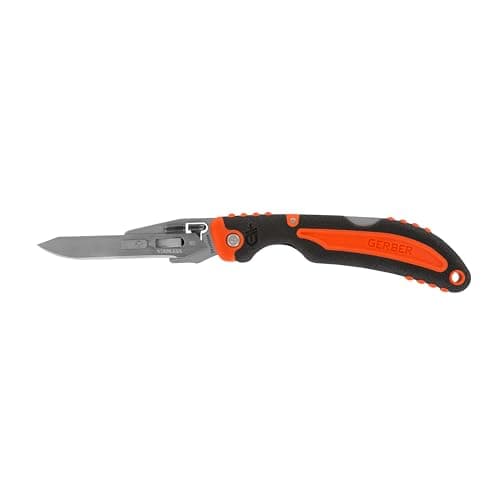
For field dressing, buy the Gerber Vital. A replaceable-blade knife is the honest answer to the actual problem with gutting an animal, which is not cutting power — it is that hide, hair and bone take the edge off a conventional blade partway through, and the second half of the job gets done with a dull knife. If the hunter would rather own one knife they sharpen themselves, the Morakniv Companion is the budget pick and the Buck 110 is the folder most hunters already trust.
Start with the distinction almost every "best hunting knife" page skips. Field dressing is the gutting job: opening the body cavity without puncturing the stomach or intestines, working around the diaphragm, and freeing the windpipe. Skinning is a separate job with a separate blade shape, and best skinning knives covers that one. The two get conflated constantly, and it is why hunters buy a big, deep-bellied skinner and then find it clumsy for the first and most delicate part of the work.
What the gutting job actually wants: a blade around three to four inches, a controllable point, a handle that still grips when it is wet with blood, and — above everything — an edge that is sharp at the end. The four picks below are ranked on exactly that, with prices pulled live from Amazon.
- 1Gerber Vital Replaceable-Blade KnifeThe pick, because it attacks the real failure mode. Gerber builds the Vital around snap-in replaceable surgical blades: when the edge dulls - and on hide and hair it will, partway through a deer - you fit a fresh one rather than finish the job with a blunt knife. For field dressing specifically that matters more than it does for anything else a hunting knife is asked to do, because the first cuts into the body cavity are the ones you want precision and a scalpel edge for. The blades are fine enough to work close to the diaphragm without pushing, and the handle has a rubberised grip for wet hands. Honest cons: replaceable blades are thin and will snap if you pry or hit bone with them, so this is not a camp knife; you have to carry spare blades and a safe way to store used ones; and a scalpel-sharp blade is genuinely easier to cut yourself with, which is a real consideration for a beginner or a gift.Best for: Best overall for field dressing
- 2
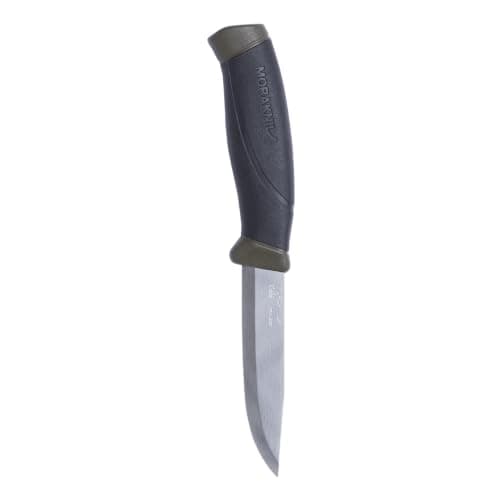 Morakniv Companion Fixed-Blade KnifeThe pick for a hunter who wants one knife, sharpens it themselves, and does not want to think about spare blades. The Companion is a Scandinavian fixed blade with a roughly four-inch blade, a high-friction rubber handle and a famously keen factory edge - and a Scandi grind is unusually easy to bring back to sharp with a simple stone, which is the property that matters on a knife you will resharpen rather than replace. It is the cheapest knife on this page by a wide margin and genuinely good rather than merely cheap. Honest cons: the carbon-steel versions rust if put away wet, and a gut pile is a wet environment; there is no finger guard worth the name, which is the one thing we would change on a knife used in blood; and the plastic sheath is functional rather than nice, which shows if this is a gift.Best for: Best budget fixed blade
 - 3
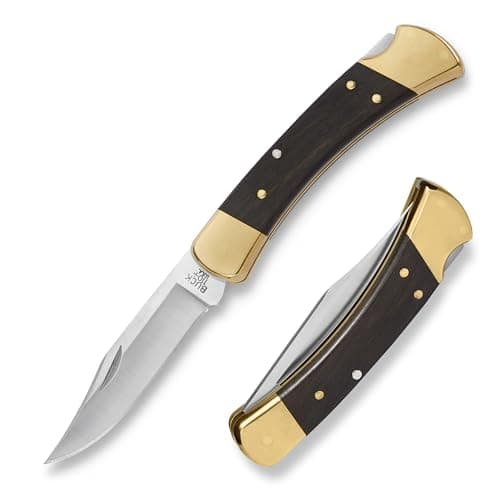 Buck 110 Folding HunterThe pick if the hunter prefers a folder, which a great many do - a folding knife rides in a pocket or on a belt all season rather than living in a pack. The Buck 110 Folding Hunter is the knife most North American hunters recognise on sight, with a clip-point blade that gives a fine, controllable tip for opening a body cavity and a lockback that will not close on your fingers mid-cut. As a gift it is the safest choice on this page: there is nothing to explain, nothing to buy alongside it, and it looks like the considered present it is. Honest cons: it is heavy for its size, being brass and wood rather than polymer; a folder is harder to clean properly than a fixed blade, which matters after field dressing specifically; and the clip point is a compromise - good at gutting, average at skinning.Best for: Best folder, and the safest gift
 - 4
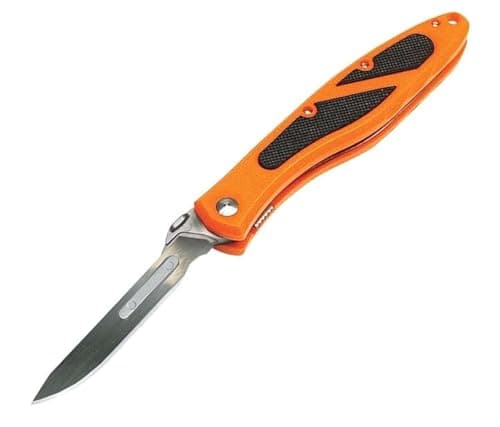 Havalon Piranta-Edge Skinning KnifeThe other replaceable-blade option, and the pick for a hunter who does the whole animal themselves rather than dropping it at a processor. Havalon builds the Piranta around a surgical blade too, but with a narrower, more curved blade profile that is at its best once the cavity is open and the work moves to caping and separating. Many hunters who process their own deer carry both this and a conventional knife, which is the honest use case rather than a one-knife solution. Honest cons: the same thin-blade fragility as any scalpel knife, and the same spare-blade logistics; the folding mechanism on a blood-slick surgical knife asks for care; and if the recipient is going to drop the deer at a processor, they do not need this level of blade.Best for: Best for someone who processes their own game
| # | Gift | Best for | Price |
|---|---|---|---|
| 1 | Gerber Vital Replaceable-Blade KnifeThe pick, because it attacks the real failure mode. Gerber builds the Vital around snap-in replaceable surgical blades: when the edge dulls - and on hide and hair it will, partway through a deer - you fit a fresh one rather than finish the job with a blunt knife. For field dressing specifically that matters more than it does for anything else a hunting knife is asked to do, because the first cuts into the body cavity are the ones you want precision and a scalpel edge for. The blades are fine enough to work close to the diaphragm without pushing, and the handle has a rubberised grip for wet hands. Honest cons: replaceable blades are thin and will snap if you pry or hit bone with them, so this is not a camp knife; you have to carry spare blades and a safe way to store used ones; and a scalpel-sharp blade is genuinely easier to cut yourself with, which is a real consideration for a beginner or a gift. | Best overall for field dressing | $37.00View on Amazon |
| 2 | Morakniv Companion Fixed-Blade KnifeThe pick for a hunter who wants one knife, sharpens it themselves, and does not want to think about spare blades. The Companion is a Scandinavian fixed blade with a roughly four-inch blade, a high-friction rubber handle and a famously keen factory edge - and a Scandi grind is unusually easy to bring back to sharp with a simple stone, which is the property that matters on a knife you will resharpen rather than replace. It is the cheapest knife on this page by a wide margin and genuinely good rather than merely cheap. Honest cons: the carbon-steel versions rust if put away wet, and a gut pile is a wet environment; there is no finger guard worth the name, which is the one thing we would change on a knife used in blood; and the plastic sheath is functional rather than nice, which shows if this is a gift. | Best budget fixed blade | $19.48View on Amazon |
| 3 | Buck 110 Folding HunterThe pick if the hunter prefers a folder, which a great many do - a folding knife rides in a pocket or on a belt all season rather than living in a pack. The Buck 110 Folding Hunter is the knife most North American hunters recognise on sight, with a clip-point blade that gives a fine, controllable tip for opening a body cavity and a lockback that will not close on your fingers mid-cut. As a gift it is the safest choice on this page: there is nothing to explain, nothing to buy alongside it, and it looks like the considered present it is. Honest cons: it is heavy for its size, being brass and wood rather than polymer; a folder is harder to clean properly than a fixed blade, which matters after field dressing specifically; and the clip point is a compromise - good at gutting, average at skinning. | Best folder, and the safest gift | $89.99View on Amazon |
| 4 | Havalon Piranta-Edge Skinning KnifeThe other replaceable-blade option, and the pick for a hunter who does the whole animal themselves rather than dropping it at a processor. Havalon builds the Piranta around a surgical blade too, but with a narrower, more curved blade profile that is at its best once the cavity is open and the work moves to caping and separating. Many hunters who process their own deer carry both this and a conventional knife, which is the honest use case rather than a one-knife solution. Honest cons: the same thin-blade fragility as any scalpel knife, and the same spare-blade logistics; the folding mechanism on a blood-slick surgical knife asks for care; and if the recipient is going to drop the deer at a processor, they do not need this level of blade. | Best for someone who processes their own game | $55.99View on Amazon |
Prices from Amazon as of October 10, 2026 and change often — the button always opens the current listing. Some links earn us a commission at no extra cost to you.
Gerber Vital Replaceable-Blade Knife
The pick, because it attacks the real failure mode. Gerber builds the Vital around snap-in replaceable surgical blades: when the edge dulls - and on hide and hair it will, partway through a deer - you fit a fresh one rather than finish the job with a blunt knife. For field dressing specifically that matters more than it does for anything else a hunting knife is asked to do, because the first cuts into the body cavity are the ones you want precision and a scalpel edge for. The blades are fine enough to work close to the diaphragm without pushing, and the handle has a rubberised grip for wet hands. Honest cons: replaceable blades are thin and will snap if you pry or hit bone with them, so this is not a camp knife; you have to carry spare blades and a safe way to store used ones; and a scalpel-sharp blade is genuinely easier to cut yourself with, which is a real consideration for a beginner or a gift.
#ad · Price as of October 10, 2026. We may earn a commission.
Morakniv Companion Fixed-Blade Knife
The pick for a hunter who wants one knife, sharpens it themselves, and does not want to think about spare blades. The Companion is a Scandinavian fixed blade with a roughly four-inch blade, a high-friction rubber handle and a famously keen factory edge - and a Scandi grind is unusually easy to bring back to sharp with a simple stone, which is the property that matters on a knife you will resharpen rather than replace. It is the cheapest knife on this page by a wide margin and genuinely good rather than merely cheap. Honest cons: the carbon-steel versions rust if put away wet, and a gut pile is a wet environment; there is no finger guard worth the name, which is the one thing we would change on a knife used in blood; and the plastic sheath is functional rather than nice, which shows if this is a gift.
#ad · Price as of October 10, 2026. We may earn a commission.
Buck 110 Folding Hunter
The pick if the hunter prefers a folder, which a great many do - a folding knife rides in a pocket or on a belt all season rather than living in a pack. The Buck 110 Folding Hunter is the knife most North American hunters recognise on sight, with a clip-point blade that gives a fine, controllable tip for opening a body cavity and a lockback that will not close on your fingers mid-cut. As a gift it is the safest choice on this page: there is nothing to explain, nothing to buy alongside it, and it looks like the considered present it is. Honest cons: it is heavy for its size, being brass and wood rather than polymer; a folder is harder to clean properly than a fixed blade, which matters after field dressing specifically; and the clip point is a compromise - good at gutting, average at skinning.
#ad · Price as of October 10, 2026. We may earn a commission.
Havalon Piranta-Edge Skinning Knife
The other replaceable-blade option, and the pick for a hunter who does the whole animal themselves rather than dropping it at a processor. Havalon builds the Piranta around a surgical blade too, but with a narrower, more curved blade profile that is at its best once the cavity is open and the work moves to caping and separating. Many hunters who process their own deer carry both this and a conventional knife, which is the honest use case rather than a one-knife solution. Honest cons: the same thin-blade fragility as any scalpel knife, and the same spare-blade logistics; the folding mechanism on a blood-slick surgical knife asks for care; and if the recipient is going to drop the deer at a processor, they do not need this level of blade.
#ad · Price as of October 10, 2026. We may earn a commission.
Field dressing vs skinning: two jobs, two blades
| Field dressing (gutting) | Skinning | |
|---|---|---|
| What you are cutting | Hide at the belly, then thin membrane | Hide away from muscle, over a large area |
| Blade length that suits it | About 3 to 4 inches | 3 to 5 inches, with more belly |
| Point shape | Fine and controllable, or a gut hook | Rounded or upswept, to avoid nicking hide |
| What ruins the job | Puncturing the stomach or intestines | A dull edge and holes in the hide |
| Edge life demanded | High - it dulls on hair partway through | High, for the same reason |
| The pick here | Gerber Vital | See the skinning roundup |
The practical consequence: a hunter who owns a big deep-bellied skinner and nothing else is using the wrong tool for the first twenty minutes of the work. A hunter who owns a four-inch knife with a fine point can do both, slightly less well at the second. Fixed vs folding hunting knife covers the other half of the decision.
Specs on the four picks
| Pick | Type | Edge strategy | Best suited to |
|---|---|---|---|
| Gerber Vital | Replaceable-blade fixed | Snap in a fresh blade mid-job | The gutting job, start to finish |
| Morakniv Companion | Fixed blade, Scandi grind | Resharpen on a simple stone | One-knife hunters on a budget |
| Buck 110 | Folding lockback, clip point | Resharpen; holds a usable edge | Pocket carry, and gifts |
| Havalon Piranta | Replaceable-blade folder | Snap in a fresh blade mid-job | Hunters who process their own game |
If the hunter resharpens rather than replaces, the sharpener matters as much as the knife — a $20 knife with a good edge beats a $200 knife with a bad one every time. Best hunting knife sharpeners ranks those, and how to sharpen a hunting knife is the plain-language method.
Do you need a gut hook?
A gut hook is a small hooked blade on the spine of a knife, designed to open the hide along the belly without the point reaching the organs underneath. It genuinely helps on the one cut it exists for, and it is in the way for everything else — which is why opinion on them is so split. What is a gut hook knife explains it properly, including the honest case against.
None of the four picks here is a gut-hook knife, and that is deliberate: a fresh, fine blade used carefully does the same cut, and a replaceable-blade knife is never dull enough to need the hook's help. If the hunter has asked for a gut hook specifically, buy one — preference is a real reason — but it is not a feature we would add for someone who has not.
Buying a field-dressing knife as a gift
Two warnings and one easy answer. The warnings: a scalpel-bladed knife is a thoughtful gift for an experienced hunter and a slightly risky one for a brand-new hunter, and a knife for anybody under eighteen is a conversation to have with a parent first. The easy answer is the Buck 110 — recognisable, nothing to explain, nothing to buy alongside it.
If you want the gift to feel complete, pair a knife with a small sharpener and a pack of nitrile gloves. That is the kit a hunter assembles for themselves and never thinks to ask for. Hunting knife gift guide runs the gift angle in full, and Gerber Vital vs Havalon Piranta is the head-to-head between the two replaceable-blade picks above if you are choosing between them.
How we chose these
We do not run a test lab and we have not field dressed an animal with each of these to compare. Every blade type, grind, lock and handle detail above is the manufacturer's own published product information, cited below, and the ranking is reasoning about which part of the job each knife suits rather than a test result. No knife here carries a score or an award from us. Our method is on the how we choose page, and prices come live from Amazon with the capture date beside them.
Keep browsing
Best hunting knives ranks the category generally, best skinning knives covers the job that comes after this one, and best hunting knives under $50 is the budget version. How to choose a hunting knife explains blade steel and grinds without the jargon.
Frequently asked questions
What is the best knife for field dressing a deer?
A replaceable-blade knife like the Gerber Vital, because the real problem with gutting an animal is that the edge dulls on hide and hair partway through and the rest of the job gets done blunt. If the hunter prefers one knife they sharpen themselves, a four-inch fixed blade like the Morakniv Companion or a Buck 110 folder both do the job well.
What size blade is best for field dressing?
About three to four inches. Long blades are harder to control inside a body cavity and offer no advantage, because nothing in field dressing requires reach. A short blade with a fine, controllable point is what keeps the tip away from the stomach and intestines, which is the only thing that genuinely ruins the job.
Is a field dressing knife the same as a skinning knife?
No, and conflating them is why hunters buy the wrong knife. Field dressing is the gutting job - opening the cavity and working around the diaphragm - and wants a short blade with a fine point. Skinning is separating hide from muscle over a large area and wants more belly and a blunter tip. A four-inch knife with a fine point does both, slightly less well at skinning.
Do I need a gut hook for field dressing?
No, though it helps on the one cut it is designed for - opening the hide along the belly without the point reaching the organs. A fresh, fine blade used carefully does the same thing, and a gut hook is in the way for every other cut. Buy one if the hunter has asked for it; do not add it for someone who has not.
Are replaceable-blade knives good for hunting?
For field dressing and processing, they are excellent, because you fit a fresh scalpel edge the moment the old one drags rather than finishing on a dull knife. They are not general-purpose knives: the blades are thin and will snap if you pry or hit bone, and you have to carry spares plus a safe way to store used blades.
Is a knife a good gift for a hunter?
Yes, and the Buck 110 is the safest version - recognisable, nothing to explain, nothing to buy alongside it. Two cautions: a scalpel-bladed knife suits an experienced hunter better than a brand-new one, and any knife for someone under eighteen is a conversation to have with a parent first.
Sources
- Gerber Gear - published product information for the Vital replaceable-blade knife (exchangeable surgical blades, rubberised grip)
- Morakniv - published product information for the Companion fixed-blade knife (blade length, Scandi grind, high-friction handle)
- Buck Knives - published product information for the 110 Folding Hunter (clip-point blade, lockback)
- Havalon Knives - published product information for the Piranta-Edge replaceable-blade knife
- Michigan State University Extension - published guidance on field dressing deer and avoiding meat contamination