Gear Guides
The Best Hearing Protection for Duck Hunting
A duck blind breaks every rule a shooting muff is built for: a hood over your ears, a gun coming up fast, four people shooting at once, and water everywhere. That is why the right answer here is not the right answer on a rifle range.
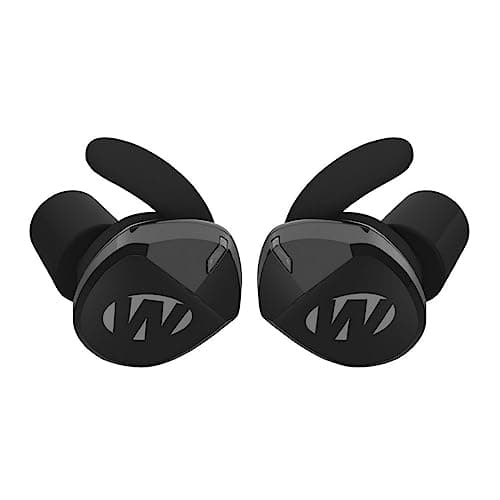
Buy the Walker's Silencer 2.0 electronic earbuds. In a duck blind they are the only form factor that does not fight the three things waterfowl hunting puts on your head — a hood, a hat and a shotgun stock — and they still publish a higher NRR (24 dB) than either electronic muff here. If you want something a gift recipient cannot insert wrong, or you are buying for a kid in the blind, the Walker's Razor Slim is the muff to get: its ultra-low-profile cups are the easiest to shoot a shotgun under.
Here is why duck hunting deserves its own page. Almost every "best shooting ear protection" list is written around a static firing line: you stand still, the gun is already shouldered, and nothing is on your head. A duck blind is the opposite. You are hunched under a hood in the dark, the birds commit without warning, the gun comes up in half a second, and three or four people fire shotguns inside a few feet of each other. Shotguns are also the loud end of the sporting-firearm range — the American Speech-Language-Hearing Association's published noise chart puts a shotgun at about 150 dB peak, against roughly 140 dB peak for firearms generally, and OSHA's own standard says impulse noise should not exceed 140 dB peak at all.
So the job is not "block the most decibels". It is "block enough decibels on a protector the hunter will still be wearing when the birds come in". The four picks below are ranked by how well each survives a real blind, with published NRR figures and live prices from Amazon.
- 1Walker's Silencer 2.0 Electronic EarbudsThe pick, because nothing about a duck blind suits a muff and everything about it suits a bud. There is no cup to collide with the comb of a shotgun stock, nothing that a parka hood pushes out of position, nothing that a hat brim lifts off the ear, and nothing to take off when a flight appears - which matters more than any rating, because the protection a hunter removes is worth zero decibels. Walker's publishes an NRR of 24 dB for the Silencer 2.0 line, which is higher than either electronic muff on this page, plus sound-activated compression, Bluetooth and three sizes of locking fin in the box. They are rechargeable, so the pre-dawn routine is a charge the night before rather than a AAA in the glovebox. Honest cons: in-ear protection depends completely on insertion and nobody - including the wearer - can see whether the seal is right, which makes buds the wrong choice for a child or a first-timer; small buds are genuinely easy to lose in a blind full of shell boxes and decoy bags; and they cost more than a very good pair of muffs.Best for: Best overall for a blind
- 2
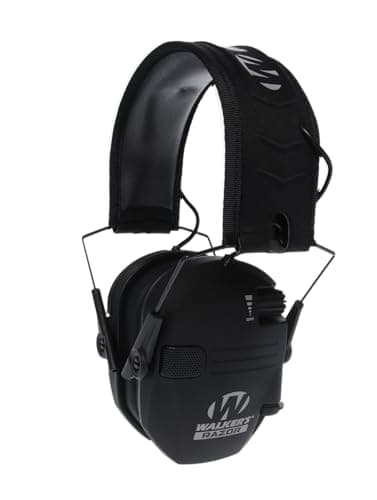 Walker's Razor Slim Electronic MuffThe pick if you want a muff, and the one to buy for somebody else. The reason is the shape: the ultra-low-profile cups are the slimmest here, which is exactly the property that decides whether a muff works on a shotgun - a shotgun is mounted with the cheek hard against the comb, and a fat cup gets levered off the ear by the stock every single time the gun comes up. Walker's publishes NRR 23 dB, two hi-gain microphones feeding full dynamic range speakers, compression that clamps a spike in 0.02 seconds, independent volume per ear and 2 AAA batteries included. Amplification matters in a blind for a reason that has nothing to do with safety: you want to hear wings and a quiet call line, and a muff that only blocks makes you the person in the blind who misses the whistle. Honest cons: slim cups hold less padding and get uncomfortable on an all-day sit sooner than a fatter muff; the amplification has an audible hiss the pricier sets do not; the headband padding is thin under a cap; and electronics plus a wet blind is a combination no muff loves.Best for: Best muff for a shouldered shotgun
 - 3
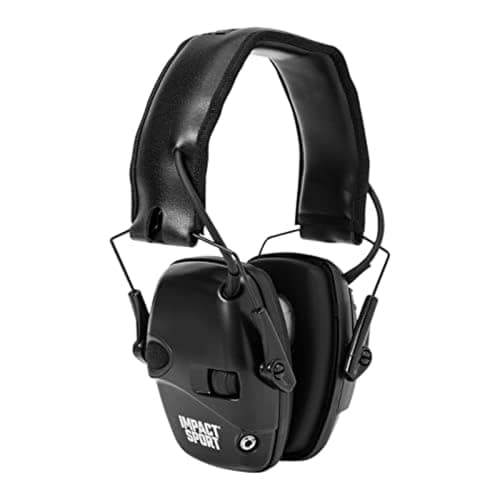 Howard Leight Impact Sport Electronic EarmuffThe default electronic muff most hunters already own, and it is a perfectly good blind muff for anyone whose gun mount tolerates it. Honeywell publishes NRR 22 dB in both on and off mode, 4x amplification of quiet sound, and electronics that cut the amplification the instant an impulse reaches 82 dB - so you hear the marsh waking up and never hear the shot at full value. Usefully for waterfowl, the earcups carry a cutaway at the bottom designed specifically to clear the stock of a long gun, which is the one concession a standard-depth muff can make to a shotgun. Honest cons: 22 dB is the lowest published rating on this page, which is the price of the electronics; it is the Med/Large size and sits loose on a small head; the 2 AAA cells are not rechargeable; and in a blind where the gun comes up fast it is still a deeper cup than the Razor Slim, so try your own gun mount before you commit.Best for: Best known default, if it clears your gun
 - 4
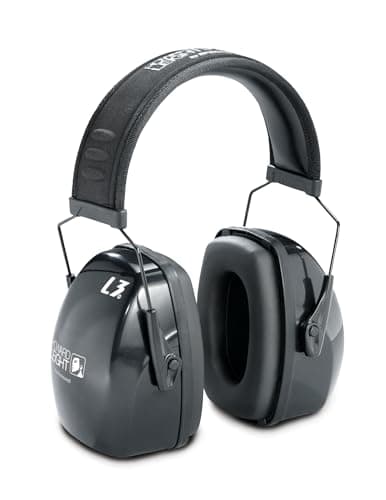 Howard Leight Leightning L3 Shooting EarmuffIncluded because the honest weak point of every other pick here is electronics in a wet blind at 5 a.m., and this is the answer to it. Honeywell rates the Leightning L3 at NRR 30 dB - substantially more raw attenuation than anything powered on this page - using an Air Flow Control design, with no batteries to flatten, no circuitry to soak and no hiss. The telescopic headband is steel-wire and the cushions snap out to be replaced, so it is the pair that survives a decade of being thrown in the bottom of a boat. Buy it as the spare that lives in the blind bag. Honest cons: it is passive, so it blocks the call line and the wing beats along with the muzzle blast, which is a real cost on a hunt where hearing birds is half the skill; the deeper cups are the most likely here to catch a shotgun stock on the mount; and a hood over a bulky muff pushes it out of seal, which is the failure mode that makes a 30 dB rating meaningless.Best for: Best for a wet morning with no batteries
| # | Gift | Best for | Price |
|---|---|---|---|
| 1 | Walker's Silencer 2.0 Electronic EarbudsThe pick, because nothing about a duck blind suits a muff and everything about it suits a bud. There is no cup to collide with the comb of a shotgun stock, nothing that a parka hood pushes out of position, nothing that a hat brim lifts off the ear, and nothing to take off when a flight appears - which matters more than any rating, because the protection a hunter removes is worth zero decibels. Walker's publishes an NRR of 24 dB for the Silencer 2.0 line, which is higher than either electronic muff on this page, plus sound-activated compression, Bluetooth and three sizes of locking fin in the box. They are rechargeable, so the pre-dawn routine is a charge the night before rather than a AAA in the glovebox. Honest cons: in-ear protection depends completely on insertion and nobody - including the wearer - can see whether the seal is right, which makes buds the wrong choice for a child or a first-timer; small buds are genuinely easy to lose in a blind full of shell boxes and decoy bags; and they cost more than a very good pair of muffs. | Best overall for a blind | $130.23View on Amazon |
| 2 | Walker's Razor Slim Electronic MuffThe pick if you want a muff, and the one to buy for somebody else. The reason is the shape: the ultra-low-profile cups are the slimmest here, which is exactly the property that decides whether a muff works on a shotgun - a shotgun is mounted with the cheek hard against the comb, and a fat cup gets levered off the ear by the stock every single time the gun comes up. Walker's publishes NRR 23 dB, two hi-gain microphones feeding full dynamic range speakers, compression that clamps a spike in 0.02 seconds, independent volume per ear and 2 AAA batteries included. Amplification matters in a blind for a reason that has nothing to do with safety: you want to hear wings and a quiet call line, and a muff that only blocks makes you the person in the blind who misses the whistle. Honest cons: slim cups hold less padding and get uncomfortable on an all-day sit sooner than a fatter muff; the amplification has an audible hiss the pricier sets do not; the headband padding is thin under a cap; and electronics plus a wet blind is a combination no muff loves. | Best muff for a shouldered shotgun | $31.48View on Amazon |
| 3 | Howard Leight Impact Sport Electronic EarmuffThe default electronic muff most hunters already own, and it is a perfectly good blind muff for anyone whose gun mount tolerates it. Honeywell publishes NRR 22 dB in both on and off mode, 4x amplification of quiet sound, and electronics that cut the amplification the instant an impulse reaches 82 dB - so you hear the marsh waking up and never hear the shot at full value. Usefully for waterfowl, the earcups carry a cutaway at the bottom designed specifically to clear the stock of a long gun, which is the one concession a standard-depth muff can make to a shotgun. Honest cons: 22 dB is the lowest published rating on this page, which is the price of the electronics; it is the Med/Large size and sits loose on a small head; the 2 AAA cells are not rechargeable; and in a blind where the gun comes up fast it is still a deeper cup than the Razor Slim, so try your own gun mount before you commit. | Best known default, if it clears your gun | $60.00View on Amazon |
| 4 | Howard Leight Leightning L3 Shooting EarmuffIncluded because the honest weak point of every other pick here is electronics in a wet blind at 5 a.m., and this is the answer to it. Honeywell rates the Leightning L3 at NRR 30 dB - substantially more raw attenuation than anything powered on this page - using an Air Flow Control design, with no batteries to flatten, no circuitry to soak and no hiss. The telescopic headband is steel-wire and the cushions snap out to be replaced, so it is the pair that survives a decade of being thrown in the bottom of a boat. Buy it as the spare that lives in the blind bag. Honest cons: it is passive, so it blocks the call line and the wing beats along with the muzzle blast, which is a real cost on a hunt where hearing birds is half the skill; the deeper cups are the most likely here to catch a shotgun stock on the mount; and a hood over a bulky muff pushes it out of seal, which is the failure mode that makes a 30 dB rating meaningless. | Best for a wet morning with no batteries | $39.32View on Amazon |
Prices from Amazon as of October 17, 2026 and change often — the button always opens the current listing. Some links earn us a commission at no extra cost to you.
Walker's Silencer 2.0 Electronic Earbuds
The pick, because nothing about a duck blind suits a muff and everything about it suits a bud. There is no cup to collide with the comb of a shotgun stock, nothing that a parka hood pushes out of position, nothing that a hat brim lifts off the ear, and nothing to take off when a flight appears - which matters more than any rating, because the protection a hunter removes is worth zero decibels. Walker's publishes an NRR of 24 dB for the Silencer 2.0 line, which is higher than either electronic muff on this page, plus sound-activated compression, Bluetooth and three sizes of locking fin in the box. They are rechargeable, so the pre-dawn routine is a charge the night before rather than a AAA in the glovebox. Honest cons: in-ear protection depends completely on insertion and nobody - including the wearer - can see whether the seal is right, which makes buds the wrong choice for a child or a first-timer; small buds are genuinely easy to lose in a blind full of shell boxes and decoy bags; and they cost more than a very good pair of muffs.
#ad · Price as of October 17, 2026. We may earn a commission.
Walker's Razor Slim Electronic Muff
The pick if you want a muff, and the one to buy for somebody else. The reason is the shape: the ultra-low-profile cups are the slimmest here, which is exactly the property that decides whether a muff works on a shotgun - a shotgun is mounted with the cheek hard against the comb, and a fat cup gets levered off the ear by the stock every single time the gun comes up. Walker's publishes NRR 23 dB, two hi-gain microphones feeding full dynamic range speakers, compression that clamps a spike in 0.02 seconds, independent volume per ear and 2 AAA batteries included. Amplification matters in a blind for a reason that has nothing to do with safety: you want to hear wings and a quiet call line, and a muff that only blocks makes you the person in the blind who misses the whistle. Honest cons: slim cups hold less padding and get uncomfortable on an all-day sit sooner than a fatter muff; the amplification has an audible hiss the pricier sets do not; the headband padding is thin under a cap; and electronics plus a wet blind is a combination no muff loves.
#ad · Price as of October 17, 2026. We may earn a commission.
Howard Leight Impact Sport Electronic Earmuff
The default electronic muff most hunters already own, and it is a perfectly good blind muff for anyone whose gun mount tolerates it. Honeywell publishes NRR 22 dB in both on and off mode, 4x amplification of quiet sound, and electronics that cut the amplification the instant an impulse reaches 82 dB - so you hear the marsh waking up and never hear the shot at full value. Usefully for waterfowl, the earcups carry a cutaway at the bottom designed specifically to clear the stock of a long gun, which is the one concession a standard-depth muff can make to a shotgun. Honest cons: 22 dB is the lowest published rating on this page, which is the price of the electronics; it is the Med/Large size and sits loose on a small head; the 2 AAA cells are not rechargeable; and in a blind where the gun comes up fast it is still a deeper cup than the Razor Slim, so try your own gun mount before you commit.
#ad · Price as of October 17, 2026. We may earn a commission.
Howard Leight Leightning L3 Shooting Earmuff
Included because the honest weak point of every other pick here is electronics in a wet blind at 5 a.m., and this is the answer to it. Honeywell rates the Leightning L3 at NRR 30 dB - substantially more raw attenuation than anything powered on this page - using an Air Flow Control design, with no batteries to flatten, no circuitry to soak and no hiss. The telescopic headband is steel-wire and the cushions snap out to be replaced, so it is the pair that survives a decade of being thrown in the bottom of a boat. Buy it as the spare that lives in the blind bag. Honest cons: it is passive, so it blocks the call line and the wing beats along with the muzzle blast, which is a real cost on a hunt where hearing birds is half the skill; the deeper cups are the most likely here to catch a shotgun stock on the mount; and a hood over a bulky muff pushes it out of seal, which is the failure mode that makes a 30 dB rating meaningless.
#ad · Price as of October 17, 2026. We may earn a commission.
Published NRR on the four picks
| Pick | Type | Published NRR | Hears game | Power |
|---|---|---|---|---|
| Walker's Silencer 2.0 | Electronic in-ear | 24 dB | Yes | Rechargeable |
| Walker's Razor Slim | Electronic muff (slim) | 23 dB | Yes | 2 AAA |
| Howard Leight Impact Sport | Electronic muff | 22 dB | Yes | 2 AAA |
| Howard Leight Leightning L3 | Passive muff | 30 dB | No | None |
Every number in that table is the manufacturer's own published figure, cited at the bottom of the page. None of it is measured by us, and none of it is a score we invented. If you want the arithmetic behind those numbers — what a labeled NRR is actually worth once it is derated for real-world fit, and how much attenuation a shotgun needs — what NRR do I need for hunting works it through.
The three things a duck blind does to a muff
It puts a hood over your ears.Waterfowl hunting happens in weather. A parka hood or a jacket collar pressed against the outside of an earcup breaks the seal at the back of the cushion, and a muff with a broken seal does not protect at a reduced rating — it protects at almost nothing, because sound takes the easiest path in. This is the single strongest argument for in-ear protection in a blind and it is not an argument that comes up on a range.
It shoulders a shotgun fast. A rifle on a bench and a shotgun on a flushing bird are different physical acts. The shotgun comes up in half a second with the head dropping to meet the comb, and anything bulky between the cheek and the stock gets shoved. A muff that gets shoved either costs you the shot or costs you the seal. Slim cups and long-gun cutaways exist for exactly this.
It is wet, and it is cold, and it is dark. Batteries do their worst work in the cold, condensation gets into things, and nobody wants to be troubleshooting electronics in the dark with frozen hands. That is why the passive muff earns a place on this page as the backup rather than as an also-ran.
Earbuds, muffs, or both?
| Your situation | Buy this | Why |
|---|---|---|
| Layered up in a hooded parka | Electronic earbuds | Nothing for the hood to break the seal on |
| Buying it as a gift | Slim electronic muff | Fit is visible from the outside; nothing to insert wrong |
| A kid or a first-timer in the blind | Muff, always | An adult can see at a glance that it is on and sealed |
| Four guns in a small pit blind | Buds under a passive muff | The only combination that stacks real attenuation |
| Cold, wet, all-day, no charging | Passive muff | No batteries to flatten and nothing to soak |
The fourth row is the one hunters skip and the one that matters most in waterfowl. Doubling up — plugs or buds in the ear with a passive muff over the top — is the only arrangement on this page that genuinely stacks protection, and a crowded pit blind with several shotguns going off at once is precisely where it is worth the inconvenience. The form-factor argument in general is settled on earplugs vs earmuffs for hunting, and do you need ear protection for hunting covers the hunters who still believe one shot a season is harmless.
Buying this as a gift for a duck hunter
Hearing protection is a surprisingly good present, because it is the thing experienced waterfowlers know they should have and keep not buying. Two rules make it land.
Buy muffs if you are guessing, buds if you know them. A muff has no fit to get wrong, no insertion technique and no size chart, and you can see from across the blind whether it is on. Buds are better in a blind but they are a personal item, and a hunter who has never worn in-ear protection may put them in badly and conclude the whole category is useless.
Buy electronic, not passive, unless it is a second pair. Duck hunting is a listening sport. A pair that blocks the call line, the whistle and the wing beat is a pair that comes off, and then you have bought nothing. If you want the rest of the blind kit, gifts for duck hunters covers it, and what to wear duck hunting handles the layer that goes over the top of all this.
How we chose these
We do not run a test lab and we have not put a meter on a shotgun. Every NRR figure, amplification claim, compression time and battery spec above is the manufacturer's own published product information, cited below; the peak-decibel figures are ASHA's published chart and OSHA's standard; and the derating advice is NIOSH's. The ranking is reasoning about what a duck blind physically does to a hearing protector, not a measured result, and nothing here carries a score or an award from us. Our method is on the how we choose page, and every price comes live from Amazon with the capture date printed beside it.
One deliberate gap, stated plainly: there is no custom-molded or digital in-ear plug on this page, which is what a serious waterfowler who shoots fifty days a season should eventually own. We do not list one because there is none in our product registry, and we do not add a product to fill a slot.
Keep browsing
Best hunting hearing protection is the general roundup and ranks all six pairs we cover, including the youth and premium-range options. Best hearing protection for youth hunters is the page to use if there is a kid in the blind, because an adult muff on a child's head does not seal at any rating. And Howard Leight Impact Sport vs Peltor Sport Tactical 500 is the head-to-head for anyone deciding whether the premium electronic muff is worth double.
Frequently asked questions
What is the best hearing protection for duck hunting?
Electronic earbuds - the Walker's Silencer 2.0 here, at a published NRR of 24 dB. A duck blind puts a hood, a hat and a fast-mounted shotgun on your head, and a bud is the only form factor none of those three can push out of position. If you want something with a fit you can verify from the outside, or you are buying for a youngster, choose the slimmest electronic muff instead.
Are earmuffs or earplugs better for duck hunting?
For the blind itself, in-ear wins on fit: a parka hood pressed against an earcup breaks the seal, and a broken seal protects at almost nothing rather than at a reduced rating. Muffs win on verifiability, which is why they are the right answer for a child, a beginner or a gift. In a crowded pit blind with several shotguns, buds under a passive muff is the only arrangement that genuinely stacks protection.
How loud is a shotgun?
ASHA's published noise chart puts a shotgun at roughly 150 dB peak, with firearms generally around 140 dB peak - and OSHA's standard states that impulse noise should not exceed 140 dB peak at all. Those are published figures, not numbers we measured. The practical consequence is that a shotgun needs real attenuation, not a token amount, and that a protector you take off when birds come in is worth nothing.
Can you hear duck calls with electronic hearing protection on?
Yes, and usually better than with bare ears. Electronic protectors amplify quiet sound and clamp down only on the impulse - the Howard Leight Impact Sport publishes 4x amplification with the electronics cutting out when an impulse reaches 82 dB. That is the reason to pay for electronic rather than passive on a hunt where hearing wing beats and a call line is half the skill.
Will hearing protection get ruined in a wet blind?
Electronics and standing water are not friends, which is why the passive Leightning L3 earns a place here as the pair that lives in the blind bag: no batteries to flatten in the cold, no circuitry to soak and nothing to troubleshoot in the dark. If you hunt wet and cold often, own an electronic pair for the flight and a passive pair as the backup.
What NRR do I need for duck hunting?
More than you will get out of a protector that does not seal. NIOSH recommends derating a labeled NRR for real-world use - 25 percent off for earmuffs, 50 percent for foam plugs - so a well-fitted 22 dB muff beats a badly fitted 30 dB one. Our page on what NRR you need for hunting works the arithmetic through against a shotgun's published peak level.
Sources
- Walker's Game Ear - Silencer 2.0 Bluetooth electronic earbuds: published NRR 24 dB, sound-activated compression, rechargeable, three fin sizes
- Walker's Game Ear - Razor Slim electronic ear muff: NRR 23 dB, dual hi-gain microphones, 0.02s sound-activated compression, independent volume per ear
- Honeywell Howard Leight - Impact Sport electronic earmuff (R-02524): NRR 22 dB, 4x amplification, 82 dB compression threshold, long-gun earcup cutaway
- Howard Leight Shooting Sports - Leightning L3 shooting earmuff (R-03318): NRR 30 dB, Air Flow Control, steel-wire telescopic headband
- American Speech-Language-Hearing Association - Loud Noise Dangers noise chart: shotgun approximately 150 dB peak, firearms approximately 140 dB peak
- OSHA 29 CFR 1910.95, Table G-16 footnote - exposure to impulsive or impact noise should not exceed 140 dB peak sound pressure level
- NIOSH - Criteria for a Recommended Standard: Occupational Noise Exposure (1998), on NRR labeling and recommended derating (25% earmuffs, 50% foam earplugs)