Gear Guides
The Best Hunting Boots (and Which Pair to Gift)
Boots are the piece of gear a hunter stands in for ten hours and quietly resents when they get it wrong. Here are the pairs worth giving, sorted by how and where the person actually hunts — each with a live price.
Ask a hunter what piece of gear they'd replace first and a surprising number say boots. Not the rifle, not the optics — the boots. They're what you stand in through a four-hour sit, what you walk two miles in before daylight, and the one thing that can turn a good morning into a miserable one. A hunter who has finally found boots that fit and stay dry will talk about them like a friend. A hunter who hasn't will complain about their feet every single season.
That makes boots one of the most genuinely appreciated gifts on this site — and one of the two or three easiest to get wrong, because a boot has to fit. This guide ranks the pairs worth giving, sorted by the thing that actually decides which one is right: where and how the person hunts. Sitting still in the cold is a completely different problem from wading a marsh, which is a completely different problem from covering ground on a hillside. Each pick below shows a live price, and there's an honest note on the size question at the end. If you want the full decision walk-through first, our how to choose hunting boots guide takes it step by step.
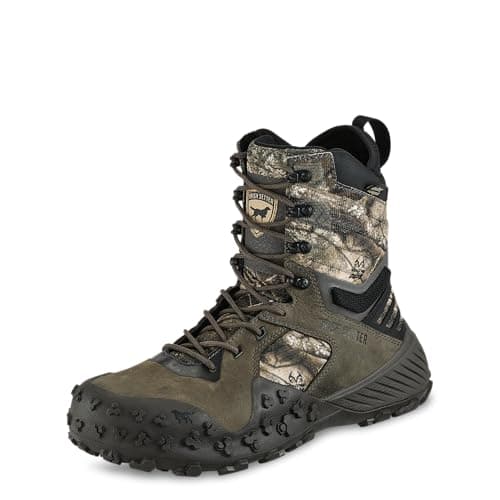
- 1Irish Setter Men's Hunting BootsIrish Setter is the name that comes up first when hunters talk about leather boots they've kept for years, and this is the pair to give when you want the safe, well-regarded answer. It's built for walking and standing in real conditions — waterproof, supportive, and made by a brand that has been putting hunters in boots for a very long time. The honest caveat is the same one that applies to every leather boot: it needs to fit, and leather has less give than rubber, so confirming their size in this brand matters more here than anywhere else on the list.Best for: Best overall
- 2
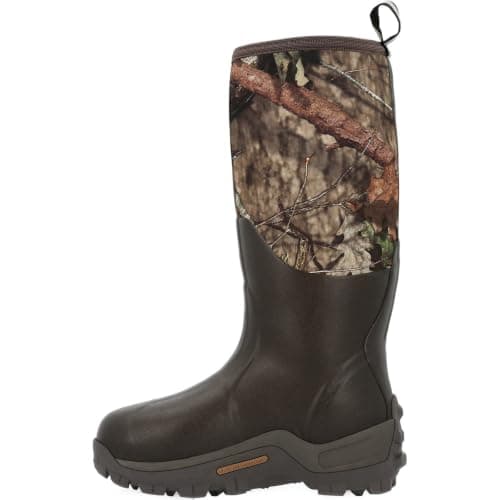 Muck Boot Woody Max Hunting BootIf the person you're shopping for hunts ducks, walks flooded timber, or crosses creeks to get to a stand, rubber is not a preference — it's the requirement, and Muck is the name that crowd trusts. A rubber boot is waterproof by construction rather than by treatment, so there's no seam to fail and nothing to re-proof each year, and you can wade in it without a second thought. It's warm and it's easy to pull on and kick off at the truck. The trade-off is that rubber breathes poorly, so it's less pleasant on a long walk in mild weather than a leather boot would be.Best for: Best for wet ground and marsh
 - 3
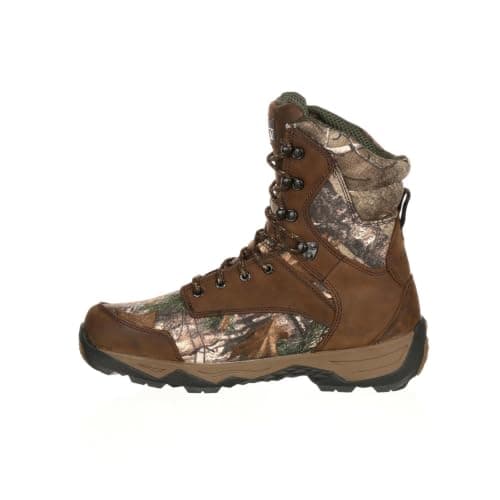 Rocky Retraction 800g Insulated Hunting BootHeavy insulation is the specific answer to a specific problem: a hunter who sits motionless in a stand generates almost no body heat, and ordinary boots lose the argument by about hour three. This Rocky pairs a waterproof build with 800 grams of insulation, which is squarely in late-season, don't-move-for-hours territory. That's also its honest limitation — the same insulation that saves a November sit makes it too warm for an early-season walk, so give this to a hunter who parks somewhere and waits rather than one who covers ground.Best for: Best for sitting still in the cold
 - 4
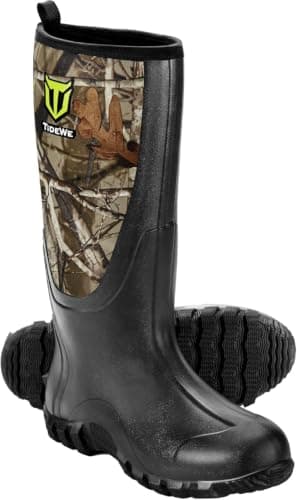 TIDEWE Rubber Hunting BootsPremium rubber boots are wonderful and they are also a lot of money for something the recipient may not have asked for. This TIDEWE pair gives you the actual function — waterproof camo rubber with a steel shank for support underfoot — at a price that makes it a realistic gift rather than a major purchase. It's the right call if you're fairly sure they hunt wet ground but you don't want to gamble a premium-boot budget on a guess, or if they need a second pair to leave in the truck.Best for: Best value rubber boot
 - 5
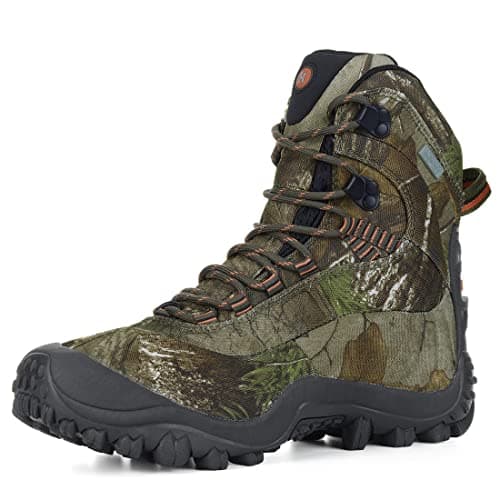 XPETI Thermator Insulated Waterproof BootThis is the hiking-boot shape rather than the tall hunting-boot shape: mid-rise, lighter on the foot, waterproof, with modest insulation and a camo finish. For a hunter who walks — spot-and-stalk, public-land scouting, upland birds — that's genuinely the better tool, and it's comfortable out of the box in a way stiff leather boots often aren't. The honest note is that a mid-rise boot gives you less protection in deep mud, tall grass and snow than a tall boot does, so it's the wrong pick for someone who hunts a marsh.Best for: Best budget boot for covering ground
 - 6
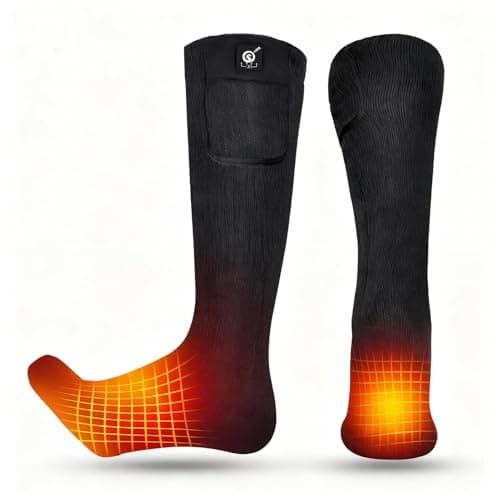 Heated Socks (Rechargeable)Not a boot, but the answer to the most common problem with boots — and the safest gift on this page, because socks don't need you to know a shoe size. Battery-heated socks attack cold feet from the inside, which is exactly the failure mode on a still, freezing sit where even good insulation eventually loses. They're the kind of small luxury a hunter never buys for themselves and is quietly delighted to receive. Give them alongside a pair of boots, or on their own when you can't confirm a size.Best for: For the hunter who already has boots
| # | Gift | Best for | Price |
|---|---|---|---|
| 1 | Irish Setter Men's Hunting BootsIrish Setter is the name that comes up first when hunters talk about leather boots they've kept for years, and this is the pair to give when you want the safe, well-regarded answer. It's built for walking and standing in real conditions — waterproof, supportive, and made by a brand that has been putting hunters in boots for a very long time. The honest caveat is the same one that applies to every leather boot: it needs to fit, and leather has less give than rubber, so confirming their size in this brand matters more here than anywhere else on the list. | Best overall | $189.95View on Amazon |
| 2 | Muck Boot Woody Max Hunting BootIf the person you're shopping for hunts ducks, walks flooded timber, or crosses creeks to get to a stand, rubber is not a preference — it's the requirement, and Muck is the name that crowd trusts. A rubber boot is waterproof by construction rather than by treatment, so there's no seam to fail and nothing to re-proof each year, and you can wade in it without a second thought. It's warm and it's easy to pull on and kick off at the truck. The trade-off is that rubber breathes poorly, so it's less pleasant on a long walk in mild weather than a leather boot would be. | Best for wet ground and marsh | $124.89View on Amazon |
| 3 | Rocky Retraction 800g Insulated Hunting BootHeavy insulation is the specific answer to a specific problem: a hunter who sits motionless in a stand generates almost no body heat, and ordinary boots lose the argument by about hour three. This Rocky pairs a waterproof build with 800 grams of insulation, which is squarely in late-season, don't-move-for-hours territory. That's also its honest limitation — the same insulation that saves a November sit makes it too warm for an early-season walk, so give this to a hunter who parks somewhere and waits rather than one who covers ground. | Best for sitting still in the cold | $109.99View on Amazon |
| 4 | TIDEWE Rubber Hunting BootsPremium rubber boots are wonderful and they are also a lot of money for something the recipient may not have asked for. This TIDEWE pair gives you the actual function — waterproof camo rubber with a steel shank for support underfoot — at a price that makes it a realistic gift rather than a major purchase. It's the right call if you're fairly sure they hunt wet ground but you don't want to gamble a premium-boot budget on a guess, or if they need a second pair to leave in the truck. | Best value rubber boot | $69.99View on Amazon |
| 5 | XPETI Thermator Insulated Waterproof BootThis is the hiking-boot shape rather than the tall hunting-boot shape: mid-rise, lighter on the foot, waterproof, with modest insulation and a camo finish. For a hunter who walks — spot-and-stalk, public-land scouting, upland birds — that's genuinely the better tool, and it's comfortable out of the box in a way stiff leather boots often aren't. The honest note is that a mid-rise boot gives you less protection in deep mud, tall grass and snow than a tall boot does, so it's the wrong pick for someone who hunts a marsh. | Best budget boot for covering ground | $55.99View on Amazon |
| 6 | Heated Socks (Rechargeable)Not a boot, but the answer to the most common problem with boots — and the safest gift on this page, because socks don't need you to know a shoe size. Battery-heated socks attack cold feet from the inside, which is exactly the failure mode on a still, freezing sit where even good insulation eventually loses. They're the kind of small luxury a hunter never buys for themselves and is quietly delighted to receive. Give them alongside a pair of boots, or on their own when you can't confirm a size. | For the hunter who already has boots | $71.99View on Amazon |
Prices from Amazon as of October 24, 2026 and change often — the button always opens the current listing. Some links earn us a commission at no extra cost to you.
Irish Setter Men's Hunting Boots
Irish Setter is the name that comes up first when hunters talk about leather boots they've kept for years, and this is the pair to give when you want the safe, well-regarded answer. It's built for walking and standing in real conditions — waterproof, supportive, and made by a brand that has been putting hunters in boots for a very long time. The honest caveat is the same one that applies to every leather boot: it needs to fit, and leather has less give than rubber, so confirming their size in this brand matters more here than anywhere else on the list.
#ad · Price as of October 24, 2026. We may earn a commission.
Muck Boot Woody Max Hunting Boot
If the person you're shopping for hunts ducks, walks flooded timber, or crosses creeks to get to a stand, rubber is not a preference — it's the requirement, and Muck is the name that crowd trusts. A rubber boot is waterproof by construction rather than by treatment, so there's no seam to fail and nothing to re-proof each year, and you can wade in it without a second thought. It's warm and it's easy to pull on and kick off at the truck. The trade-off is that rubber breathes poorly, so it's less pleasant on a long walk in mild weather than a leather boot would be.
#ad · Price as of October 24, 2026. We may earn a commission.
Rocky Retraction 800g Insulated Hunting Boot
Heavy insulation is the specific answer to a specific problem: a hunter who sits motionless in a stand generates almost no body heat, and ordinary boots lose the argument by about hour three. This Rocky pairs a waterproof build with 800 grams of insulation, which is squarely in late-season, don't-move-for-hours territory. That's also its honest limitation — the same insulation that saves a November sit makes it too warm for an early-season walk, so give this to a hunter who parks somewhere and waits rather than one who covers ground.
#ad · Price as of October 24, 2026. We may earn a commission.
TIDEWE Rubber Hunting Boots
Premium rubber boots are wonderful and they are also a lot of money for something the recipient may not have asked for. This TIDEWE pair gives you the actual function — waterproof camo rubber with a steel shank for support underfoot — at a price that makes it a realistic gift rather than a major purchase. It's the right call if you're fairly sure they hunt wet ground but you don't want to gamble a premium-boot budget on a guess, or if they need a second pair to leave in the truck.
#ad · Price as of October 24, 2026. We may earn a commission.
XPETI Thermator Insulated Waterproof Boot
This is the hiking-boot shape rather than the tall hunting-boot shape: mid-rise, lighter on the foot, waterproof, with modest insulation and a camo finish. For a hunter who walks — spot-and-stalk, public-land scouting, upland birds — that's genuinely the better tool, and it's comfortable out of the box in a way stiff leather boots often aren't. The honest note is that a mid-rise boot gives you less protection in deep mud, tall grass and snow than a tall boot does, so it's the wrong pick for someone who hunts a marsh.
#ad · Price as of October 24, 2026. We may earn a commission.
Heated Socks (Rechargeable)
Not a boot, but the answer to the most common problem with boots — and the safest gift on this page, because socks don't need you to know a shoe size. Battery-heated socks attack cold feet from the inside, which is exactly the failure mode on a still, freezing sit where even good insulation eventually loses. They're the kind of small luxury a hunter never buys for themselves and is quietly delighted to receive. Give them alongside a pair of boots, or on their own when you can't confirm a size.
#ad · Price as of October 24, 2026. We may earn a commission.
How we chose these
We don't run a boot through a wear-test program, and we're not going to pretend otherwise. These picks come from each boot's published construction and materials, the reputation of the brand among hunters who've worn its boots for years, and one blunt gift-fit question: does this boot solve a problem the recipient actually has? That's why the list is organized by use rather than by price — a superb insulated boot is the wrong gift for someone who hunts early-season birds, no matter how good it is. You can read the full method on our how we choose page. Prices come from a live feed, so the figure next to each boot is the current one rather than something typed in months ago.
Start with where they hunt, not with the boot
Every good boot decision runs backwards from the ground. Before you look at a single product, answer one question about the person you're shopping for: are their feet going to be wet, cold, or tired? Those are three different problems and they have three different answers.
Wet means water they will actually stand in — flooded timber, a marsh edge, a creek crossing, spring mud. That is rubber's job and nothing else does it as cleanly. Cold means long stationary sits in late season, where the enemy is not water but stillness; that's the case for serious insulation. Tired means distance — a hunter who walks miles, climbs, or still-hunts through timber wants a lighter, more flexible boot and will happily trade some warmth for it. Plenty of hunters have two pairs for exactly this reason, which is worth remembering: giving someone a second, purpose-built pair is not a redundant gift.
Rubber or leather?
This is the fork most gift-buyers get stuck on, so here it is plainly. Rubber boots are waterproof because of what they're made of, not because of a treatment that can wear off. There are no seams to leak and nothing to re-proof each season, they hose clean, and they hold scent less than leather — which matters to deer hunters more than you'd guess. They also pull on and off in seconds. Against that: rubber doesn't breathe, so feet can end up damp from sweat on a warm walk, and rubber gives you less ankle support than a well-built leather boot.
Leather boots breathe better, support the ankle better under a load, and generally feel more precise on uneven ground. A good pair molds to the foot over a season or two and gets better rather than worse. The catch is that leather's waterproofing comes from construction and treatment, so it wants occasional care, and leather isn't meant for wading. Our rubber vs leather hunting boots comparison goes through this properly if you want the long version. And if you're wondering whether the hiking boots in their closet would just do the job, our hunting boots vs hiking boots piece answers that honestly — sometimes they will.
How much insulation is the right amount?
Insulation in hunting boots is usually quoted in grams, and the instinct is to treat a bigger number as better. It isn't. Insulation is matched to activity, not to bravery. A hunter who sits still in cold weather makes very little heat, so they need a lot of insulation. A hunter who walks makes plenty of heat, and a heavily insulated boot will make their feet sweat — and damp feet get cold far faster than dry ones. That's the trap: an over-insulated boot can genuinely leave someone colder than a lighter one would have.
So the practical version is: heavy insulation for the stand-sitter in late season, light or no insulation for the walker and the early-season hunter, and a warm sock plus a moderate boot for anyone in between. If the person you're buying for hunts across the whole season, err toward the moderate boot and give them a way to add warmth — heated socks, a good wool layer, or the ideas in our gifts to keep a hunter warm roundup.
The size problem — read this before you buy
Boots are the only category on this site where getting one number wrong ruins the gift, so it's worth being direct. Hunting-boot sizing is not consistent between brands. On top of that, hunters usually wear a thicker sock than they would with street shoes, and many people need a wider or narrower fit than the default. A boot that's half a size too small is unwearable on a cold day, because feet need room for the sock and the air the sock traps.
You have better options than guessing. Ask whoever else lives in the house. Look inside a boot they already own and read the size off the tongue. Ask them outright and accept that the surprise is worth less than the boot fitting. Or take the approach that works every time: choose the exact pair, print the page, and give it with a card — they confirm the size themselves and you still did all the thinking. And whichever route you take, buy somewhere with a painless exchange policy.
Keep browsing
Shopping for a specific person rather than a specific boot? Our gifts for duck hunters page leans heavily on staying dry, and hunting gifts for dad covers the safest all-round presents. For the full walk-through of the boot decision itself, start with how to choose hunting boots.
And before you spend boot money, check what is on their feet inside the boot: plenty of "these boots are cold" complaints are really a cotton sock problem. Our best hunting socks roundup covers the wool blends worth giving and why a thicker sock is not automatically a warmer one.
One more thing to pass on with the boots, especially if you are buying close to the season: how to break in hunting boots sets out how long heavy leather honestly takes, why the sock they hunt in has to be the sock they break them in with, and which popular shortcuts — soaking, heat, a ten-mile walk on day one — damage the boot instead of softening it.
Two narrower pages pick up where this one stops. If the hunter freezes out on late-season sits, best hunting boots for cold weather re-ranks this field for that one job, and how to keep your feet warm hunting fixes most cold-feet complaints for the price of a pair of socks rather than a pair of boots.
Frequently asked questions
What are the best hunting boots to give as a gift?
It depends entirely on where the person hunts. For general use and long-term wear, a well-regarded leather boot like the Irish Setter is the safe answer. For anyone who hunts wet ground or waterfowl, a rubber boot such as the Muck Woody is the right tool. For late-season hunters who sit still in the cold, a heavily insulated boot like the Rocky Retraction is the one that solves their actual problem.
Are rubber or leather hunting boots better?
Neither is better overall — they solve different problems. Rubber is waterproof by construction, hoses clean, holds less scent and can be waded in, but it breathes poorly. Leather breathes better, supports the ankle under a load and molds to the foot over time, but it needs occasional care and isn't meant for standing in water. Match the material to the ground they hunt.
How much insulation do hunting boots need?
Match it to how much they move. A hunter who sits motionless in late-season cold generates little body heat and wants heavy insulation. A hunter who walks a lot generates plenty and wants light or no insulation, because a too-warm boot makes their feet sweat and damp feet get cold faster than dry ones. More insulation is not automatically better.
How do I get the boot size right without asking?
Check inside a pair they already own — the size is usually printed on the tongue or footbed. Failing that, ask someone else in the household, or pick the exact boots, print the page and give it with a card so they can confirm the fit themselves. Always buy from a retailer with an easy exchange policy, since hunting-boot sizing varies between brands and hunters wear thicker socks.
Is a second pair of hunting boots a wasted gift?
Not at all. Plenty of hunters keep two pairs precisely because one boot can't cover every situation — rubber for wet ground and a lighter leather or mid-rise boot for walking and mild weather. If you know what they already own, buying the pair that covers the other job is a genuinely thoughtful gift.