Gear Guides
The Best Duck Hunting Gear
Duck hunting is the only kind of hunting where you are standing in the water, in the dark, in the wind, next to a shotgun. Three things ruin the morning - wet, cold and loud - and all three are solvable. Here is the gear that solves them, cheapest fix first.
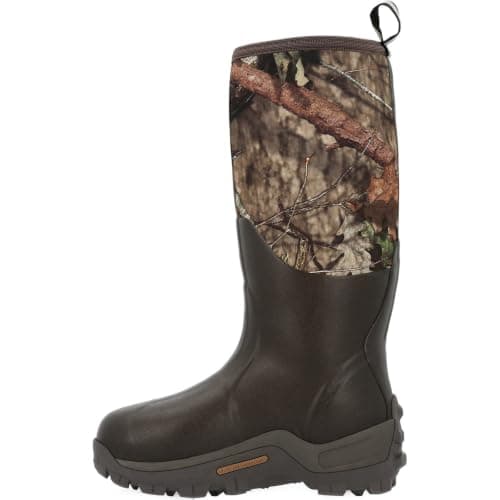
The verdict: the Muck Boot Woody Max is the first purchase, and it is for the hunter standing in flooded timber or a marsh rather than sitting in a dry field blind. Sealed rubber is not a preference in duck hunting, it is the entry requirement: once a boot lets water in, the morning is over, and no amount of insulation anywhere else on your body compensates for it. The budget pick is the HOT SHOT Razorback reversible hand muff, which costs a fraction of everything else here and fixes the problem gloves cannot — you need bare fingers to work a call, a gun and decoy lines, and a belted muff gives you somewhere to put them between flights.
Duck gear gets sold as camo and calls. The thing that actually decides whether a hunter stays until the flight is over is much more boring: whether they are dry, whether the wind is off them, and whether their hands work. Waterfowl hunting is uniquely hard on gear because you are in the water rather than near it, and because the cold is almost always wet cold and wind cold rather than still dry cold.
And one thing nearly everyone skips. A shotgun fired from inside a blind, with hard walls reflecting the blast back at you, is the loudest thing most hunters expose themselves to, several times a morning, often alongside two or three other guns. Hearing damage does not hurt and does not heal. All prices below are pulled live and dated.
- 1Muck Boot Woody Max Hunting BootThe pick, and the item on this page with the least room for compromise. Muck publishes the Woody Max as a rubber hunting boot built for wet ground, and the reason it is first is binary rather than incremental: a sealed rubber boot either keeps water out or it does not, and everything else about a duck hunt is downstream of that answer. What the premium over a cheap rubber boot buys is not more dryness - it is the bond quality at the seams and the sole, which is where rubber boots actually fail, and a neoprene upper that flexes with the ankle instead of fighting it, which matters enormously when you are walking a quarter mile through sucking mud carrying decoys. Muck is also the brand most waterfowlers converge on, which is worth something when the alternative is guessing. Honest cons: rubber does not breathe at all, so a hunter who walks a long way in will arrive with wet feet from the inside - that is a sock problem, not a boot problem, and merino is the fix. Pull-on rubber boots give less ankle support than a lace-up, which is a real consideration on uneven flooded timber. They are not warm enough on their own for a genuinely cold static sit without a heavyweight sock. And rubber boots are the hardest footwear to size by guesswork, because there is no lacing to adjust.Best for: Best overall - for the hunter standing in water
- 2
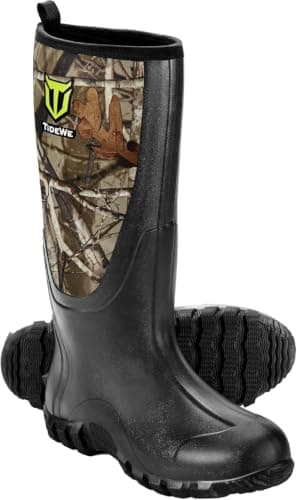 TIDEWE Rubber Hunting BootsThe pick for anyone who needs the sealed-rubber requirement met without premium money, and an entirely honest recommendation rather than a downgrade. TIDEWE publishes these as waterproof camo rubber hunting boots, and the central fact of the category applies here too: the water-exclusion job is done by the material, and the material is the same. For a hunter who gets out four or five mornings a season, the difference between these and a premium pair is longevity and ankle comfort over hundreds of miles, neither of which they will reach. This is also the sensible buy for a first season, when you do not yet know whether you will hunt flooded timber, dry fields or both - find out in cheap boots, then upgrade with information. Honest cons: cheaper rubber boots fail at the seams and the sole bond sooner, and the failure is sudden rather than gradual - one morning they leak and that is that. The flex and fit are less refined, which you notice on a long walk in. The insulation ratings on budget rubber boots are generous, so plan on a heavyweight sock. And sizing is less consistent across budget brands, so order with the intention of exchanging.Best for: Best value boots - for the hunter who only hunts ducks a few times a year
- 3
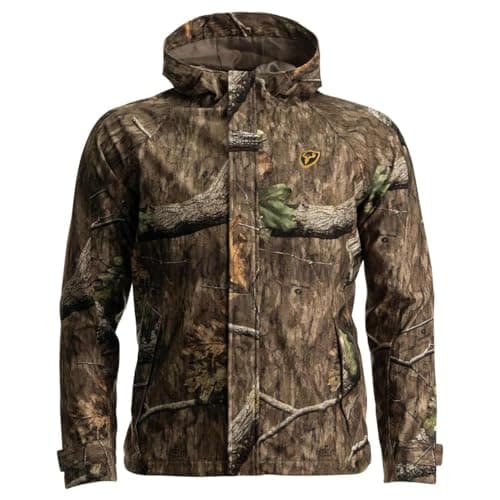 ScentBlocker Drencher Waterproof Rain JacketThe pick for the layer that decides whether rain sends you home. ScentBlocker publishes the Drencher as a packable waterproof camo rain jacket with taped seams, and taped seams are the specification to look for rather than a waterproof rating: a waterproof fabric with untaped stitching leaks at every needle hole, which is why cheap rain gear fails along the shoulders exactly where rain lands. For duck hunting a shell does two jobs at once, and the second is the bigger one - it blocks wind. Wet cold at 40 degrees with a 20 mph wind across open water takes more out of a hunter than dry cold at 20, and a windproof shell over insulation is the only thing that stops it. Packable matters because the shell lives in a bag until it is needed. Honest cons: fully waterproof means minimally breathable, so you will sweat in it on the walk in carrying decoys - vent it or carry it. A shell is not insulation and it is a mistake to treat it as a jacket; it needs layers under it. Taped seams and coatings wear out with abrasion and washing, so this is a garment with a service life rather than a lifetime. And no rain jacket helps with water coming in over the top of your boots.Best for: Best shell - for a hunter facing wind and rain in an open blind
- 4
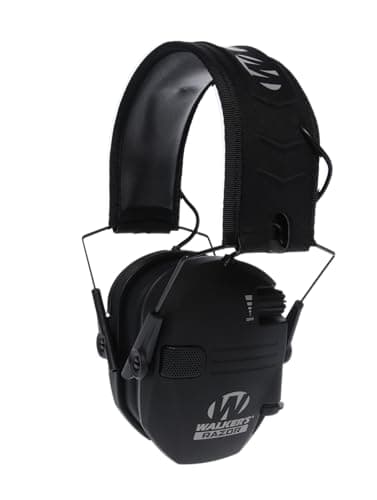 Walker's Razor Slim Electronic MuffThe pick for the thing almost nobody on a duck hunt is wearing and everybody should be. Walker's publishes the Razor Slim as an electronic earmuff with slim cups, and electronic is the key word: these amplify quiet sound so you can still hear wingbeats, a dog, a call and a hunting partner, and then clamp down on the gunshot. Passive plugs or muffs protect just as well but cut you off from the morning, which is why hunters take them off and then forget to put them back on. The slim cups are the specific reason this model suits waterfowl - a thick muff interferes with mounting a shotgun and shifts your cheek weld, which costs you birds, and that interference is exactly why most hunters abandon hearing protection. A blind makes the problem worse, not better: hard walls reflect the blast back at you, and several guns firing at once compounds it. Honest cons: electronics mean batteries, and a dead battery in the cold turns these into ordinary muffs. The amplification picks up wind noise across an open marsh, which some hunters find intolerable - in-ear electronic protection is the alternative there. Any muff is one more thing to get wet. And they do not fit comfortably under a tight hood.Best for: Best hearing protection - for a hunter shooting from inside a blind
- 5
 Duck Commander Duck CallThe pick for the one piece of duck gear that is a skill purchase rather than an equipment purchase. Duck Commander publishes this as a field-ready duck call, and the honest reason it is the recommendation for most people is that the call is not the limiting factor - a cheap call in practised hands kills far more ducks than an expensive one in unpractised hands, and for a new hunter the right move is to buy a well-made call at modest money and spend the saved difference on time. Waterfowl calling rewards restraint more than volume: knowing when not to call is most of it. A single reed is also more forgiving to learn on than a double, and this is a call a hunter will keep in the bag as a backup even after they graduate to custom acrylic. Honest cons: a call will not make a new hunter effective, and over-calling actively pushes birds off a spread - this is gear that can make your hunting worse. Polycarbonate calls sound different from acrylic or wood and more experienced hunters will have a preference. It needs drying after a wet morning or the reed sticks. And it does nothing for the hunter who is not willing to practise at home before the season.Best for: Best call to start on - for a hunter learning to call
- 6
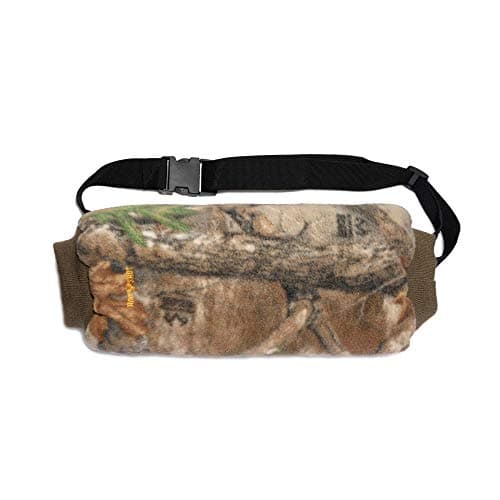 HOT SHOT Razorback Reversible Hand MuffThe honest cheap answer, and a better buy for duck hunting than any glove. HOT SHOT publishes the Razorback as a belted reversible hand muff that flips from camo to blaze orange, and the reason a muff beats gloves specifically for waterfowl is that duck hunting needs bare fingers at exactly the moments it is coldest: working a call, handling wet decoy lines, loading, and mounting a gun. Gloves either come off for all of that - at which point they are doing nothing - or they are thin enough to be useless. A muff at your waist is somewhere to put bare hands between flights, warms them in seconds rather than minutes, and takes a disposable warmer inside for a cold morning. It is also one size, which makes it the single safest gift on this page. Honest cons: a muff is useless while you are actively doing anything, because your hands are not in it - it is a recovery tool, not a working one. It sits at your waist where a shell belt and a shotgun also want to be. The reversible blaze orange side is a deer-season feature, not a duck one. And it will get wet in a marsh, at which point the fleece lining takes a long time to come back.Best for: Budget pick - the cheapest thing that keeps your hands working
| # | Gift | Best for | Price |
|---|---|---|---|
| 1 | Muck Boot Woody Max Hunting BootThe pick, and the item on this page with the least room for compromise. Muck publishes the Woody Max as a rubber hunting boot built for wet ground, and the reason it is first is binary rather than incremental: a sealed rubber boot either keeps water out or it does not, and everything else about a duck hunt is downstream of that answer. What the premium over a cheap rubber boot buys is not more dryness - it is the bond quality at the seams and the sole, which is where rubber boots actually fail, and a neoprene upper that flexes with the ankle instead of fighting it, which matters enormously when you are walking a quarter mile through sucking mud carrying decoys. Muck is also the brand most waterfowlers converge on, which is worth something when the alternative is guessing. Honest cons: rubber does not breathe at all, so a hunter who walks a long way in will arrive with wet feet from the inside - that is a sock problem, not a boot problem, and merino is the fix. Pull-on rubber boots give less ankle support than a lace-up, which is a real consideration on uneven flooded timber. They are not warm enough on their own for a genuinely cold static sit without a heavyweight sock. And rubber boots are the hardest footwear to size by guesswork, because there is no lacing to adjust. | Best overall - for the hunter standing in water | $107.87View on Amazon |
| 2 | TIDEWE Rubber Hunting BootsThe pick for anyone who needs the sealed-rubber requirement met without premium money, and an entirely honest recommendation rather than a downgrade. TIDEWE publishes these as waterproof camo rubber hunting boots, and the central fact of the category applies here too: the water-exclusion job is done by the material, and the material is the same. For a hunter who gets out four or five mornings a season, the difference between these and a premium pair is longevity and ankle comfort over hundreds of miles, neither of which they will reach. This is also the sensible buy for a first season, when you do not yet know whether you will hunt flooded timber, dry fields or both - find out in cheap boots, then upgrade with information. Honest cons: cheaper rubber boots fail at the seams and the sole bond sooner, and the failure is sudden rather than gradual - one morning they leak and that is that. The flex and fit are less refined, which you notice on a long walk in. The insulation ratings on budget rubber boots are generous, so plan on a heavyweight sock. And sizing is less consistent across budget brands, so order with the intention of exchanging. | Best value boots - for the hunter who only hunts ducks a few times a year | $74.99View on Amazon |
| 3 | ScentBlocker Drencher Waterproof Rain JacketThe pick for the layer that decides whether rain sends you home. ScentBlocker publishes the Drencher as a packable waterproof camo rain jacket with taped seams, and taped seams are the specification to look for rather than a waterproof rating: a waterproof fabric with untaped stitching leaks at every needle hole, which is why cheap rain gear fails along the shoulders exactly where rain lands. For duck hunting a shell does two jobs at once, and the second is the bigger one - it blocks wind. Wet cold at 40 degrees with a 20 mph wind across open water takes more out of a hunter than dry cold at 20, and a windproof shell over insulation is the only thing that stops it. Packable matters because the shell lives in a bag until it is needed. Honest cons: fully waterproof means minimally breathable, so you will sweat in it on the walk in carrying decoys - vent it or carry it. A shell is not insulation and it is a mistake to treat it as a jacket; it needs layers under it. Taped seams and coatings wear out with abrasion and washing, so this is a garment with a service life rather than a lifetime. And no rain jacket helps with water coming in over the top of your boots. | Best shell - for a hunter facing wind and rain in an open blind | $79.99View on Amazon |
| 4 | Walker's Razor Slim Electronic MuffThe pick for the thing almost nobody on a duck hunt is wearing and everybody should be. Walker's publishes the Razor Slim as an electronic earmuff with slim cups, and electronic is the key word: these amplify quiet sound so you can still hear wingbeats, a dog, a call and a hunting partner, and then clamp down on the gunshot. Passive plugs or muffs protect just as well but cut you off from the morning, which is why hunters take them off and then forget to put them back on. The slim cups are the specific reason this model suits waterfowl - a thick muff interferes with mounting a shotgun and shifts your cheek weld, which costs you birds, and that interference is exactly why most hunters abandon hearing protection. A blind makes the problem worse, not better: hard walls reflect the blast back at you, and several guns firing at once compounds it. Honest cons: electronics mean batteries, and a dead battery in the cold turns these into ordinary muffs. The amplification picks up wind noise across an open marsh, which some hunters find intolerable - in-ear electronic protection is the alternative there. Any muff is one more thing to get wet. And they do not fit comfortably under a tight hood. | Best hearing protection - for a hunter shooting from inside a blind | $30.31View on Amazon |
| 5 | Duck Commander Duck CallThe pick for the one piece of duck gear that is a skill purchase rather than an equipment purchase. Duck Commander publishes this as a field-ready duck call, and the honest reason it is the recommendation for most people is that the call is not the limiting factor - a cheap call in practised hands kills far more ducks than an expensive one in unpractised hands, and for a new hunter the right move is to buy a well-made call at modest money and spend the saved difference on time. Waterfowl calling rewards restraint more than volume: knowing when not to call is most of it. A single reed is also more forgiving to learn on than a double, and this is a call a hunter will keep in the bag as a backup even after they graduate to custom acrylic. Honest cons: a call will not make a new hunter effective, and over-calling actively pushes birds off a spread - this is gear that can make your hunting worse. Polycarbonate calls sound different from acrylic or wood and more experienced hunters will have a preference. It needs drying after a wet morning or the reed sticks. And it does nothing for the hunter who is not willing to practise at home before the season. | Best call to start on - for a hunter learning to call | $22.99View on Amazon |
| 6 | HOT SHOT Razorback Reversible Hand MuffThe honest cheap answer, and a better buy for duck hunting than any glove. HOT SHOT publishes the Razorback as a belted reversible hand muff that flips from camo to blaze orange, and the reason a muff beats gloves specifically for waterfowl is that duck hunting needs bare fingers at exactly the moments it is coldest: working a call, handling wet decoy lines, loading, and mounting a gun. Gloves either come off for all of that - at which point they are doing nothing - or they are thin enough to be useless. A muff at your waist is somewhere to put bare hands between flights, warms them in seconds rather than minutes, and takes a disposable warmer inside for a cold morning. It is also one size, which makes it the single safest gift on this page. Honest cons: a muff is useless while you are actively doing anything, because your hands are not in it - it is a recovery tool, not a working one. It sits at your waist where a shell belt and a shotgun also want to be. The reversible blaze orange side is a deer-season feature, not a duck one. And it will get wet in a marsh, at which point the fleece lining takes a long time to come back. | Budget pick - the cheapest thing that keeps your hands working | $24.99View on Amazon |
Prices from Amazon as of November 24, 2026 and change often — the button always opens the current listing. Some links earn us a commission at no extra cost to you.
Muck Boot Woody Max Hunting Boot
The pick, and the item on this page with the least room for compromise. Muck publishes the Woody Max as a rubber hunting boot built for wet ground, and the reason it is first is binary rather than incremental: a sealed rubber boot either keeps water out or it does not, and everything else about a duck hunt is downstream of that answer. What the premium over a cheap rubber boot buys is not more dryness - it is the bond quality at the seams and the sole, which is where rubber boots actually fail, and a neoprene upper that flexes with the ankle instead of fighting it, which matters enormously when you are walking a quarter mile through sucking mud carrying decoys. Muck is also the brand most waterfowlers converge on, which is worth something when the alternative is guessing. Honest cons: rubber does not breathe at all, so a hunter who walks a long way in will arrive with wet feet from the inside - that is a sock problem, not a boot problem, and merino is the fix. Pull-on rubber boots give less ankle support than a lace-up, which is a real consideration on uneven flooded timber. They are not warm enough on their own for a genuinely cold static sit without a heavyweight sock. And rubber boots are the hardest footwear to size by guesswork, because there is no lacing to adjust.
#ad · Price as of November 24, 2026. We may earn a commission.
TIDEWE Rubber Hunting Boots
The pick for anyone who needs the sealed-rubber requirement met without premium money, and an entirely honest recommendation rather than a downgrade. TIDEWE publishes these as waterproof camo rubber hunting boots, and the central fact of the category applies here too: the water-exclusion job is done by the material, and the material is the same. For a hunter who gets out four or five mornings a season, the difference between these and a premium pair is longevity and ankle comfort over hundreds of miles, neither of which they will reach. This is also the sensible buy for a first season, when you do not yet know whether you will hunt flooded timber, dry fields or both - find out in cheap boots, then upgrade with information. Honest cons: cheaper rubber boots fail at the seams and the sole bond sooner, and the failure is sudden rather than gradual - one morning they leak and that is that. The flex and fit are less refined, which you notice on a long walk in. The insulation ratings on budget rubber boots are generous, so plan on a heavyweight sock. And sizing is less consistent across budget brands, so order with the intention of exchanging.
#ad · Price as of November 24, 2026. We may earn a commission.
ScentBlocker Drencher Waterproof Rain Jacket
The pick for the layer that decides whether rain sends you home. ScentBlocker publishes the Drencher as a packable waterproof camo rain jacket with taped seams, and taped seams are the specification to look for rather than a waterproof rating: a waterproof fabric with untaped stitching leaks at every needle hole, which is why cheap rain gear fails along the shoulders exactly where rain lands. For duck hunting a shell does two jobs at once, and the second is the bigger one - it blocks wind. Wet cold at 40 degrees with a 20 mph wind across open water takes more out of a hunter than dry cold at 20, and a windproof shell over insulation is the only thing that stops it. Packable matters because the shell lives in a bag until it is needed. Honest cons: fully waterproof means minimally breathable, so you will sweat in it on the walk in carrying decoys - vent it or carry it. A shell is not insulation and it is a mistake to treat it as a jacket; it needs layers under it. Taped seams and coatings wear out with abrasion and washing, so this is a garment with a service life rather than a lifetime. And no rain jacket helps with water coming in over the top of your boots.
#ad · Price as of November 24, 2026. We may earn a commission.
Walker's Razor Slim Electronic Muff
The pick for the thing almost nobody on a duck hunt is wearing and everybody should be. Walker's publishes the Razor Slim as an electronic earmuff with slim cups, and electronic is the key word: these amplify quiet sound so you can still hear wingbeats, a dog, a call and a hunting partner, and then clamp down on the gunshot. Passive plugs or muffs protect just as well but cut you off from the morning, which is why hunters take them off and then forget to put them back on. The slim cups are the specific reason this model suits waterfowl - a thick muff interferes with mounting a shotgun and shifts your cheek weld, which costs you birds, and that interference is exactly why most hunters abandon hearing protection. A blind makes the problem worse, not better: hard walls reflect the blast back at you, and several guns firing at once compounds it. Honest cons: electronics mean batteries, and a dead battery in the cold turns these into ordinary muffs. The amplification picks up wind noise across an open marsh, which some hunters find intolerable - in-ear electronic protection is the alternative there. Any muff is one more thing to get wet. And they do not fit comfortably under a tight hood.
#ad · Price as of November 24, 2026. We may earn a commission.
Duck Commander Duck Call
The pick for the one piece of duck gear that is a skill purchase rather than an equipment purchase. Duck Commander publishes this as a field-ready duck call, and the honest reason it is the recommendation for most people is that the call is not the limiting factor - a cheap call in practised hands kills far more ducks than an expensive one in unpractised hands, and for a new hunter the right move is to buy a well-made call at modest money and spend the saved difference on time. Waterfowl calling rewards restraint more than volume: knowing when not to call is most of it. A single reed is also more forgiving to learn on than a double, and this is a call a hunter will keep in the bag as a backup even after they graduate to custom acrylic. Honest cons: a call will not make a new hunter effective, and over-calling actively pushes birds off a spread - this is gear that can make your hunting worse. Polycarbonate calls sound different from acrylic or wood and more experienced hunters will have a preference. It needs drying after a wet morning or the reed sticks. And it does nothing for the hunter who is not willing to practise at home before the season.
#ad · Price as of November 24, 2026. We may earn a commission.
HOT SHOT Razorback Reversible Hand Muff
The honest cheap answer, and a better buy for duck hunting than any glove. HOT SHOT publishes the Razorback as a belted reversible hand muff that flips from camo to blaze orange, and the reason a muff beats gloves specifically for waterfowl is that duck hunting needs bare fingers at exactly the moments it is coldest: working a call, handling wet decoy lines, loading, and mounting a gun. Gloves either come off for all of that - at which point they are doing nothing - or they are thin enough to be useless. A muff at your waist is somewhere to put bare hands between flights, warms them in seconds rather than minutes, and takes a disposable warmer inside for a cold morning. It is also one size, which makes it the single safest gift on this page. Honest cons: a muff is useless while you are actively doing anything, because your hands are not in it - it is a recovery tool, not a working one. It sits at your waist where a shell belt and a shotgun also want to be. The reversible blaze orange side is a deer-season feature, not a duck one. And it will get wet in a marsh, at which point the fleece lining takes a long time to come back.
#ad · Price as of November 24, 2026. We may earn a commission.
Wet, cold, loud - in that order
Every duck hunting problem is one of three things, and they are not equally urgent. Getting wet ends the morning in an hour. Getting cold ends it in three. Hearing damage ends nothing today and everything in thirty years.
| The problem | What it actually costs you | The fix, cheapest first |
|---|---|---|
| Water in your boots | The morning, within an hour | Sealed rubber boots - this one is not optional |
| Water from above | Your insulation stops insulating | A taped-seam waterproof shell |
| Wind across open water | More heat than low temperature does | The same shell, worn as a windbreak |
| Sweat from the walk in | You are wet before the hunt starts | Merino socks and base layer, not cotton |
| Hands that stop working | Missed birds, fumbled loads | A belted hand muff, not gloves |
| Gunfire inside a blind | Permanent hearing loss, no warning | Electronic muffs you will actually keep on |
Notice what is not on that list: camo pattern, call brand, decoy count. Those matter to how many birds you work. The six rows above decide whether you are still there when the birds show up.
Why boots are the one purchase you cannot cheap out of category on
You can hunt ducks in a cheap jacket and a cheap call. You cannot hunt ducks in a boot that leaks, because the failure is total rather than partial. This is the one place in waterfowl gear where the category is non-negotiable even though the price point inside it is.
Sealed rubber keeps water out. All of it does. That is worth being blunt about: the premium over a budget rubber boot does not buy you more dryness, it buys seam and sole bond durability, ankle flex, and fit. If you hunt a handful of mornings a year, a budget pair genuinely does the job. If you hunt forty, the cheap pair will fail mid-season.
Depth is the other decision. Knee boots are right for a marsh you walk and a field blind; flooded timber past knee depth is a wader problem, not a boot problem, and no boot on this page solves it. Know the water you hunt before you buy. Rubber vs leather hunting boots works through the trade in full, and best hunting boots is the wider roundup.
Wet cold is a different problem from dry cold
A whitetail hunter in a stand at 15 degrees is dealing with still, dry air. A duck hunter at 40 degrees with wind across open water and spray off the decoys is losing heat much faster, and almost everyone underestimates it because the number on the thermometer looks mild.
The layering answer is the same as everywhere else but the shell matters more: merino next to skin so you stay warm while damp, insulation over it, and a windproof waterproof layer on top that never comes off. Best base layers for hunting covers the bottom of that stack and best hunting rain gear covers the top. For the full head-to-toe version specific to this hunt, see what to wear duck hunting.
When layering runs out, the honest answer is added heat rather than more fabric: best hand warmers for hunting is the cheapest version, and a disposable warmer inside the hand muff is the specific trick for this hunt.
What this page leaves out, and why
No decoys, no blind bag, no waders, no dog gear. Decoy spreads are a strategy question that depends on your water and your pressure far more than on which brand you buy. Waders are a depth decision we cannot make for you, and a wader that fits wrongly is genuinely dangerous in moving water. Dog gear is a whole discipline. And no firearms or shotgun accessories, which this site does not cover at all.
What we have ranked instead is the part that transfers across every duck hunt regardless of where you do it: staying dry, staying warm, keeping your hands and ears working, and being able to call without buying a custom.
Match the gear to the hunt
Flooded timber or a marsh you wade. The Muck Woody Max, then the shell. Boots first, always.
Four or five mornings a season, first duck gear. The TIDEWE rubber boots and the hand muff. Learn what you actually hunt before upgrading.
Dry field blind, wind off the lake. The ScentBlocker Drencher as a windbreak matters more than the boots here.
Hunting with a group, or shooting from a hard-walled blind. The Walker's Razor Slim. This is the pick with the longest payback period of anything on this site.
New hunter who wants to learn to call. The Duck Commander call and practice time at home. Not a more expensive call.
Smallest budget. The HOT SHOT hand muff. One size, cheap, and it keeps the hands that do all the work actually working.
Frequently asked questions
What gear do I need to start duck hunting?
In order: sealed rubber boots or waders appropriate to your water, a taped-seam waterproof shell, hearing protection you will actually keep on, warm non-cotton layers, and a call you are willing to practise with. Boots come first because the failure is total - once water is in, the morning is over. Decoys and camo matter to how many birds you work, but they do not decide whether you are still there when the birds arrive.
What boots are best for duck hunting?
Sealed rubber, and which pair depends on how often you hunt rather than how dry you need to be. All sealed rubber keeps water out; the Muck Boot Woody Max is the pick because the premium buys seam and sole durability plus a neoprene upper that flexes with the ankle on a long walk through mud. The TIDEWE rubber boots are the honest value answer for a hunter who gets out a handful of mornings a season. If your water is deeper than knee height, that is a wader question, not a boot question.
Do I need hearing protection for duck hunting?
Yes, and it is the most-skipped item in waterfowl hunting. A shotgun is well above the threshold where hearing damage begins, a blind reflects the blast back at the shooter off hard walls, and several guns on one flight compounds it - while the damage itself is painless, cumulative and permanent. The reason hunters go without is that bulky muffs interfere with mounting a gun, which is exactly why electronic muffs with slim cups, or in-ear electronic protection, are the right answer: you still hear wingbeats and your partner, and the shot gets clamped.
How cold is too cold for duck hunting?
The temperature is the wrong number to watch. Wet cold at 40 degrees with a 20 mph wind across open water takes more out of a hunter than still dry cold at 20, which is why waterfowlers get caught out on mild-looking mornings. What decides it is whether you are dry, whether the wind is blocked, and whether your hands still work - a windproof waterproof shell, merino rather than cotton next to skin, and a hand muff with a disposable warmer in it cover all three.
Are gloves or a hand muff better for duck hunting?
A muff, for this hunt specifically. Duck hunting needs bare fingers at the coldest moments - working a call, handling wet decoy lines, loading, mounting a gun - so gloves either come off for all of it or are too thin to help. A belted muff is somewhere to put bare hands between flights, warms them in seconds, and takes a disposable warmer inside. The honest limitation is that it does nothing while you are actively doing something; it is a recovery tool rather than a working one.
What is the best duck call for a beginner?
A well-made single-reed call at modest money, like the Duck Commander, plus time practising before the season. The call is almost never the limiting factor - a cheap call in practised hands works far better than an expensive one in unpractised hands, and over-calling actively pushes birds off a spread, so this is gear that can make your hunting worse if you buy it without putting in the work. Spend the saved money on shells and practice, and upgrade to a custom acrylic later if you want to.
What makes a good gift for a duck hunter?
The hand muff and the hearing protection are the two safest, because neither needs a size you have to guess and both are things duck hunters know they should own and postpone. Boots are the highest-value gift and the riskiest - rubber boots are hard to size by guesswork because there is no lacing to adjust, so check the size first. A call is a nice gift for a new hunter and a slightly loaded one for an experienced one, since most have a strong preference by then.
Sources
- Amazon listing - Muck Boot Woody Max: published as a rubber hunting boot with neoprene upper for wet ground
- Amazon listing - TIDEWE Rubber Hunting Boots: published as waterproof camo rubber hunting boots
- Amazon listing - ScentBlocker Drencher Rain Jacket: published as a packable waterproof camo shell with taped seams
- Amazon listing - Walker's Razor Slim Electronic Muff: published as an electronic earmuff with slim cups
- Amazon listing - Duck Commander Duck Call: published as a field-ready duck call
- Amazon listing - HOT SHOT Razorback Reversible Hand Muff: published as a belted hand muff reversing from camo to blaze orange